
I have a deep passion for poultry farming, especially chickens. My love for them began during my school years in the early 1930s, thanks to the principal and teacher, Mr. Winter, who set up a poultry farm at our school. Each student brought a chicken from home, and before long we had a sizable flock. You should have seen the enthusiasm with which we dove into the new venture. After classes we would rush home for lunch and then hurry back to school, where there was no shortage of work waiting for us. We built a chicken coop, a storage shed for feed, and nesting boxes for egg-laying. We took turns supervising the farm every day so it was never left unattended. We fed and watered the birds and cleaned their living quarters. To keep track of egg production, we put numbered rings on the chickens’ legs. We marked the date and the chicken’s number on the eggs with a pencil. At the end of each day we recorded every egg in a logbook. At the end of the month we tallied how many eggs each chicken had laid—by month, by quarter, and for the year.
We sold the eggs to the Raikolhozsoyuz, a cooperative for collective farms. In return, we received chicken feed, also for a fee. Every month, quarter, and year we discussed the results—whether we had made a profit or suffered a loss. At general meetings, a board elected from among the students presented the reports.
In the first year we discovered our mixed-breed chickens weren’t laying enough eggs to justify their feed and upkeep, so we decided to get purebred birds. Our mentor, Mr. Winter, took it upon himself to help us. By spring we began receiving shipments of eggs from a new breed for us—Rhode Island Reds.
Within six months we had completely replaced our flock with that breed. Oh, how beautiful those chickens were! Our joy knew no bounds. By autumn the Rhode Island Reds had multiplied so much that villagers came from all around to see them.
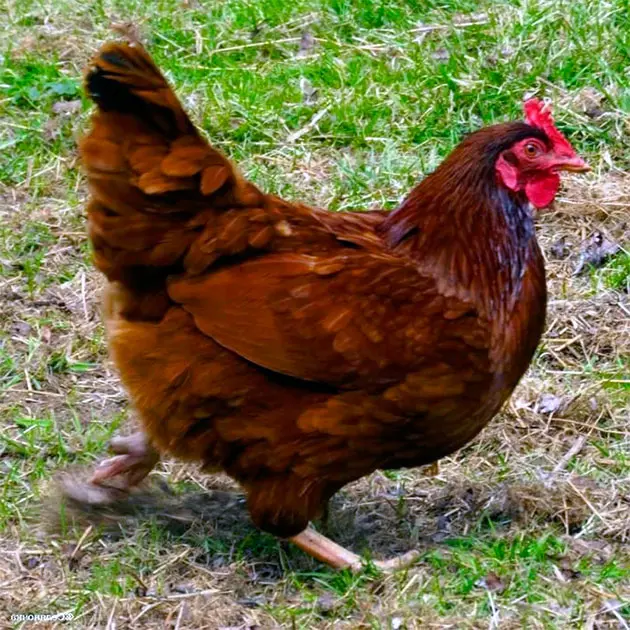
I can still picture those chickens: large and dark red, with a golden sheen to their feathers, and very calm. They laid a tremendous number of large eggs, stopping only during molting.
My fascination with chickens started with the Rhode Island Reds and became a lifelong passion. Now, at 72 years old, I am a retired worker. Though I don’t have the strength I once did, I still indulge in this captivating hobby. I’ve kept chickens of various breeds, but in my opinion none can compete with the Rhode Island Reds. They rarely get sick, endure cold winters easily, aren’t picky about feed, and will peck at almost anything. They are great mothers and dependable.
In the summer of 1990, at the request of a poultry enthusiasts’ society, three of us—my wife, N.P. Protasov, and I—set out on an expedition to look for Pavlovsk chickens. We traveled to a place where we had been told there might be descendants of Pavlovsk chickens.
After driving more than 1,000 kilometers we arrived at the home of the man who had written to us, Vyacheslav Petrovich Belousov. He led us to the village where the chickens were kept. The owners confirmed these were indeed descendants of Pavlovsk chickens, with a silver coloration. There was a clear resemblance.
The return journey with our precious chickens felt shorter and less exhausting, but it wasn’t without stress. During one stop to feed the birds, a rooster escaped. It’s hard to convey the panic we felt in that moment. Fortunately, we managed to catch the runaway rooster. The chickens settled in well at their new home.
