
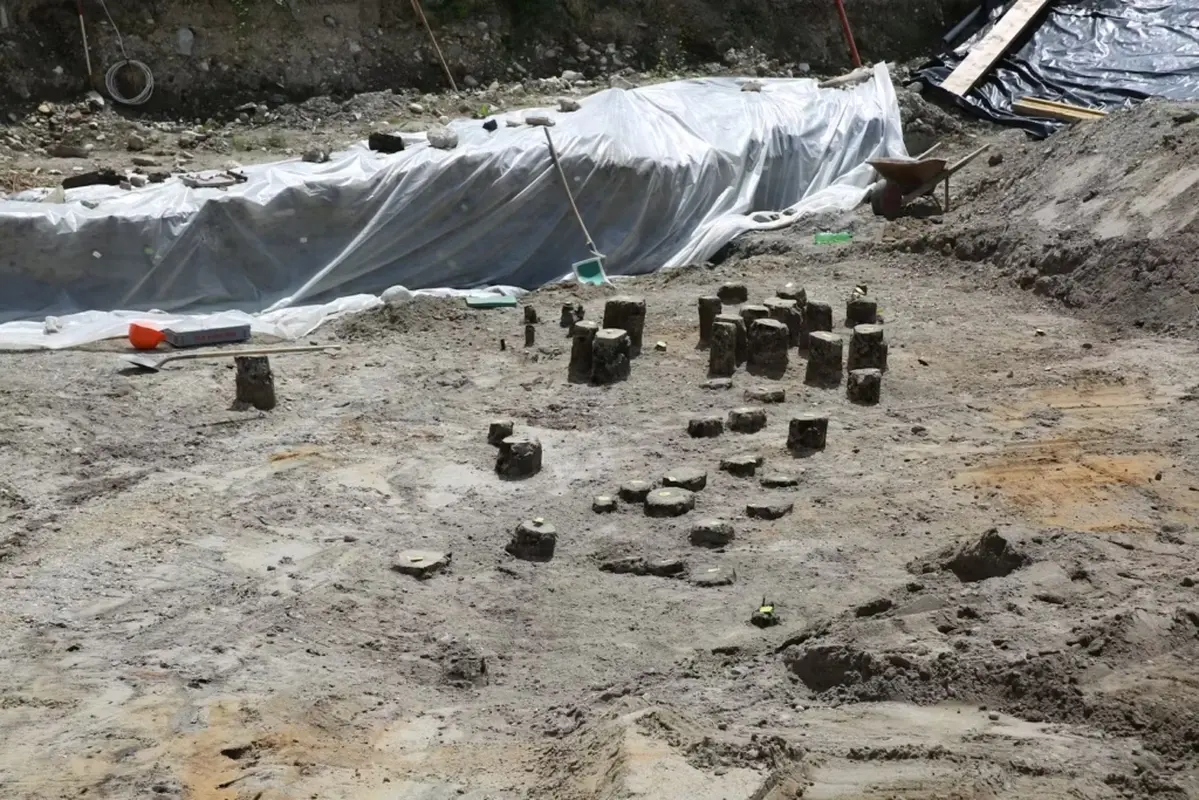
 During construction work in the Canton of Bern, workers unearthed the remains of a wooden bridge dating back to the Roman era, approximately 2,000 years old. Archaeologists are calling it one of the region’s most significant discoveries in decades.
What Did the Researchers Reveal?
The archaeological service of the Canton of Bern reported that over 300 oak piles were found in the groundwater at the site of the former Zihl River. These findings indicate that there was once a large bridge built by the ancient Romans.
Dendrochronological studies (the analysis of tree rings) confirmed that the bridge underwent multiple repairs and reconstructions over several centuries.
The earliest fragments of the bridge were dated to around 40 B.C., indicating it was constructed shortly after the Roman conquest of the Celtic Helvetii. The latest parts of the structure were dated to A.D. 369, during the reign of Emperor Valentinian I. This means the bridge was continuously used for over 400 years, as reported by Arkeonews.

Before the arrival of the Romans, the Swiss plateau was inhabited by the Celtic Helvetii tribe. In 58 B.C., Julius Caesar defeated them in the Battle of Bibracte, after which the region gradually became integrated into the Roman world, fully joining the empire by 15 B.C. To strengthen their northern border, the Romans began actively constructing roads, military outposts, and cities in the territory.
The bridge stood near the gates of Petinesca, a Roman city close to modern-day Studen. This strategically significant infrastructure played an important role in Romanization. It connected settlements, military camps, and trade routes, facilitating the spread of Roman authority and commerce deep into Celtic territory.
Unique Finds in the Zihl River
At the site of the ancient river, archaeologists discovered a remarkable number of ancient Roman artifacts. Among them were shoe nails, horseshoes, axes, parts of harnesses, fishing tridents, keys, and coins.
One of the most astonishing discoveries was a large wooden and iron carpenter’s plane, which has been exceptionally well-preserved because of the moist soil and lack of oxygen. Such tools are rarely found intact.

Scientists expect that after conservation, the discovered artifacts will provide more valuable information about daily life in Roman Switzerland—from craftsmanship and agriculture to travel and trade.
The excavations did not halt construction: the research team worked during a scheduled break, allowing for the preservation of this historical monument while keeping the construction timeline on track.
