
The Tintina Fault, long quiet beneath parts of North America, may be a ticking time bomb. Canadian seismologists from the University of Victoria and the University of Alberta recently warned that the fault could trigger a devastating earthquake. This seismic event could impact parts of Canada, the United States, and Alaska.
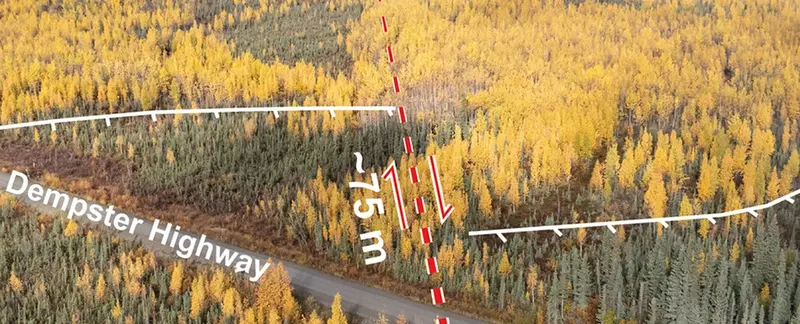
The team found that the Tintina Fault, located about 20 kilometers from Dawson City in Yukon, Canada, is slowly accumulating stress underground, and this hidden threat could erupt into a powerful earthquake. Researchers said the fault runs beneath highways, rivers, and critical infrastructure and extends into the interior regions of Alaska.
Dr. Michael West, a seismologist at the Alaska Earthquake Center, told the Daily Mail: “The situation is gradually approaching a potentially very powerful earthquake.” He also said this is one of the least studied fault systems in North America.
What Do We Know About This Hidden Threat?
The Tintina Fault stretches more than 1,000 kilometers from British Columbia through Yukon to Alaska. Scientists previously believed the fault had been silent for 40 million years. However, the authors of a new study found evidence that two clusters of massive earthquakes, which significantly shifted the Earth’s surface, occurred along the fault 2.6 million years ago and 132,000 years ago, according to Science Alert. The last notable earthquake on the Tintina Fault happened about 12,000 years ago.
Researchers measured that the fault is moving at a rate of 0.2 to 0.8 millimeters per year. That slow motion means a strong earthquake could be inevitable.
The Tintina Fault has largely gone unnoticed by scientists compared with more well-known faults like the San Andreas, which stretches over 1,200 kilometers across California.
Dr. Theron Finley from the University of Victoria, the lead author of the study, said, “The fault may be in the late stages of the seismic cycle.” He added that “over the past couple of decades, several minor earthquakes with magnitudes of 3 to 4 have been recorded along the fault.” Until recently, nothing indicated that “it is capable of major ruptures.”
Over the last 12,000 years, the Tintina Fault has accumulated about 6 meters of displacement, which, according to scientists, is more than enough energy for a powerful earthquake of magnitude 7.5 or greater that could affect more than 125,000 people. That would be particularly dangerous for people living in remote areas that are unprepared for earthquakes and where emergency response is limited.
A potential earthquake could devastate critical infrastructure such as the Trans-Alaska Pipeline and cause long-lasting damage to local ecosystems.
Seismologists Are Concerned
“The most dangerous aspect is not just that the fault is active. The problem is that no one is paying attention to it,” West said.
A study published in Geophysical Research Letters showed that parts of ancient glacial terrain have shifted significantly, providing clear evidence of powerful earthquakes in the past.
To map areas vulnerable to future quakes, researchers used satellites and drones. The team found scars on the landscape that indicate the fault has repeatedly ruptured the Earth’s surface.
Seismologists are worried because in the latest 2024 Alaska model developed by the U.S. Geological Survey (USGS), the Tintina Fault was not considered a source of serious earthquake risk.
“In official models, it isn’t even recognized as a separate earthquake source, but the landscape tells a different story,” Dr. Finley said.
Photo: pixabay.com