
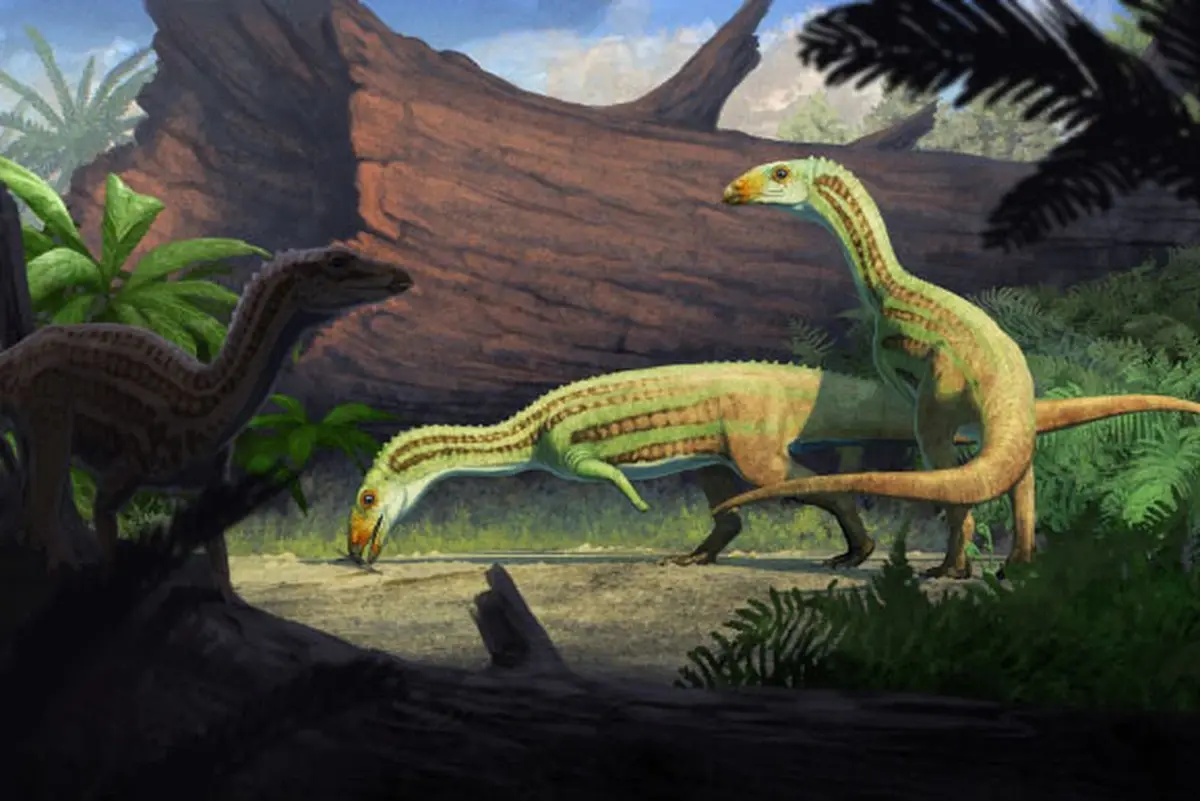
Paleontologists at the University of Washington call a strange feature of the species Sonselasuchus cedrus baffling.
Paleontologists discovered fossil remains of a distant crocodile relative — a reptile from the Chinle Formation — in Petrified Forest National Park in Arizona. The finds show that about 215 million years ago Sonselasuchus cedrus began life moving on all fours and then, as it grew, switched to walking on two legs.
The Triassic period lasted from 251.9 to 201.3 million years ago. The Chinle Formation, which formed in the Late Triassic, is most widespread across Arizona, Utah, New Mexico, and Colorado.
Sonselasuchus cedrus belonged to the shuvosaurids (Shuvosauridae), an extinct family of pseudosuchian reptiles. Its body was surprisingly similar to the body plan of ornithomimid theropod dinosaurs.
This distant crocodile relative grew on average to about 63.5 cm, had a toothless beak, large eye sockets, and hollow bones.
Those similarities to ornithomimids arose independently, not because the groups were closely related. Lead author Elliot Armor Smith explained that the resemblance probably reflects that crocodile-line and bird-line archosaurs evolved in the same ecosystems and filled similar ecological roles.
He added, “Even though upright posture, a toothless , hollow bones, and large eye sockets are characteristic of ornithomimid theropods, the example of shuvosaurids like Sonselasuchus shows that these features also evolved in crocodile-line archosaurs.”
The species Sonselasuchus cedrus is represented by more than 950 fossils belonging to at least 36 individuals, Sci.news reported.
After analyzing limb proportions across different animals, the university team concluded that bipedalism in Sonselasuchus cedrus could be linked to changes in its growth pattern.
Elliot Armor Smith said the fossil reptile’s forelimbs and hindlimbs “were more proportional when young, and the hindlimbs became longer and stronger as they matured.”
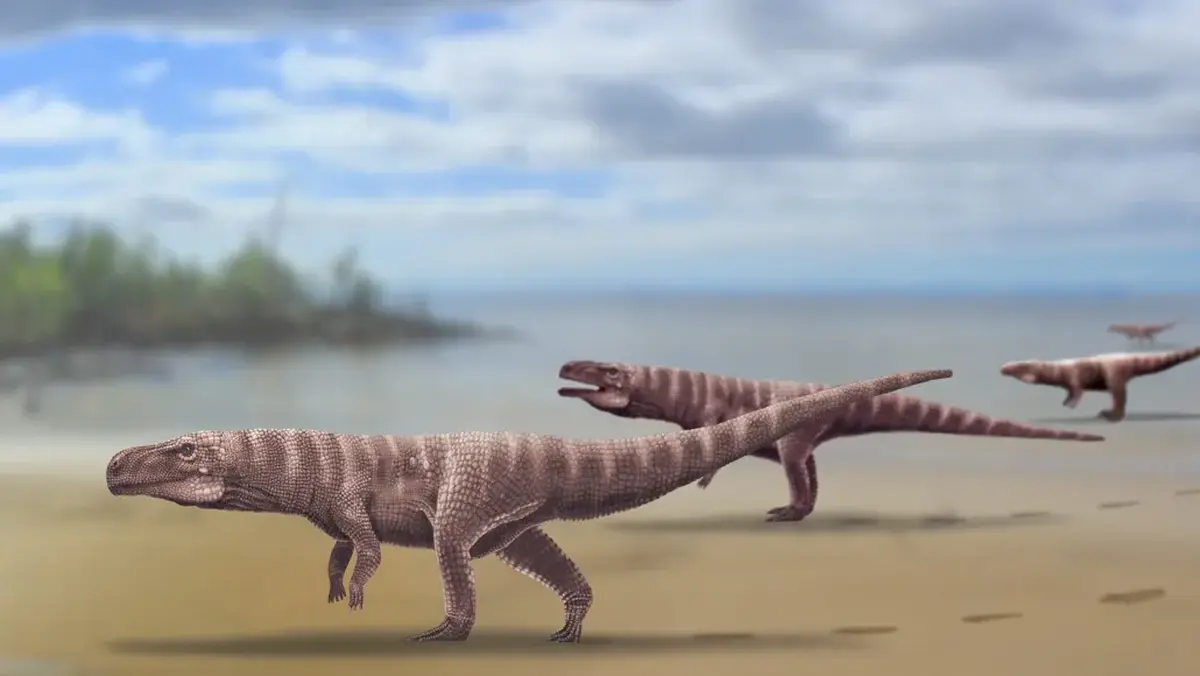
“Basically, these animals started life on four legs and then, as they matured, learned to walk on two. And that’s very unusual,” the researcher said.
Sonselasuchus cedrus lived in forests, and its species name cedrus means “cedar” — the familiar evergreen conifer similar to the trees that grew in Late Triassic forests.
“Since fieldwork began at Petrified Forest National Park in 2014, we’ve collected more than 3,000 fossils from the Sonselasuchus bonebed,” said Professor Christian Sidor of the University of Washington. Scientists think there is much more to find there.
Professor Sidor added that, in addition to Sonselasuchus, the bonebed has yielded fossils of fish, amphibians, as well as dinosaurs and other reptiles.
The Journal of Vertebrate Paleontology published the study’s results.
A relative of a crocodile from the Triassic period wandered across Arizona on two legs.
2