
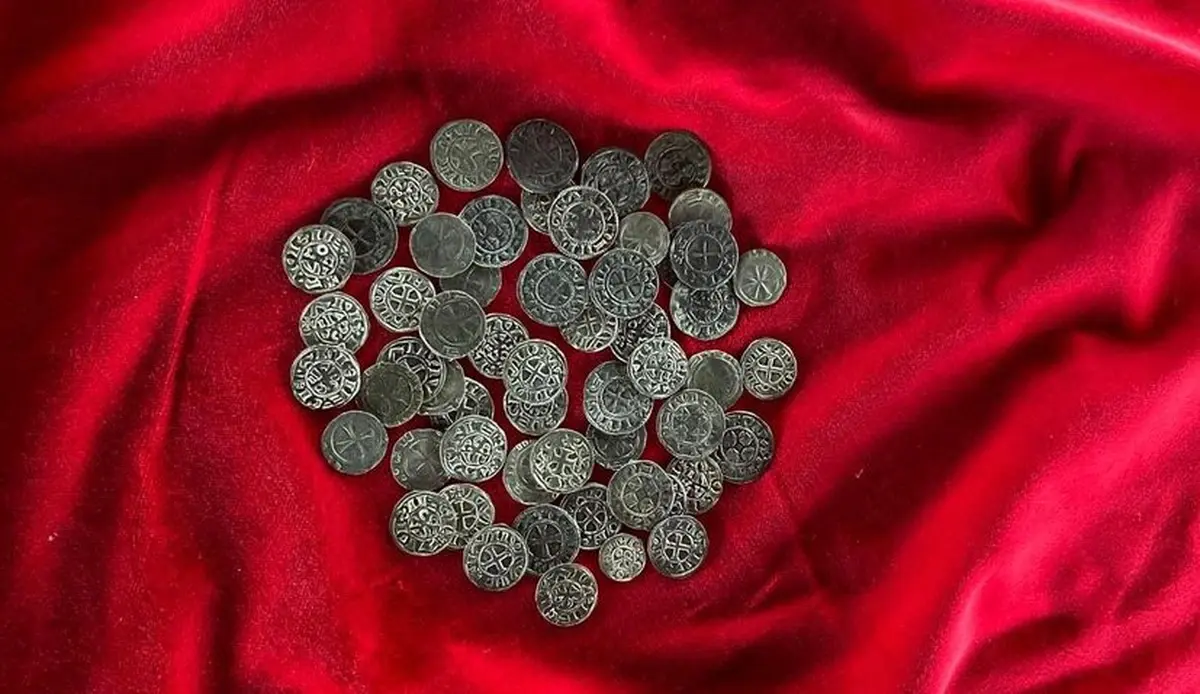
 Rare silver coins from the First Crusade (1096–1099) were uncovered at the Batina archaeological site in Croatia’s Baranja region. This location is linked to Iron Age settlements and the Roman border system.
Experts believe this discovery will help scholars rethink modern perceptions of medieval trade routes, economic history, and the movement of crusaders through Central and Southeastern Europe.
A discovery that was not expected here
Archaeological work in this area has been ongoing since 2008, primarily focusing on ancient fortifications and Roman military structures. Therefore, archaeologists did not anticipate finding any medieval artifacts here.
Archaeologist Domagoj Duimić, the site’s curator, emphasized that the discovery was completely unexpected. “We did not expect to find anything medieval here. Even in France, where these coins were minted, examples of this type are extremely rare due to the continent-wide silver shortage characteristic of that period,” Duimić explained.
The collection found includes 56 medieval French silver coins originating from Limoges, Toulouse, Albi, and the diocese of Le Puy. These coins were minted from the late 9th to the mid-13th century, overlapping with the era of the First Crusade. The appearance of this treasure in Croatia indicates unexpected connections between regions of Western Europe and the Danube basin.
The medieval period represented by these coins was marked by a silver crisis across Europe. A decline in silver mining, political instability, and disruptions to trade routes led to a widespread shortage of the metal. As a result, mints in French territories produced significantly fewer coins than usual. Certain types of coins have survived to this day in very limited quantities, as reported by Arkeonews.
This is what makes the Croatian hoard so unusual: some of the coins found in Batina represent more than 10 percent of all known examples in the world. Such a concentration makes this one of the most significant medieval numismatic finds documented in Europe.
Possible connections to crusader routes
Since the coins date back to the era associated with the First Crusade and come from regions that actively participated in mobilizing crusaders, the treasure may be linked to crusader movements. Alternatively, it could be connected to pilgrimage routes leading to the Holy Land. Croatia’s geographical position made it a corridor for groups traveling through the Balkans toward Constantinople and the Levant.
The discovery in Batina provides material evidence that Western European travelers may have passed through northern Croatia in the 11th and 12th centuries. The presence of French silver coins at a site dominated by Iron Age and Roman remains adds valuable information for mapping alternative medieval routes.