
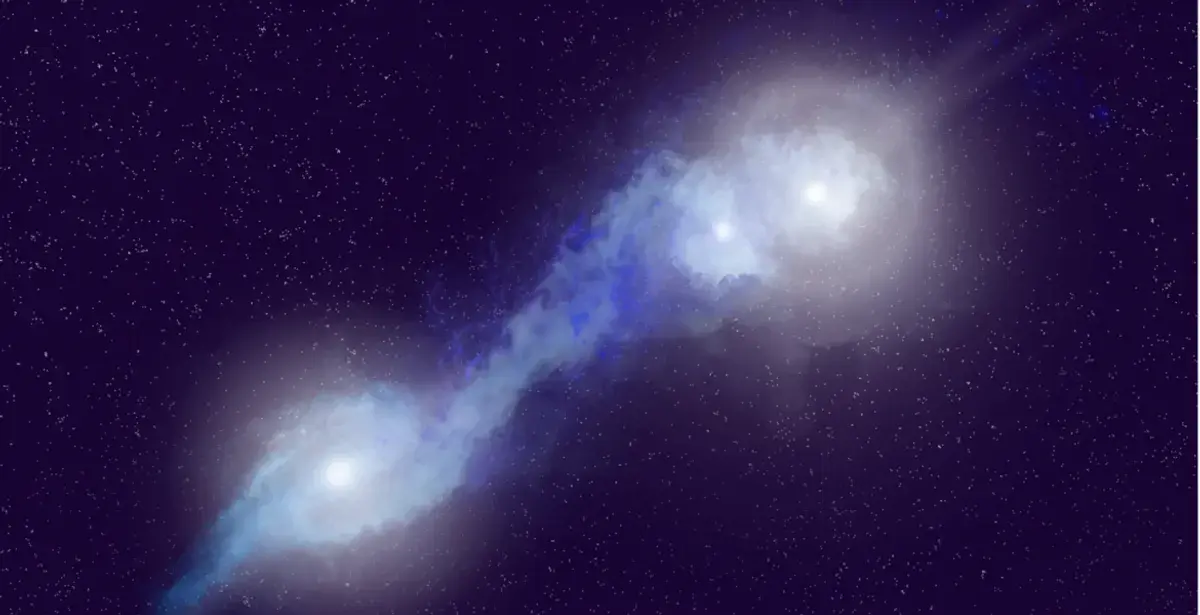
 Galaxies can be separated by hundreds of thousands of light-years, but sometimes they merge. During such collisions, the supermassive black holes at the centers of these galaxies can become active due to new streams of gas being funneled into their cores as a result of the merger.
For the first time, researchers reported the merger of three , during which all three supermassive black holes are simultaneously active and emitting radio waves.
The triple system, named J1218/1219+1035 by , is located 1.2 billion light-years away from Earth. The distance between the galactic cores, which contain the supermassive black holes, is approximately 22,000 and 97,000 light-years.
What else did the scientists reveal?
Large spiral galaxies, such as , have grown in size due to interactions with smaller companion galaxies. Large elliptical galaxies are the result of collisions between spiral galaxies. This is likely how the Milky Way and Andromeda will collide in a few billion years. Meanwhile, the merger of three galaxies occurs much less frequently, according to IFLScience.
“Triple active galaxy systems like this one are incredibly rare, and observing one during a merger allows us to see how massive galaxies and their black holes come together,” said Dr. Emma Schwartzman from the U.S. Naval Research Laboratory, the lead author of the study.
Initial data about this intriguing system were obtained through infrared observations. Radio astronomical observations using the NSF Very Large Array (NSF VLA) and the NSF Very Long Baseline Array (NSF VLBA) provided crucial insights into this rare phenomenon. These two observatories confirmed the first detection of three radio-active active galactic nuclei in the merging galaxy system.
Supermassive can reach astonishing sizes, but the processes behind their growth are not fully understood. The collision observed by scientists is a possible scenario for the development of these processes. Meanwhile, studying this and other similar systems could provide insights into their evolution. The team plans further observations of the system in the radio range and beyond.
The findings of the study were published in The Astrophysical Journal Letters.