
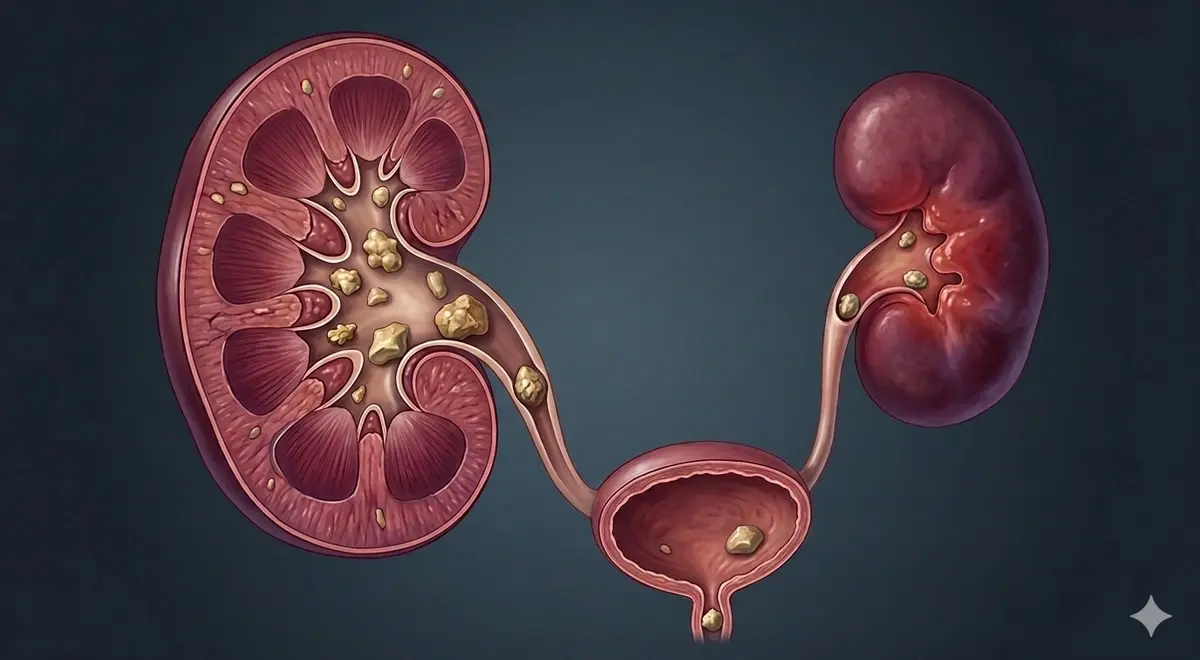
 Kidney stones have plagued people for centuries. They cause excruciating pain and can lead to serious complications, especially when proper medical care isn’t available. So any new information about kidney stones matters.
An interdisciplinary team behind a new study found living bacteria and biofilms inside the most common type of kidney stones — those made of calcium oxalate (or oxalate stones). They account for about 80 percent of all cases. Until now, doctors thought these stones were made entirely of minerals that crystallized from salts in urine.
Bacteria aren’t just present in calcium oxalate stones — they actively take part in forming them.
“This scientific breakthrough overturns the long-held assumption that these stones form solely through chemical and physical processes; it’s clear that bacteria can live inside stones and actively contribute to their formation,” says urologist Kimora Scotland, the study’s lead author.

Scientists found live bacteria inside the most common kidney stones
Stone formation begins when tiny crystals nucleate and grow from supersaturated urine. Medical science has developed some ways to suppress that process, Science Alert reported.
Their paper explains that nucleation and crystal growth are complex processes in which many factors can act as either catalysts or inhibitors, depending on the local environment and a molecule’s physical properties.
Urologists already knew bacteria were involved in forming so-called struvite kidney stones, a relatively rare type that makes up 2–6 percent of cases. But no one suspected these microbes were part of the formation process for the much more common calcium oxalate stones.
Using electron and fluorescence microscopy, the team didn’t just find a few bacteria attached to the surface of a calcium stone. They found living bacteria and even biofilms embedded inside the crystals that make up the stones.
“We identified a previously unknown mechanism of stone formation that helps explain why these stones are so common,” Scotland said.
She says bacteria can promote stone formation in the kidneys and then become trapped in the newly formed structure, around which crystals continue to aggregate.
The team proposed that kidney stones should be seen as an “organic-inorganic biocomposite” in which bacterial biofilms are a key component — even in cases where routine clinical tests don’t detect bacteria.
This discovery affects the health of tens of millions of people worldwide. But the team needs further studies to pin down the exact role bacteria play in stone formation.
“We want to understand exactly what makes some patients particularly prone to recurrent stone formation, and what allows specific bacterial species to form stones,” Scotland emphasized.
The study’s findings were published in the journal PNAS.