
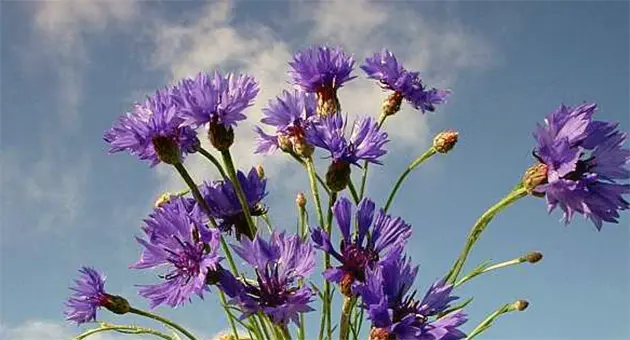
The blue cornflower is widespread across much of the former Soviet Union, except in arid regions and the far north. It blooms from May to August.
The first mention of the cornflower dates to Pliny the Elder in the 1st century AD, when it was just beginning to be cultivated in ancient Rome alongside rye.
One ancient Greek legend tells of Asclepius — the son of Apollo and the god of medicine — who learned that cornflower juice healed wounds and used it to treat many warriors.
In modern medicine, the cornflower is recognized as a mild diuretic and choleretic agent.
Traditional medicine uses this plant to treat conditions such as dropsy, jaundice, and inflammation of the kidneys and bladder. Additionally, an infusion of blue cornflower acts as an antispasmodic.
The flower infusion is consumed for colds, coughs, stomach pain, fever, and palpitations, and it can also be used as drops or compresses for certain eye conditions. Crushed cornflower seeds are sprinkled on warts, and the leaves are applied to wounds.