

It sounds like a stunt, but a new study found that seeing Batman on a subway really did make people more likely to help.
What’s Batman got to do with it?
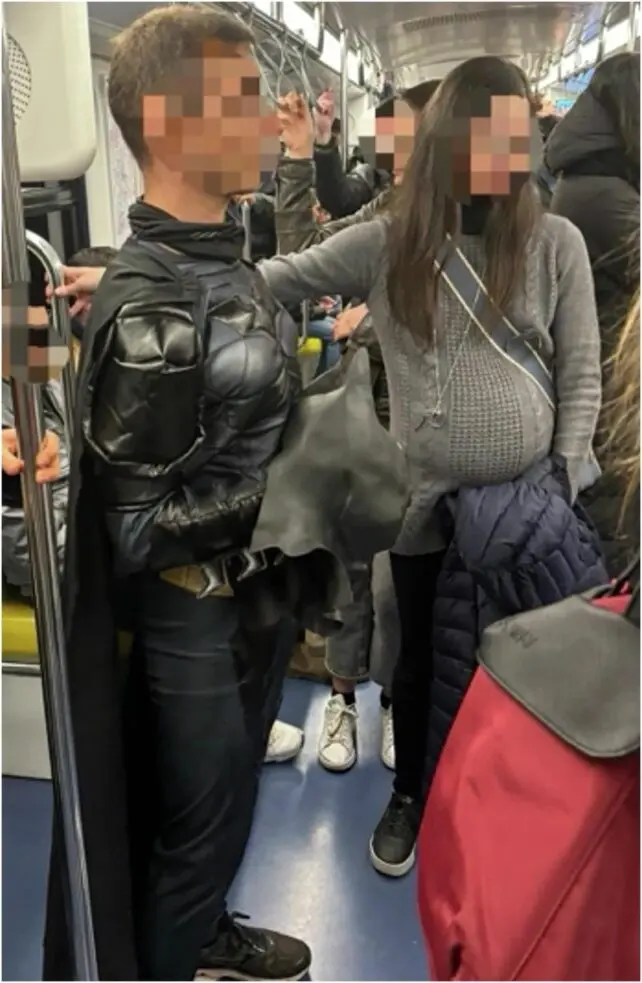
Psychologists from the Catholic University of the Sacred Heart in Italy conducted 138 experiments in the Milan subway to determine whether anyone would give up their seat for a pregnant passenger.
The main characters in these experiments were a man dressed as Batman and a woman wearing a prosthetic belly to play a pregnant passenger. To make sure no one suspected the two were working together, they boarded the train through different doors, stood apart, and didn’t interact.
They found that Batman’s presence correlated with passengers’ prosocial behavior. In 67 percent of cases, people offered their seats to the pregnant woman when Batman was on the train. In contrast, when the superhero was absent, this happened only 37.66 percent of the time.
What explains the passengers’ behavior?
So why did people become kinder upon seeing Batman? It’s unlikely the effect came from people fearing judgment from a superhero famous for punishing villains.
When researchers asked people why they gave up their seats, most said they wanted to help the pregnant woman; others cited social norms or safety concerns.
Among those who gave up their seats, none said Batman’s presence specifically motivated them. In fact, 43 percent reported they didn’t even see him, according to ScienceAlert.
The team suggested that seeing something unexpected makes people more alert and more likely to notice someone who needs help.
For example, someone might be engrossed in a podcast on the way to work and not pay attention to other passengers. A person boarding the train in a Batman costume is likely to catch your eye, and suddenly you notice the pregnant passenger who needs the seat more than you do.
This may happen subconsciously, which could explain why most helpful passengers did not directly link their action to the caped crusader. The behavior of those who reported not seeing Batman at all is harder to explain, but the team suggested those passengers likely noticed the commotion the superhero caused.
Francesco Pagnini, a member of the research team, suggested the superhero figure may also have reminded people of cultural values, gender roles, and norms of chivalrous assistance.
To test that idea, the researchers plan to run similar experiments with different characters. Would people’s altruism increase in the presence of, say, Darth Vader, who isn’t exactly known for prosocial behavior?
The results of the study were published in the journal npj Mental Health Research.
