
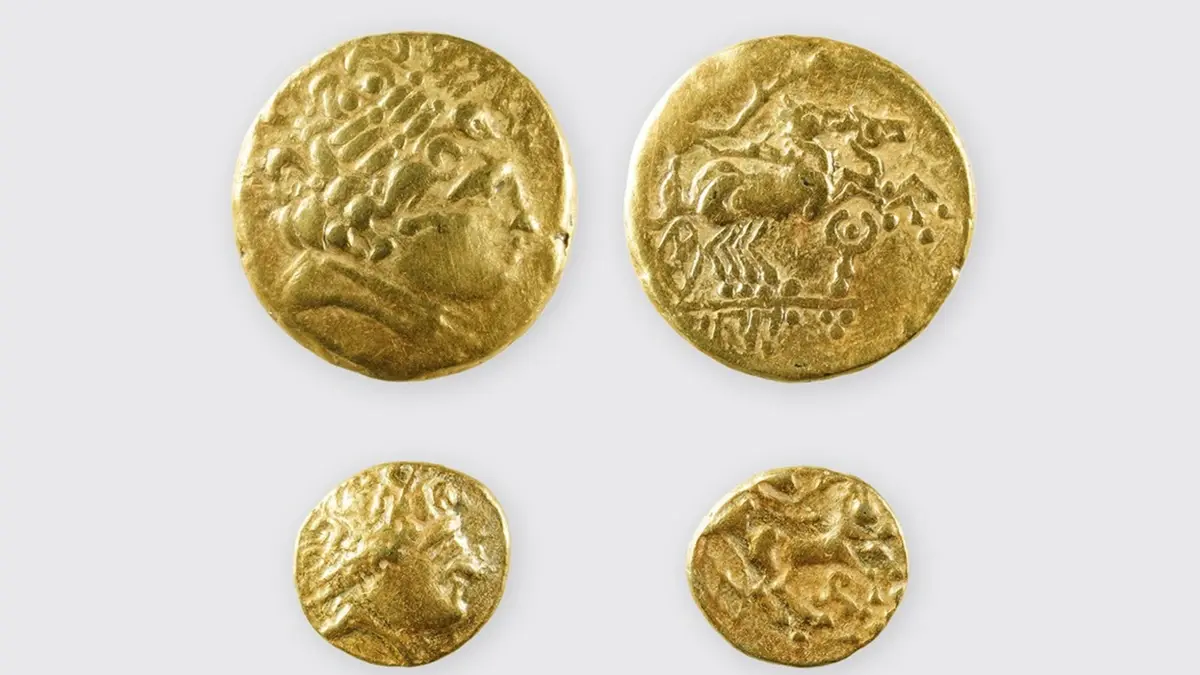
 The discovery was made during an examination of the Berenfelds swamp in the municipality of Arisdorf, near Basel. Wolfgang Niederberger and Daniel Mona, a duo of volunteer archaeologists from the “Archaeology of Basel-Land” organization, uncovered what may be two of the oldest Celtic ever found in the country. These coins are believed to be offerings to the gods, according to the publication Live Science.
The coins were minted around 2300 years ago, in the 3rd century BC. “This makes them part of a very small collection of over 20 known examples of the oldest Celtic coins discovered in Switzerland,” the researchers stated.
One coin is a stater weighing 7.8 grams, while the other is a stater weighing 1.86 grams. The term “stater” originates from ancient Greek coins. By the late 4th century BC, the Celts of continental Europe, serving as mercenaries, increasingly received their pay in Greek coins. Over time, these coins inspired the minting of Celtic coins in the early 3rd century BC.
In this case, the scientists stumbled upon gold staters minted during the reign of Philip II of Macedon, the father of Alexander the Great. The obverse of both coins features the profile of the Greek god Apollo, while the reverse depicts a chariot pulled by two horses.
However, the two recently discovered coins differ slightly from the Greek models. For instance, on the reverse of the smaller coin, beneath the horses, there is a triple spiral. This symbol, known as a triskelion, is commonly found in Celtic art.
The volunteer archaeologists shared that they discovered these coins thanks to their intuition. In 2022-2023, they found 34 Celtic silver coins in the area and decided to conduct further research there.
Gifts to the Gods?
According to the researchers, these two coins were sacrificed to the gods. Meanwhile, experts noted that Celtic gold coins were not used in everyday transactions; they were too valuable for that. Instead, they were used for paying wages, as dowries, and as diplomatic gifts, particularly for achieving political goals.
The locations where the were found were considered sacred by the Celts. Therefore, it can be assumed that the coins were intentionally left there as offerings to the gods.