
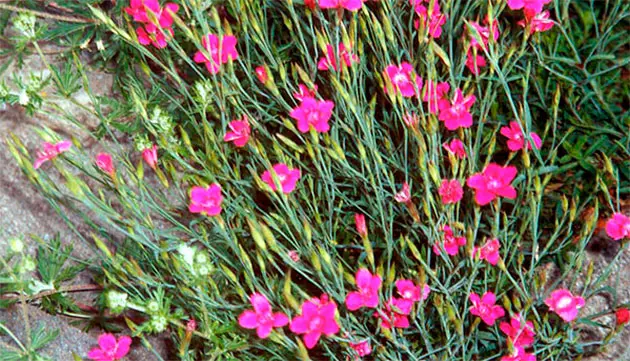
On sweltering summer days in meadows where the grass hasn’t been cut, you can spot the delicate pinkish-red flowers of the field carnation, marked with dark stripes and white speckles. Each blossom sits alone on a slender, upright stem. Try to pick one and others seem to follow — each plant sends up several branches, each topped with a flower. All the branches grow from a stem so thin that, weighed down by blooms, it sprawls across the ground like grass. That’s why it’s called the field carnation. In folk tradition the plant is often called “maiden beauty,” “little bells,” “spark,” or “teardrops” because of its grace.
The gentle fragrance of the field carnation’s flowers is reminiscent of the spice made from the dried buds of the tropical clove tree. The field carnation is valued as a nutritious forage plant, and in folk medicine and veterinary practice, infusions and decoctions from its stems and leaves are used as a hemostatic, anti-inflammatory, and pain-relieving remedy.
This plant is also a common ornamental. Numerous varieties of the field carnation have been developed, with flowers in white, pink, or red and a pale “eye” at the center. Among the carnations used in floriculture there are many showier options, but they all belong to the same genus—Dianthus, a name from the Greek dios (divine) and anthos (flower), meaning “divine flower.” According to one Greek myth, the huntress goddess Diana once grew angry with a shepherd boy for scaring away the game with his flute playing. In her rage Diana plucked out the boy’s eyes, and when she realized what she had done she dropped them to the ground, where they sprouted into beautiful flowers.
The genus Dianthus comprises nearly 250 species, with the greatest number found around the Mediterranean and across Eurasia, and a few species in North America. In this region alone there are about 100 species, with the field carnation among the most widespread. It appears in the European part of Russia, in Siberia, and in the Far East. Besides meadows, the plant grows along forest edges, in clearings, by roadsides, and in pastures.
Some wild species are quite rare. For instance, the Dniester carnation grows on granite cliffs and gneiss outcrops along the Southern Bug, Ingul, and Ingulets rivers in Ukraine. This plant has a low but sturdy branching stem that emerges from the base. Its branches are lined with narrow, stiff leaves and end in solitary red flowers. There are so many blooms that a single plant can resemble a lush bouquet. This carnation flowers continuously through June and July.
Another rare species is the Acantholimon carnation, which grows only in the Krasnodar region from Novorossiysk to Tuapse on marl outcrops in the lower mountain belt, where it forms fairly dense cushions up to 31 inches in diameter. Both of these rare species are listed in the Red Book of the USSR. The primary threat to their survival is bouquet collectors.
For the same reason, the magnificent fluffy carnation—a striking ornamental of the region’s meadows, forests, and mountain ranges from west to east—has nearly vanished. The fluffy carnation bears solitary, relatively large flowers with fringed petals in shades of lilac-pink, pale lilac, or white and emits a delicate fragrance on long flower stalks. It blooms from June to August. In many areas it has become rare and is now listed among plants needing special protection. The fluffy carnation is cultivated as an ornamental, forage, and honey plant. Folk medicine uses both its above-ground and below-ground parts.
All carnations are easily propagated by seed. They prefer light, sandy soils and sunny habitats.
