
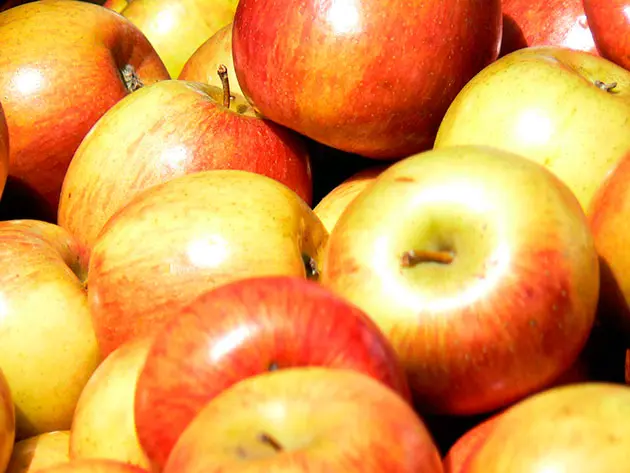
Unlike currants, sea buckthorn, roses, and some other berry and ornamental plants, apple trees are difficult to root. However, modern misting systems, growth regulators, and other techniques that stimulate adventitious root formation make it possible to propagate several apple varieties on their own roots.
**Pepin Shafran**. This winter variety, developed by I.V. Michurin, offers several advantages: early fruiting, high yield, and excellent flavor. The fruit can be eaten fresh from October through February, even into March, and is suitable for juicing, jam-making, and pickling. When the above-ground parts are damaged by frost in harsh winters, the variety can be restored from green cuttings; around 100 varieties have been tested, showing varying degrees of rooting difficulty. Some varieties are hard to root, some medium, and some easy; the easy group produces a good root system in 70–100% of cuttings. Rooted cuttings from these varieties grow and develop normally, producing own-rooted trees that, in many agricultural and biological respects, are comparable to trees grafted onto seedling rootstocks. They also offer two practical advantages for amateur gardeners. First, if the above-ground part freezes or is damaged by rodents, the tree can regenerate from root suckers. Second, the adventitious root system of own-rooted plants is shallower, making them suitable for sites with relatively high groundwater.
In the central and northwestern parts of the Non-Black Soil Zone, these varieties do well because conditions favor crown restoration and the varieties have a strong shoot-producing capacity. They bear fruit annually. A drawback is that without thinning pruning the crown becomes dense with age, which leads to smaller fruit.
**Findings from Lebedyansk**. A clone of Pepin Shafran identified in Lebedyansk (Lipetsk region) stands out for earlier ripening and an excellent dessert flavor. It reaches consumer maturity in September and can be stored in a refrigerator until December or January. The clone is early-bearing and prolific, fruiting heavily each year. Its winter hardiness is better than Pepin Shafran’s, while its scab resistance is average. Like Pepin Shafran, it tends to develop a dense crown with age, which reduces fruit size.
**Vityaz**. Vityaz is a late-winter variety developed by S.I. Isaev. It grows vigorously and forms a strong crown, with the main skeletal branches positioned horizontally—making maintenance easier and encouraging earlier fruiting. Yield and winter hardiness are good, and scab resistance is average. The fruit is medium to large (110–200 g), has a relatively high vitamin C content (up to 20 mg%), and stores well. Consumer maturity runs from December to April, making the fruit good for compotes and juices. One downside is that the fruit is quite tart and may not appeal to those who prefer sweeter apples.
**Mechta**. Mechta is a summer variety developed by the All-Union Research Institute of Horticulture named after I.V. Michurin. One of its main advantages is high early fruiting capacity: it can start bearing in the second year after planting. The tree is medium in height, winter-hardy, and productive, with medium-sized fruit that have a pleasant sweet-tart flavor. Compared with the widely grown summer variety Grushovka Moscow, Mechta fruits annually and shows relative resistance to scab.
**Aport Blood Red**. Aport Blood Red is an old folk variety known for large, attractively shaped fruit with good flavor. The winter hardiness, early fruiting, yield, and scab resistance of the clone cultivated at the Timiryazev Academy are average. In the Moscow region, consumer maturity runs from late October to February. The fruit is suitable for drying, juicing, and cooking.
**Zhigulevskoye**. Zhigulevskoye is a winter variety developed by S.P. Kedrin. The tree is medium in height, productive, early-bearing, winter-hardy, and relatively resistant to scab. The fruit is above average in size, brightly colored, and tasty. It ripens in September and can be stored until January, making excellent juice and compotes.
All of the recommended varieties except Aport Blood Red are early-bearing and productive, which increases the chances of getting a return before the onset of harsh winters that typically occur every 10 to 11 years.
In areas where fruit trees suffer frost damage almost every year, grow the listed apple varieties as bushes.
Currently, scientific institutions and nurseries still produce own-rooted apple seedlings in very limited quantities. Amateur gardeners may consider trying to grow them themselves. Creating conditions for rooting green cuttings requires fairly complex specialized equipment, so a more accessible method is propagation by layering.
Plant a one-year-old tree (own-rooted or grafted) at an angle in the fall so you can pin it to the ground early the following spring. Cover the shoots that grow from the lateral buds with soil at the base, and hill them up in several stages as they grow. Keep the soil mound loose and moist; in warm weather roots will form by autumn. Separate the layers and plant them in their permanent locations in spring, and protect the young roots from frost by covering them with leaves, pine needles, sawdust, or other insulating materials.
Some amateur gardeners use air layering to obtain own-rooted apple trees. Try this modification: in spring, choose a strong lateral shoot from the previous year on the desired variety. Cut a strip of bark 5–10 mm wide about 5–10 cm from the tip. Make longitudinal cuts in the ringed section of bark, 2–3 cm long. Treat the wound with rooting powder prepared at a ratio of 2.5 mg naphthaleneacetic acid per 1 g of talc. The most effective root-formation stimulant for apple trees is indole-3-butyric acid, but it is not commercially available.
Wrap the prepared section of the branch, avoiding the tip, with moist sphagnum moss and cover it with a piece of black polyethylene film, securing it tightly at both ends. In autumn, remove the layer with formed roots from the film and moss, cut it from the tree, shorten the young shoot, and plant it in a pot filled with a clean, sieved mix of topsoil, peat, and sand in equal parts. Store it in a basement over winter, keeping the roots from drying out, and transplant it to a permanent location in spring.
If you already have own-rooted apple trees on the property, propagate them by root cuttings, as recommended by B. Florov.
Care for own-rooted apple trees is similar to grafted trees, but give a little extra attention to the root system. Superficial adventitious roots are more vulnerable to drought, frost, and weeds, but they also respond well to good care.