
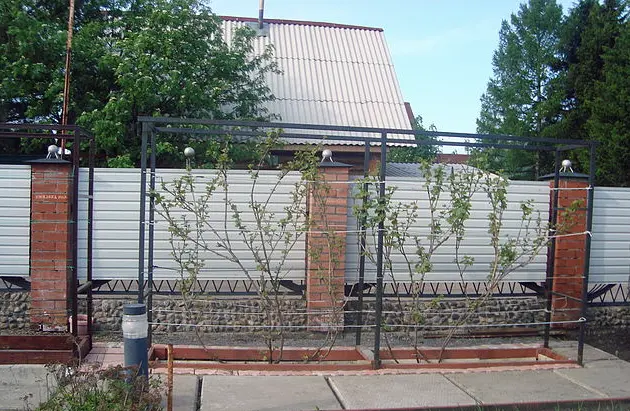
Want to get the most out of a tiny garden plot?
Let’s talk about vertical gardening techniques for tomatoes and cucumbers.
Tomatoes. For commercial cultivation, choose varieties that can bear the weight of their fruit and ripen evenly. In home gardens and summer cottages, though, you can grow a wider collection of varieties, including vining types.
High-yielding, large-fruited vining varieties grown on a grape trellis need to be tied to a support, because the fruit weight can make the plants topple. That makes plant care harder: fruit can end up on the ground, and if the harvest isn’t collected in time, tomatoes will rot.
Experience shows that tying to a single stake is ineffective. If you plant low-growing varieties on the ground, you risk losing 70–80 percent of your harvest. This is where a grape trellis helps. First, plan your garden bed and decide how many rows you want. Bury posts at both ends of the bed and stretch aluminum wire in about 5–7 horizontal rows. Plant tomato seedlings along the trellis, and as the plants grow, tie them to the wire.
The height of the trellis depends on the variety. For example, for “De Barao,” “Lemon Vines,” and “Amateur Pink,” the ideal height is 5–10 feet. Take care when tying so you don’t break stems or damage fruit clusters. Any tying method is fine as long as it doesn’t harm the plants.
This creates a green vegetable wall that gets light from both sides if the trellis runs north–south.
You can also build trellises with only a top row of wire. From that top wire, drop ropes with pre-tied loops and secure them to the plants. Then use special hooks to attach stems and fruit clusters to the loops. In summer, when the tomatoes ripen, trellises draped with red fruit look stunning. Large-fruited tomatoes do best on trellises, while smaller varieties thrive on a three-sided pyramid.
To make a pyramid, secure wires as guy lines at the top of a 5–10 foot pole. Stretch the wires out and anchor them with supports. Plant tomatoes at each support, then train the plants up the wires. Space pyramids 4 feet apart, with 3 feet between rows.
Tomatoes are less demanding than some other vegetable crops, but they produce best in fertile soils that warm up well. You can still get good yields in sandy or heavy clay soils with timely fertilization and regular loosening of the rows.
Cucumbers. Unlike tomatoes, cucumbers have large leaves and the vines they form during the season don’t always grow in the directions you want; they often tangle and shade themselves. That makes care and harvesting harder. Early in the ripening period, pick fruit every 2–3 days; during peak production, pick every day or even more frequently. Imagine how much time a gardener spends walking the rows — and how easy it is to step on a vine. A damaged vine can die, reducing the yield for the whole bed.
To get a high yield in a small area, a grape trellis or a three-sided pyramid can be very helpful.
Sow cucumbers when the soil warms to 54–55°F. For normal growth, daytime temperatures of 77–81°F are needed. The best temperatures for fruiting are about 89.6°F during the day and 68–72°F at night. Cucumbers love light, so a trellis is a good fit. Start seedlings in peat or compost pots on a windowsill or in a plastic greenhouse to get an earlier, bigger harvest. Harden seedlings off in a shaded spot before planting them in the ground.
Harvest size depends not only on light but also on nutrition and soil moisture. Cucumbers are picky about soil fertility, structure, and salinity; they are especially sensitive to high salt levels and acidic soils.
The best cucumber varieties for our conditions are “Nizhinsky Local,” “Cucumbers,” and “Nizhinsky-12.”