
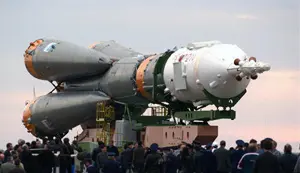
A conventional chemical rocket—the same kind that launches our satellites—would have to weigh as much as the Moon to reach Alpha Centauri, the nearest star. Even then, only a speck of dust would make it to the star.
By contrast, a light engine, or photon engine, would need roughly one kilogram of fuel per second. Photon engines are far more efficient for interplanetary travel than chemical rockets. But how can we envision a flight powered by a beam of light?
We can sketch this idea schematically. Every particle has an antiparticle counterpart. For example, the electron’s positively charged counterpart is the positron. When a particle and its antiparticle collide, they annihilate and turn into light. If we filled one chamber with particles and another with antiparticles, then mixed portions from both into a third chamber, the resulting light beam could be powerful enough to push even the heaviest interplanetary spacecraft deep into space.