
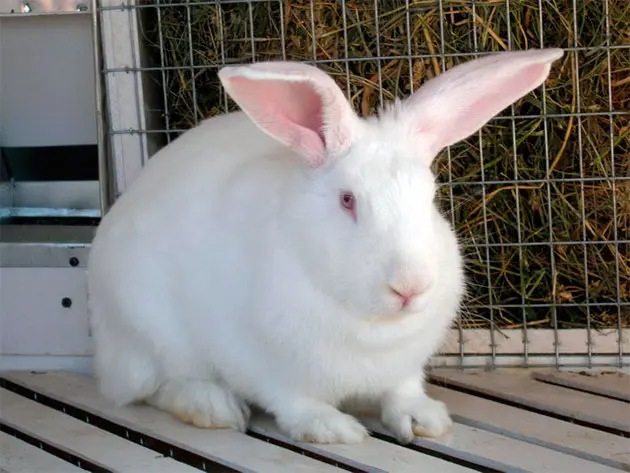
I’ve long wanted to see Angora rabbits. Where are they bred? Where do those fluffy tufts on their ears and paws come from, those adorable little bangs, and those magnificent collars? I’ve heard there are even a few at VDNH (the Exhibition of Achievements of National Economy). Luck is on my side now—I’m off to meet Dymka and her Angora companions. The owner of these rabbits, Tatyana Vasilyevna Alexeeva, laughs and points to boxes of hay on the balcony: “The ones who will definitely survive the winter in this Moscow apartment are the ‘bunnies.'”
I stare at Dymka. She’s a stunning creature—a fluffy young doe with the softest, most beautiful blue coat. The fur is long and fine, with individual strands curling delicately, almost as if permed. Fur this long (15 cm or more) can be spun without any additional thread. It’s cleaner than goat wool because it doesn’t need to be washed to remove grease; it’s pure as is.
Dymka’s mother is white, also with long fur, while her father—”daddy,” as the owners call him—is blue, so Dymka clearly takes after him. Now the challenge is finding a blue male for Dymka. The owner observes that blue and gray Angora rabbits tend to be more affectionate and tame faster than white ones. The advantage of white fur is that it can be dyed any color.
Each of these “ear-flappers” has its own charm. The gray fluffy favorite of the owner’s daughter Natasha (Dymka’s brother) can perform like a dog, drumming with his paws; I got a demonstration of this little circus act. I noticed the owners are always interacting with the rabbits—holding them, grooming them. That isn’t just affection: fluffy rabbits need to be tame so they allow grooming without panicking and hiding in their cages. Otherwise, their delicate fur can mat. To tame young rabbits, the owners bring them from their summer house to Moscow. Tatyana Vasilyevna says she picks up the newborn kits, counts them, checks their health, and makes sure their bellies are full, without fearing that the mother will stop feeding them. The tame doe calmly watches all these actions, trusting her babies to the owner’s hands.
So where do these Angora rabbits live once they move from the summer house to Moscow? In a glassed-in balcony with double frames, where six cages are stacked in three tiers. Two lightweight plywood cages sit at the top and can be moved into the kitchen so the babies are born in warmth. The rabbits are delicate and afraid of the cold. All the cage floors are made of wooden slats that can be removed and cleaned. The gaps between the slats are narrow—just enough for droppings to fall through. Keeping the floor dry is crucial.
Another clever device helps keep the floor dry: rabbits always choose a specific corner for their toilet. The owner designates that corner by installing a narrow feeder—about 2 inches wide—along one wall, which encourages the toilet to be on the opposite wall. Along that opposite wall she nails wide boards so waste drains only under the slats into a removable metal tray that can be cleaned, like the slats. Tatyana Vasilyevna makes these cages herself. She says cages for fluffy rabbits should be made from welded wire; chain-link fencing lets long fur get caught in the gaps.
The hay feeders are placed outside the cages on purpose: the rabbits’ coats shouldn’t be contaminated with bits of hay. That’s why the rabbits live on a wooden floor instead of wire, and without bedding, which would also dirty their fur.
Before the kits are born, the owner places a nesting box about 4 inches high in the plywood cage that gets moved to the kitchen. It’s open at the top, and the bottom is mesh fine enough to let droppings through while keeping the kits from falling out.
I asked a question many rabbit breeders worry about: what prevents does from eating their young? Her answer: always keep water in the drinking bowl, and the doe must be completely tame. Until the kits grow up, avoid scented creams, deodorants, or perfumes—these can irritate the mother. Even small things, like the creak of a gate or the sound of a falling object, can startle her and cause her to harm her young. Isolate a stressed doe from males, because if a male is nearby thumping his paws, the doe might eat her offspring. If she cannot be isolated with her young, pairing her with a male can sometimes calm her down.
The owner always provides milk for the nursing doe. Kits stay under their mother’s care for about a month to six weeks, but the owners still have a lot of responsibilities. As soon as the kits are born they check on them even at night—making sure everyone has eaten and that none of their bellies are sunken. Why at night? Rabbits have their biggest appetite then; they are largely nocturnal. If the kits are calm, not scattered around the nest, their fur shiny, and their bellies full, the owners can sleep soundly.
How should Angora kits be fed if their mother is not available? The feed must be rich in protein to promote better fur growth. The most important thing, Tatyana Vasilyevna warns, is to avoid feeds with a laxative effect. Soft droppings aren’t a disaster, but if droppings stick to Angora fur the strands will mat and have to be sheared, which reduces yield. Choose feeds carefully. The best food, she says, is compound feed; if it’s intended for cattle or pigs, sift it first because it often contains too much salt. The rabbits particularly enjoy potato peels—she washes them thoroughly, cooks them, and adds a bit of salt. When they see the peels, the rabbits turn up their noses at the compound feed. They also like cooked zucchini. Beets can cause loose stools, so give them cooked and in small amounts.
Their feed is sprinkled with crushed calcium gluconate, which they need; when a doe has kits she’ll grab a tablet straight from the owner’s hand. It’s also beneficial to give carrots and cabbage. “The neighbors at the vegetable store already know me,” Tatyana Vasilyevna says. “I collect leftover, non-moldy cabbage leaves from the containers for the rabbits.” Dymka’s family also enjoys dry bread, but avoid fresh bread because it can ferment in the intestines and cause bloat. Grains like oats and barley are good; soaked in warm water, they become a vitamin-rich feed.
In winter the owners stock up on hay and store it in boxes on the balcony. They also dry nettles in bundles on a string. In early spring they give dandelion greens, and at the summer house they feed plenty of fresh grass, but they acclimate the rabbits gradually—the grass should be slightly wilted before feeding. The same goes for switching to rural water; otherwise the rabbits’ stomachs may get upset. After a move from Moscow, the owner gives boiled water for a week, then fills their bowls with water from an artesian well rather than surface well water because it’s safer.
Now to the part that makes all this care worthwhile: rabbit fur. Tatyana Vasilyevna does not shear the rabbits. She says old fur can remain and block new growth. She only uses blunt-ended scissors if fur has matted in an area—often under the males’ armpits—carefully cutting the tuft and gently pulling it apart by hand.
The owners groom the rabbits once a day, and the animals enjoy it. Gray rabbits shed faster than white ones. Fur production isn’t seasonal, and quality doesn’t depend on the animal’s sex, she says. With gentle handling she collects 70–100 grams of fur from each rabbit per plucking, doing this about three times a year. Specialists say one adult Angora rabbit can yield 150–300 grams of fur per year, with the best animals producing up to 400–500 grams.
When should serious plucking begin? Does may pull out their fluffy collars with their hind legs to make a nest during mating, so watch them closely. If combing reveals no loose fur against the skin, it’s too early to pluck. For gray rabbits, fluff the fur: if it appears dark against the skin, it’s time to groom. The skin of fluffy rabbits is very delicate, so pluck carefully, holding the rabbit with one hand. Place the rabbit on your lap and brush it lightly with a massage brush, then press a small tuft against the brush with your right thumb and pluck gently in the direction of hair growth.
How should fur be stored? The owner says keep it in boxes or jars. In plastic or even cloth bags the fur will mat immediately.
My visit to Dymka and her relatives comes to an end. The owner and I walk through the first frost to the metro, past the boxy buildings and “ants’ nests” of Moscow’s outskirts. It’s heartening that city dwellers in these neighborhoods take an interest in nature—sacrificing balconies for rabbits, caring for them, and looking forward to summer so the animals can survive the winter and return to the summer house in spring. It’s also wonderful that this “living nature” appeals to someone who isn’t a biologist but an engineer. Tatyana Vasilyevna is a designer.