
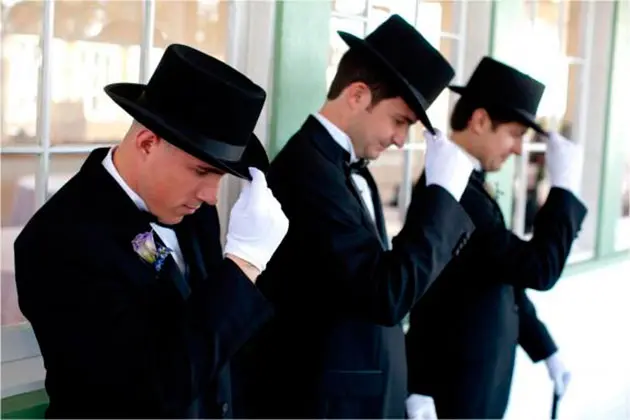
Most commonly accepted rules of behavior are tied to ideas of beauty.
Today many of these rules are purely traditional and their practical value is questionable. For example, the custom of a man walking ahead of a woman when descending stairs dates back to when men carried candles and women wore long dresses; it was meant to avoid stepping on the delicate fabric.
In European cultures, shaking hands is the usual greeting — a sign of respect today, but originally a way to show peaceful intentions by revealing empty hands. In parts of the East, Arabs cross their arms over their chests, Turkmen tuck their hands into long sleeves, and in China people let their hands hang at their sides when bowing.
If you’re unsure what to do with your hands in social situations, keep them on your lap or on the table (but don’t splay your elbows wide). Break habits like fidgeting, tapping your fingers on the table, biting your nails, scratching your head or behind your ear, or rubbing your cheeks.
A polite person avoids turning their back on anyone, sitting facing their conversation partner or at least turned slightly sideways. When elders enter a room, younger people stand. Men also stand when a woman enters.
The tone of voice carries emotional nuance and strength. It says something about a person’s character and signals whether you’re dealing with someone polite or rude. Tone matters as much as gestures and posture; the same words can land very differently depending on how they’re spoken.
When talking to someone, avoid unrelated activities — don’t read, chat with a neighbor, play with a cat, “study” the ceiling, or gaze dreamily out the window. Such behavior can be offensive.
It’s impolite to shout across a table, down a hallway, from a balcony, across the street, or from a bus. But don’t stand so close that you can feel the other person’s breath.