
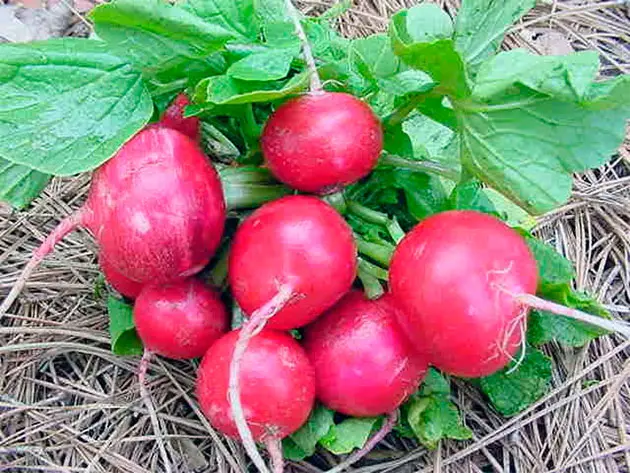
Last year I discovered a previously unknown variety of radish that’s truly remarkable. In my unheated greenhouse I grow tomatoes and cucumbers, and early in spring I sow radishes in the spaces between those plants. The radishes don’t interfere with the other plants’ growth and actually create a microclimate around the cucumber and tomato plants, their large leaves shielding them from unexpected frosts. I cover the seedlings and the radishes with thick wrapping paper during bad weather — it’s a reliable way to protect the plants from dying.
My radishes mature quickly. By the time the cucumbers start to bear fruit they’re nearly all harvested, which frees up the space between the rows. That lets me dig deep furrows for “subsurface” irrigation where the radishes once grew.
In the photo you can see four varieties of radishes: a regular one (I don’t know the name), Soskulka, White Giant, and a new hybrid. The new hybrid came from cross-pollinating the White Giant with Soskulka. I named the hybrid Miracle Radish. In taste it surpasses every variety I know; the only one that might compare is the White Giant, which is one of its parent plants. Both parent varieties are unusually juicy, not bitter, and they don’t go woody. In size the roots have no competitors — each weighs between 300 and 500 grams. If you sow radishes with 15 cm spacing between plants, you can harvest up to 25–30 kg of juicy roots from just one square meter. I make several sowings throughout the warm season, so this delicious product stays on the table for a long time.
I learned how to produce seeds for the Miracle Radish. To do that I left a few plants from the first sowing, and by mid-summer I had seed pods. The seed plants grew to over 3 meters tall and produced numerous side shoots, which required staking. Otherwise the stems would break at the slightest touch because the seed plants’ stems are very juicy and fragile. So I stake them carefully and promptly. Flowering and pod formation continue all summer until the first frosts.
I don’t collect the seed pods during the summer. At the end of the season I pull up the entire plants, hang them in my garden shed until it gets cold, then remove the pods and thresh them to extract the seeds. I store the seeds at home until spring. In the spring I sow the dry seeds into well‑moistened soil, and the seedlings appear within three to four days after sowing.