
“Prepare your sled in summer and your cart in winter,” goes the old saying. The same applies to the qualities our children will need to excel in school; we must think ahead. However, many parents mistakenly equate overall development solely with a child’s analysis and synthesis skills, memory, attention, and intellect, neglecting the importance of physical fitness.
Adults who eagerly answer the most unexpected questions from curious little ones (like “Is there life on Mars?”) often fail to take seriously questions such as, “Why is that aunt so fat?” or “How can I learn to jump rope?” As a result, many first-graders experience a sharp decline in physical activity alongside their intellectual engagement, which not only complicates their adjustment to the new school environment but can also lead to sudden health issues. This can manifest as so-called school neuroses, exacerbated stomach ailments, and an increase in acute respiratory viral infections. Their loss of independent thinking and growing rigidity also severely hamper their interactions with peers. Therefore, we must set aside our personal urgent matters to assist our children.
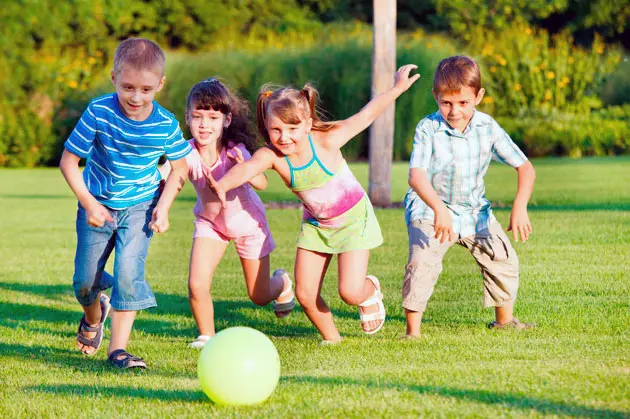
Not everyone may realize that children primarily accumulate social experience through joint play. Boys and girls who spend ample time outdoors and engage in self-directed play adapt to school conditions more quickly than their “homebound” counterparts. This helps explain why those “homebound” children are more likely to cling to the teacher or sit quietly at their desks during lessons and breaks.
Let’s recall the scene of future first-graders being ceremoniously welcomed as they bring their documents and take a unique “exam” demonstrating their reading and counting skills at the beginning of summer. However, only a few schools assess children’s ability to throw and catch a ball alongside their academic skills. That skill indicates the development of small muscle groups in the arms, which will ultimately affect writing speed. Psychologists have also found that children who can adeptly jump rope tend to grasp arithmetic concepts better. Additionally, how many times a child can sit up from a lying position is significant; strong back and abdominal muscles help maintain proper posture at their desks.
Special studies have shown that gymnastics, games, and sports enhance children’s memory and attention, improve movement precision and speed, foster discipline and logical thinking, and cultivate diligence and perseverance.
Even brief daily sessions of physical exercise, preferably with parents, are extremely beneficial for children’s health.
Before starting any training, I ask that you meet two conditions. First and foremost, obtain permission from a pediatrician. No matter how well you know your child, only a doctor can provide an objective assessment of their health. The second condition is to determine your child’s level of physical development, which you can do yourself using the following system:
a) Calculate the child’s physical development index using the formula: height minus the sum of body weight and chest circumference;
b) Based on the physical development index, identify the group number to which your child belongs according to the scale below;
c) Conduct simple motor tests. It’s best to do this over two days.
Physical Development Index – Group Number
23 and below – I
23.1–30.9 – II
31.0–37.9 – III
38.0–42.9 – IV
43.0 and above – V
A standing long jump provides insight into speed and strength, as well as leg muscle power. Perform the jump on a non-slip surface toward a designated mark. Have the child swing their arms back, thrust them forward, and, pushing off with both feet, jump as far as possible. Measure the jump length from the take-off mark to the point where the heels touch the ground. Record the best of three attempts (in centimeters).
Do push-ups from a lying position (with a straight torso) to assess arm and shoulder strength. Have the child support their body on extended arms and toes. Ensure the stomach does not touch the floor during each push-up. Count how many push-ups the child completes.
To assess coordination, agility, and reaction time, have the child stand one meter from a wall and throw and catch a ball (15 centimeters in diameter) with both hands. Count how many successful catches happen in 30 seconds.
Have the child do sit-ups from a lying position on their back (arms extended forward, back straight) to measure abdominal muscle strength. Count how many sit-ups the child completes.
Have the child jump rope on both feet to evaluate coordination, agility, reaction speed, endurance, and leg muscle strength. Count the number of jumps until fatigue sets in.