
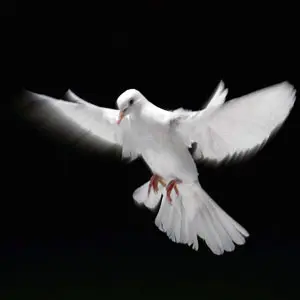
As far back as 3,000 years ago, the ancient Persians knew that doves could find their way home from distant lands. They were the first to establish a pigeon post system.
The story of the dove is much like the story of domesticated crops: people learned to raise it before they even gave it a name. However, even though people used pigeons for communication, we still haven’t unraveled how these birds navigate back to their lofts. Countless experiments have tried to figure it out!
Take one experiment as an example. Researchers put a pigeon in a dark box so it couldn’t see its surroundings. Maybe the bird was memorizing the twists and turns of the route. To rule that out, experimenters tied the box to a rope and spun it for a long time. Then they transported it a great distance in a different direction and spun the box again.
Yet, when released, the pigeon would soar upward, survey its surroundings, and fly directly back to its loft without fail.
For a while, people thought pigeons navigated using the Earth’s magnetic field. Researchers attached copper plates and magnets to the birds’ backs, but the pigeons still managed to find their way home.
So the millennia-old mystery of pigeon navigation remains unsolved, much like the enigma of how migratory birds orient themselves. If researchers could crack this code, they might build ships and airplanes that, in a birdlike way, would inherently know where to go, guiding humans more effortlessly on long journeys.