
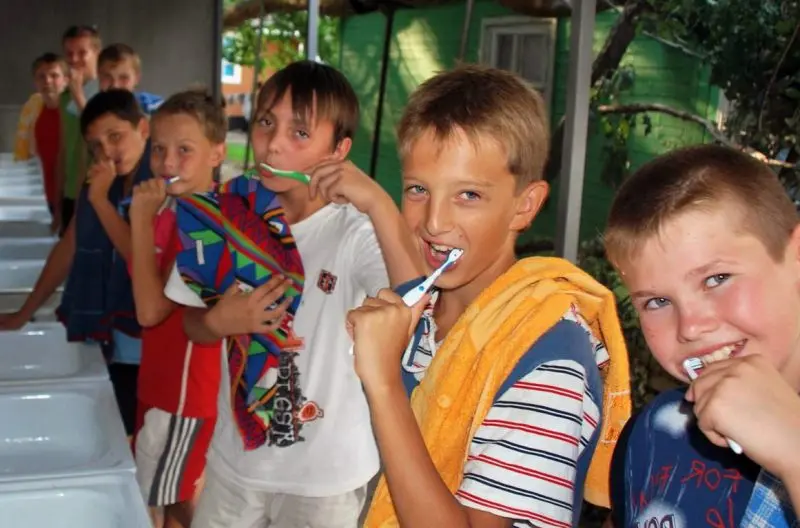
In pioneer camps, the principle of age differentiation is used to tailor programs to three groups of children: Octoberists (ages 7–9) in Group I, junior pioneers (ages 10–12) in Group II, and senior pioneers (ages 13–15) in Group III. A key condition for a restorative stay in outdoor pioneer camps is a well-organized daily routine. Each squad follows a daily schedule aligned with the children’s age-related needs and guided by these principles: maximum time outdoors; systematic hardening of the body; balanced nutrition; physical activity; physical education; and work.
Physical education benefits a child only when it accounts for health status, age, gender, and developmental level, and when it ensures consistency, progression, and gradual increases in physical load. In the pioneer camp, physical education takes these forms:
1. Hardening through exposure to air, water, and sunlight.
2. Morning hygiene gymnastics.
3. Active games.
4. Participation in sports clubs and classes.
5. Sports competitions.
6. Training for and completion of summer GTO (Ready for Labor and Defense) standards, Levels I and II.
7. Tourism and excursions.
8. Work activities.
Organizing corrective gymnastics and therapeutic physical education for children in special groups with developmental deviations and posture issues is especially important in the pioneer camp. Classes for these groups are held outdoors three times a week, led by a physical education instructor according to a set schedule and supervised methodologically by the camp physician.
All sports competitions are run under the camp’s medical supervision. The doctor examines every participant and clears them to take part. Another important health-promoting activity in pioneer camps is tourism, which serves as active recreation, an effective hardening method, and benefits the cardiovascular and nervous systems.
The duration of hikes is determined by the group’s age. For children under 9 years old and for children in other physical-education groups, walks and excursions outside the camp are organized. Before each hike, the doctor examines every participant and clears them to participate.
The rest schedule in the pioneer camp includes socially useful work aimed at fostering a love of physical labor, developing work skills, and teaching children to care for themselves. Properly organized, manageable outdoor work has health benefits. Teenagers older than 13 take part in agricultural work on collective and state farms and on the pioneer camp’s agricultural plot. Children under 13 help cultivate and care for decorative plants. On collective and state farms, strict work schedules are set: for children aged 13–15, total work time does not exceed 2 hours; for children under 13, it is limited to 1 hour. Safety protocols are enforced during work. Tasks are simple and designed to eliminate the risk of injury, poisoning, or exposure to harmful industrial factors.
Health institutions’ favorable environmental conditions — the combination of water, sunlight, ozonated air, and green spaces in outdoor and resort areas — should be used effectively. Proper hardening of a child’s body through natural factors leads to higher hemoglobin levels, improved metabolism, a stronger nervous system, better compensatory functional capacity, reduced fatigue, and increased resistance to illness.
