
Children who are used to gradual hardening are generally more cheerful, catch colds less often, and are less susceptible to infectious diseases. When they do get sick, they tend to recover more easily and with fewer complications. The main principles of hardening a child include gradual exposure, consistency, attention to individual characteristics, and regular medical supervision.
Gradually acclimate children to lower temperatures. Use a strict individual approach based on each child’s age and health, since not all children respond the same way to temperature changes.
Air baths play a significant role in hardening children. Younger children should spend time outdoors in light clothing. Over-bundling can cause overheating and increase the risk of colds. Take air baths when the air temperature is no lower than 64–68°F (18–20°C), for 10 minutes up to 1 hour, and keep children active during this time.
For children who frequently catch colds or who have recently recovered from illness, take air baths at air temperatures no lower than 72°F (22°C) for 5–6 minutes.
Water procedures are also crucial for strengthening a child’s body; these include wiping, dousing, and bathing. For younger children, start wiping with water at 89.6°F (32°C) and gradually decrease the temperature to 68–72°F (20–22°C) for 3–4-year-olds and to 64–66°F (18–19°C) for younger schoolchildren. The duration of this procedure should be 3–4 minutes. For older schoolchildren, the water temperature should not be lower than 64°F (18°C).
Dousing in the summer should be done outdoors with water temperatures no lower than 66°F (19°C), lasting 2–3 minutes. After dousing, dry the child off quickly. For nervous or easily excitable children, warm the water to 95–96.8°F (35–36°C).
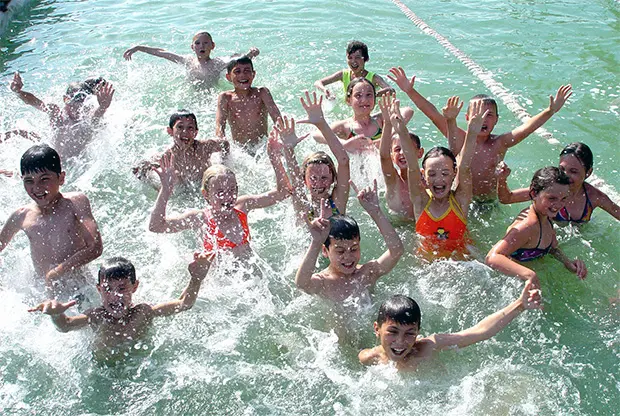
The most effective way to harden children in the summer is swimming in rivers, lakes, or the sea, which is allowed for children over 3 years old. Preschoolers should start swimming in calm, sunny weather with air temperatures no lower than 77–79°F (25–26°C) and water temperatures no lower than 72–73°F (22–23°C), beginning with once a day. School-aged children can swim twice a day, with 2–3 hour breaks, even in cooler water and air temperatures. In the first few days, stay in the water for no more than 1–2 minutes, gradually increasing to 10 minutes. Children who can swim may increase time in the water to 15–20 minutes.
Sunbathing is another effective method for boosting a child’s health. Exposure to sunlight significantly increases the body’s resistance to infections and colds. Gradually increase sun exposure from 2–3 minutes up to 25–30 minutes for younger schoolchildren and up to 45–60 minutes for older students. After sunbathing, follow with water procedures.
During children’s rest periods, focus on their physical activity. Research shows that well-organized physical education positively affects a child’s mental and physical development. Healthy, hardened, and physically active children miss fewer classes because of colds and learn school material more effectively. These children are more productive, tire less easily, and cope with challenges more readily. Physical exercise helps children develop a conscious attitude toward work. Group training builds habits of mutual assistance and support and teaches them to consider collective interests.
Physical education is also closely linked to labor education and polytechnic training. Doing gymnastics, sports, and games helps children develop proper posture and coordination, contributing to their physical development and health.
For preschoolers, hold regular physical education sessions during rest periods to improve their motor skills.
When choosing physical exercises for children under 7, remember that their lung tissue is not fully developed. Their nasal passages, trachea, and bronchi are relatively narrow, which makes it harder for air to reach the lungs. The diaphragm sits higher, so breathing movement is limited. Young children breathe more shallowly and more often than adults. Shallow breathing can reduce lung ventilation, so encourage outdoor physical activities to stimulate gas exchange.
The cardiovascular system of preschoolers is well adapted to the demands of a growing body. Compared to adults, children’s blood vessels are wider, allowing freer blood flow, shorter circulation paths, and a faster heart rate. However, nervous regulation of the heart in young children is not fully developed, which can cause quick excitability, irregular rhythms, and fatigue of the heart muscle during exertion. With brief rest periods and changes in activity, a child’s heart can recover quickly.
