
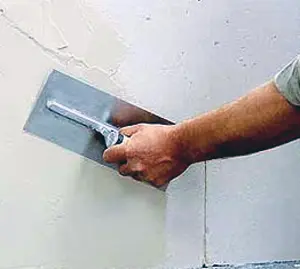
Proper care of oil-based coatings on wooden and metal surfaces not only extends the life of those structural elements but also keeps a room looking neat; the same applies to decorative finishes.
You can do most painting work at home yourself. Tools and materials are available at hardware and paint stores. The quality of materials matters: cheap substitutes and inferior products will make the finish break down faster and waste your money.
Linseed oil, oil paints, enamels, driers, and thinners for heavy paints should all be high quality. These materials must meet the appropriate standards. The same insistence on quality applies to pigments used to tint glue-based wall paints; the pigments must be lightfast. Common lightfast pigments include zinc white and lithopone, yellow ochre, Mars yellow, chromium oxide (green), ultramarine (blue), ochre, mummy, iron oxide (red), and ground chalk.
With those pigments you can mix dyes of any color and shade. Other painting ingredients are used in small amounts and are typically sold as finished products rather than substitutes.
Painting repairs in a room usually begin with whitewashing the ceiling. Before you whitewash, spread sawdust on the floor and lay down mats or old newspapers. Remove that protective covering right after the whitewashing and painting; otherwise dirt can embed in floorboards or parquet.
Scrape old whitewash off the ceiling with a spatula, then fill cracks and gaps. Use this putty for filling: soak 100 g of carpentry glue in cold water (just enough water to cover the broken pieces of glue). After 12 hours, drain the unabsorbed water from the swollen glue, then dissolve the glue over low heat, stirring constantly to prevent burning.
In the hot glue solution, add two tablespoons of linseed oil and mix. Gradually incorporate 3 kg of sifted chalk, kneading the mixture until you get a smooth paste suitable for puttying.
After filling cracks and other defects, prime the ceiling with a copper sulfate primer. Prepare the primer by dissolving 100–150 g of copper sulfate in 2 liters of boiling water. Separately, dissolve 200 g (dry weight) of swollen carpentry glue in another 2 liters of boiling water. In the hot glue solution, dissolve 250 g of grated household soap, then add 1/4 cup of linseed oil. Mix this emulsion thoroughly, then pour in the prepared copper sulfate solution. Cool the mixture slightly and add 3 kg of sifted chalk. Dilute with warm water to a total volume of 10 liters. The same primer can also be used on walls.
Prepare ceiling whitewash like this: mix 1 kg of sifted chalk with 40 g of ultramarine (blue) and 1/2 liter of water into a thick paste. Soak 60 g of carpentry glue in cold water, then drain and melt the swollen glue over low heat. Mix the warm glue solution with the chalk paste and thin it until it forms a suspension that flows easily from a brush.
Apply the whitewash to the ceiling with a brush. Apply the first coat parallel to the windows and the second coat perpendicular to the first. In summer, avoid whitewashing during the hottest part of the day, since heat can cause poor adhesion. After work, rinse brushes thoroughly with water, shake them out, and dry them.
For colored glue painting on walls, remove the old paint first. Damp the walls with warm water, scrape off the softened paint with a spatula, then let the walls dry. Sand the surface with a piece of pumice or sandpaper attached to a wooden block. Fill cracks, gaps, and holes with putty, then prime the walls with the primer described above. Apply the primer with brushes first horizontally, then vertically, blending during the second pass to avoid leaving streaks.
Make wall paint the same way as ceiling whitewash, but use a little more glue and add a coloring pigment in addition to chalk. Mix pigments with a small amount of glue solution and grind them into a thick paste before adding them to the paint, then thin with more glue solution to reach a suspension that flows easily from the brush.
To ensure a uniform finish, follow the established ratio of chalk, colored pigment, and glue solution when preparing the working mix. The amount of pigment should be one-sixth the amount of chalk.
To choose a shade, mix dry pigments in various proportions, then add chalk and a little glue solution. Apply the sample to a piece of glass and dry it gently over low heat. Judge the color and shade from the dried sample.
Painting windows, doors, and walls with oil paint. Oil paint can be used on wood, plaster, and metal. With quality materials and proper technique, those coatings are durable, attractive, and hygienic.
For working mixtures, use thick oil paints or ready-to-use paints along with linseed oil, driers, and oil enamels. Clean surfaces of dust, dirt, mold, stains, and rust, then dry them. Prime the surface, fill defects, sand, and apply two coats of paint, allowing each coat to dry for at least a day.
Prepare an oil primer from linseed oil with a small amount (about 10%) of mummy or iron oxide. The reddish color of this layer is fine because the subsequent oil paint will completely cover the primer.
You can prime up to three times, allowing each layer to dry. Fill any defects with putty made from linseed oil (use a 10% glue solution mixed with chalk in proportions that create a thick mass). Apply the putty with a spatula and smooth it with pumice or sandpaper after it dries.
After filling defects, putty the surface once or twice more. Apply the putty with a spatula in a thin, even layer. Treat the dried putty with pumice.
Thin thick paints with linseed oil to working consistency (about 400 g of linseed oil per 1 kg of thick paint). Stir the mixture with a spatula and then brush it on. Stir the paint each time before you use it. Paint from top to bottom, then crosswise to that direction. Apply at least two coats, allowing drying between coats.
Floor Painting. For cracked floors, fill gaps, plane down any unevenness, and prime the floor with hot linseed oil. Once the linseed oil dries, prime a second time. Then putty the floor (add about 5% dry ochre to the putty), and sand after the putty dries. Paint floors only when they are completely clean and dry. Apply at least three coats, allowing each layer to dry. Let the final coat dry for at least six days; in winter, allow up to twelve days.
Apply one or two layers of oil floor varnish over the last coat to significantly increase durability. Use only high-quality natural linseed oil for floor painting.
Wallpapering Walls. Commercial wallpapers meet the applicable standards; rolls are 6–12 meters long and 50, 60, or 75 cm wide. Wallpapers vary by paper density, adhesive, surface characteristics, and number of printed colors.
A border is a narrow strip of paper with a pattern that harmonizes with the wallpaper’s design and color. Borders are 3–16 cm wide and should be cut according to the pattern before use.
A frieze is used to glue the upper parts of walls and comes in widths of 20, 35, and 60 cm. The widest strips, applied above a panel, are called tapestries.
Wallpapering is done on well-dried plaster. If plaster hasn’t dried properly, wallpaper can peel and stains can appear. In wooden houses, wait at least a year before the initial wallpapering so the structure can settle. In wooden houses, nail damp cardboard tightly to the walls before wallpapering; when the cardboard dries it stretches and provides a smooth surface. Soak the cardboard sheets in water and stack them overnight so they become evenly damp. Nail the cardboard in place with wallpaper nails and seal joints with paper strips or putty.
When wallpapering, wash off excess paste and clean any remnants. If you wallpaper over existing wallpaper, first check how well the old paper adheres. Remove any peeling wallpaper, cover exposed areas with newspapers, remove nails, and fill holes with putty.
Before wallpapering freshly plastered walls, rub the surface with a smooth brick or stone. Prepare the walls with paste before applying the wallpaper.
Prepare paste like this: for 10 liters of paste, mix 1.5 kg of rye, wheat, or flour paste with 1 liter of 10% hide or bone glue. First make a dough from the flour, then thin it with warm glue solution and boiling water. Strain the resulting mixture.
For wallpapering with newspapers, coat each sheet with paste and apply it to the wall. Smooth it with a brush while the paste is still wet to avoid wrinkles, bubbles, and other imperfections. You can use a slightly thinner paste for newspapers than for preparing the walls.
Measure the room to determine the number of wallpaper strips and borders; add an extra 12% for cuts, pattern matching, and waste.
When trimming wallpaper, cut the left edge first and cover the right wall starting from the window. When wallpapering the left wall (from the window), cut the right edge. This overlap method helps hide shadows from the edge; if you hang paper edge to edge, the order doesn’t matter. For walls opposite windows, the edge trimming method prevents the edge from casting a visible shadow. The applied wallpaper edge should face the light.
After trimming, cut individual strips to the room height (or the panel height if the wallpaper doesn’t go to the top). Stack the cut strips so each lower strip extends by the width of the edge; stacking makes pasting easier and helps avoid soiling the front side of the wallpaper.
Before you start, check the corners of the room for plumb. Wallpaper following the vertical line marked by the free edge of the already pasted strip. If a corner is out of plumb by, for example, 2 cm at the lower corner, allow the upper corner to deviate by the same amount. That way the lower edge fits precisely into the corner, and you trim the excess at the top along the corner line.
Do not glue baseboards and moldings. Always start wallpapering from the outer corners of the room and work “from the light.”
Wallpapering Technique. After applying paste to a strip, fold it in half with the pasted sides together and hand it to a partner standing on a ladder. After unfolding the strip and checking for plumb, the partner applies the top end of the strip at the cornice and smooths the strip from top to bottom with a clean, dry cloth, removing bubbles and wrinkles. Smooth and press carefully to avoid damaging the wallpaper or smudging the pattern. You can also use a stiff brush for smoothing.
When working with overlap, apply the next strip to the uncut edge of the previous strip, always aligning the pattern. Trim excess ends at the top, baseboards, and door moldings with a sharp knife. Use scraps of wallpaper above window openings and door frames.
After papering all the walls, apply a narrow border at the cornice as a final finish.
You can also hang wallpaper slightly below the cornice (for example, 0.5 cm). Measure the distance from the cornice and mark a line with a chalk line. The upper strip is called a frieze when applied horizontally. Sometimes only the lower part of the wall is papered to about 1.5 meters, creating a panel with a border above it.
The number of wallpaper pieces needed. The standard usable width of wallpaper is 47 cm (without the edge). Pieces come in lengths of 7 or 12 meters.
Measure the room’s length and width and multiply by two to get the perimeter. Divide the perimeter by the usable wallpaper width to find how many strips you need from top to bottom. Divide the length of a wallpaper roll by the wall height to find how many strips one roll yields. For example, a 12-meter roll will yield four strips for a room with a 3-meter wall height. Divide the total number of strips needed by the number of strips per roll to find how many rolls you need, then add one roll for pattern matching and waste. One border piece is 6 meters long and cuts into three strips, so the number of border pieces needed equals the perimeter in meters divided by 18.
Choosing harmonious colors. Match the color and shade of wallpaper or glue paint to the room’s purpose. For a general living room, choose yellow-brown, yellow, beige, or similar colors. Paint a child’s room in yellow or green; a bedroom in light green, light blue, or beige; a kitchen in light green, blue, sea colors, or white. Paint bathrooms and toilets in light green, blue, or white.
When selecting paint or wallpaper for a renovation, take the furniture color into account.