
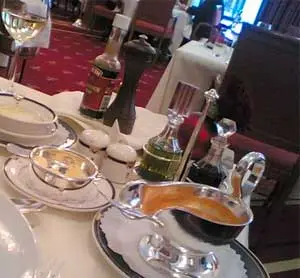
 Properly presented food not only stimulates the appetite but can also aid digestion. An appropriate table setting creates the comfort needed to enjoy a meal. For that reason, table service should include the dishes and utensils required for cold appetizers, first courses, second courses, desserts, hot beverages, pastries, and more.
Appetizers are served before the first course. Salads (vegetable, meat, fish) are placed on the table in salad bowls, with a tablespoon on top of the salad and a plate underneath the salad bowl. Herring is served on herring dishes, and caviar is presented in caviar dishes. Green onions served with caviar are presented on a glass plate. If a caviar dish is not available, grainy caviar can be served on a glass plate set in a salad bowl filled with crushed ice. Flat spatulas are provided for serving caviar onto plates. Red caviar, smoked salmon, and salmon are served on small plates, while ham, sausage, boiled fish, baked meats, poultry, and game are presented on larger platters. A fork and spoon should be placed on those platters or plates. Various sauces, sour cream, and vinegar with horseradish are served in sauceboats. Butter is served in butter dishes or on a plate. Canned goods in oil are served in their factory boxes on a plate, while those in marinade are served in salad bowls (without the boxes).
When there are many appetizers and not enough space on the table, serve cold fish appetizers first: caviar, lightly salted fish (such as salmon, smoked salmon, or trout), herring, canned fish, boiled fish (such as sturgeon or beluga), marinated fish, jellied fish, stuffed fish, and dishes like carp with honey. Next come cold meat appetizers: ham, sausage, suckling pig, pâté, tongue, poultry, game, and aspic. After the meat appetizers, present the vegetable, meat, or fish salads.
First courses — borscht, cabbage soup, other soups, and broths — are served after the appetizers in soup bowls with a ladle. Clear broths can also be served in broth cups (holding about 2 cups) with a dessert spoon. Serve sour cream in a sauceboat alongside borscht and cabbage soup, and provide pastries as well. For clear broths, serve pastries with appropriate fillings; pureed soups are accompanied by croutons. For okroshka, cold borscht, or other cold soups, finely crushed ice can be served in a salad bowl.
Second hot courses are served in the following order: fish dishes, meat dishes, poultry and game (roasts), then vegetables and greens. Keep that sequence unless one of the listed dishes is not being served. Present second courses on platters, with sauces in sauceboats.
Desserts — compotes, fruit jellies, mousses, gelatin, and ice cream — are served in dessert bowls or small dessert cups, filled just before serving. Provide dessert spoons for sweet dishes, and special spoons for ice cream. After dessert, serve black coffee and fruits if desired. Black coffee is brought in a coffee pot, poured into small cups, and presented on saucers with a small coffee spoon. Serve fruits in deep bowls or pyramid-shaped vases, or place them on dessert (appetizer) plates. Instead of black coffee, you may serve punch in punch bowls or pitchers; ladle punch into punch cups or dessert bowls with a special spoon.
Setting the Table: Dishes, Cutlery, and Food Arrangement
For each diner, place a small dinner plate on the table and set an appetizer plate on top. To the left of the plates, place a fork with the tines facing up. If fish dishes are served, add a second fork for fish to the left of the main fork. Place a bread plate for rolls and bread to the left of the forks.
On the right side of the plate, set a knife with the blade facing the plate, and place a spoon next to the knife with the bowl facing up. If fish knives are available, place them between the dinner knife and the spoon on the right side of the plate.
Place a napkin on top of the plates. You may lay a knife and fork on top of the napkin on the appetizer plate. Set plates and cutlery about 2 cm from the edge of the table. Arrange large platters with appetizers in the center of the table, with salad bowls and plates of other appetizers at the ends of the table.
Set salt, pepper, mustard, and vinegar in small containers or separate dishes. To decorate the center of the table, arrange fresh flowers in tall crystal or porcelain vases.
Setting the Tea Table
For tea, serve sugar, cakes, cookies, pastries, jam, candies, lemon, and cream. Present cakes, cookies, and pastries on flat platters. Cut cakes and serve them on dessert plates with spatulas, and serve cookies and pastries with tongs.
Serve jam in bowls and spoon it into small saucers with a dessert spoon. Present candies in bowls or boxes; provide tongs for unwrapped candies. Serve lemon on large plates, sliced thinly with the peel on, and use a special fork to take lemon from the plate.
Serve cream in a cream pitcher. Arrange platters of cakes, cookies, pastries, jam, and candies in the center of the table, with a sugar bowl, lemon, and cream pitcher between them. Place small stacks of saucers for jam in several spots. You can also serve fruits in deep bowls at the tea table.
In front of each person seated at the table, place a dessert plate with a dessert spoon.
