
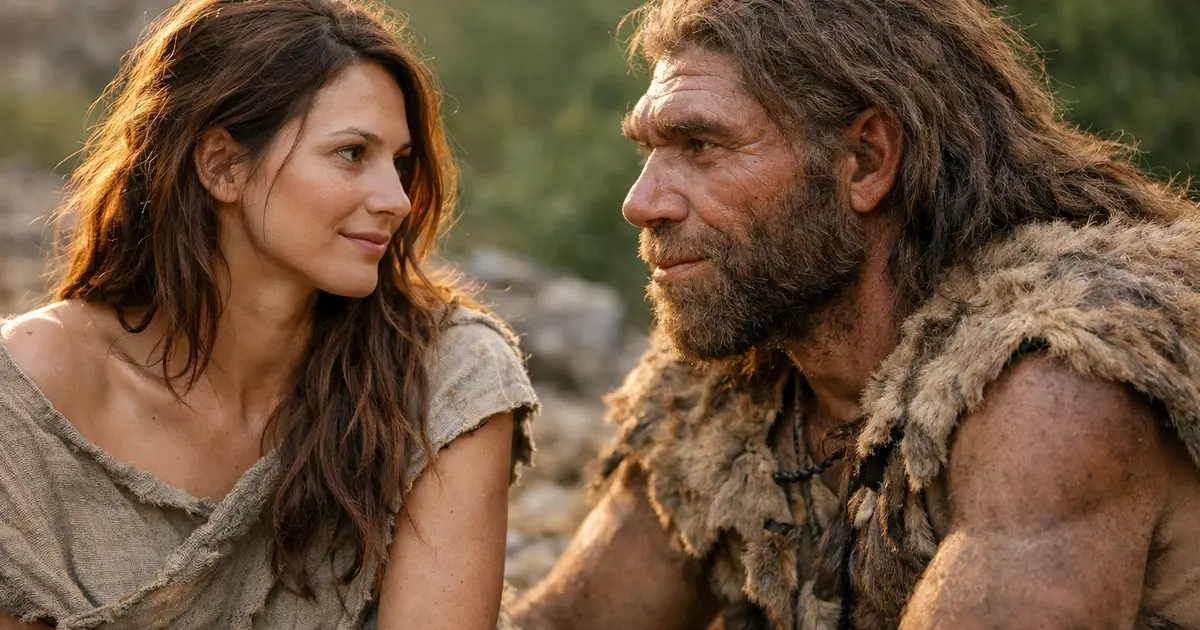
 A new genetic study has revealed that when began interbreeding with Neanderthals around 50,000 years ago, it was predominantly human women who paired with Neanderthal men.
According to a team of scientists led by Professor Alexander Platt, this mutual attraction between male Neanderthals and female Homo sapiens may explain the existence of so-called “Neanderthal deserts” in human chromosomes. These are regions in the modern human genome where Neanderthal genes are rarely found.
Thus, researchers have come to understand why contemporary humans have a relatively low level of Neanderthal genes. The team noted that most people of non-African descent today carry, on average, about 2 percent Neanderthal .
What did the research reveal?
Since the first genomes of modern humans and Neanderthals were sequenced over 20 years ago, scientists have been puzzled by the phenomenon of “Neanderthal deserts.”
Experts were baffled by the fact that the genes inherited from could only be found in tiny segments of our X chromosome, even though these genes are more prevalent in other chromosomes. Moreover, the X chromosome of modern humans contains areas completely devoid of Neanderthal genes.
“For many years, we assumed that these ‘Neanderthal deserts’ existed because certain Neanderthal genes were biologically toxic to humans (as is often the case during species divergence), so we thought these genes might cause health issues and were likely eliminated by natural selection,” Professor Platt explained.
However, during their research, the team concluded that the most plausible explanation for the “Neanderthal deserts” is actually partner preference—an evolutionary mechanism that plays a crucial role in sexual selection.
The scientists analyzed the genomes of 73 women from three modern African populations without Neanderthal ancestry and compared them to the genomes of several Neanderthals. Initially, the researchers examined the X chromosomes of Neanderthals and found a significantly higher number of modern human genes than in other Neanderthal chromosomes. This finding indicated that the absence of Neanderthal genes in the human X chromosome is not due to incompatibility, as reported by Live Science.
Rather, the surprisingly large number of modern human DNA fragments found in Neanderthals can be attributed to partner selection preferences, the researchers believe. Since females have two X chromosomes while males have only one, the preference for partners between female Homo sapiens and male Neanderthals means that fewer Neanderthal X chromosomes entered the human gene pool.
However, the reasons behind the mutual attraction between human women and Neanderthal men remain unclear to scientists.
As Professor Platt stated, his team plans to “explore the evolution of social structures and gender roles among Neanderthals” in hopes of ultimately unraveling this mystery.
The results of the study were published in the journal Science.