
 Artifacts from the Stone Age discovered in Germany have reshaped our understanding of the timeline of on our planet.
It turns out that around 43,000 years ago, long before the advent of writing, hunters and gatherers in what is now Europe developed a system of written signs. These prehistoric communication symbols are structurally very similar to the earliest form of proto-cuneiform created by the Sumerians in Mesopotamia around 3500 B.C.
The images carved by European on Paleolithic objects were not random marks; they represented a coherent system for conveying information through symbols.
What Did Researchers Discover?
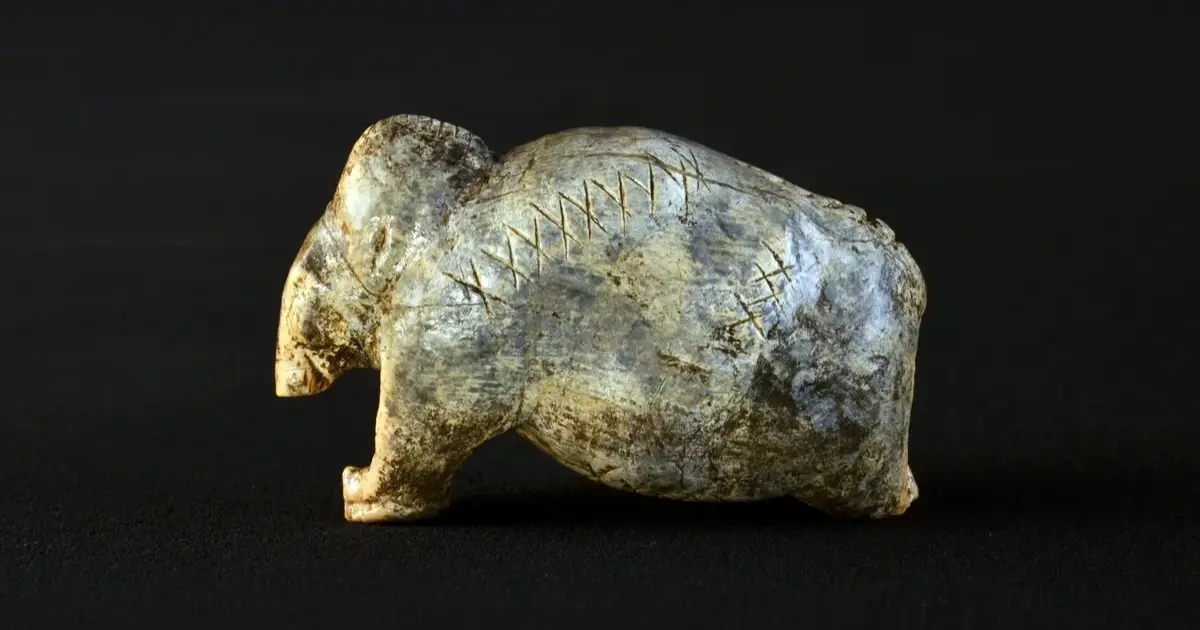
Using computational methods, a team of German scientists studied over 3,000 signs engraved on 260 individual artifacts from the Aurignacian culture, which existed between 43,000 and 34,000 years ago and was associated with the first modern humans to reach Central Europe. Many of these relics, including figurines of humans and animals as well as stone tools, were excavated in the Swabian Alps.
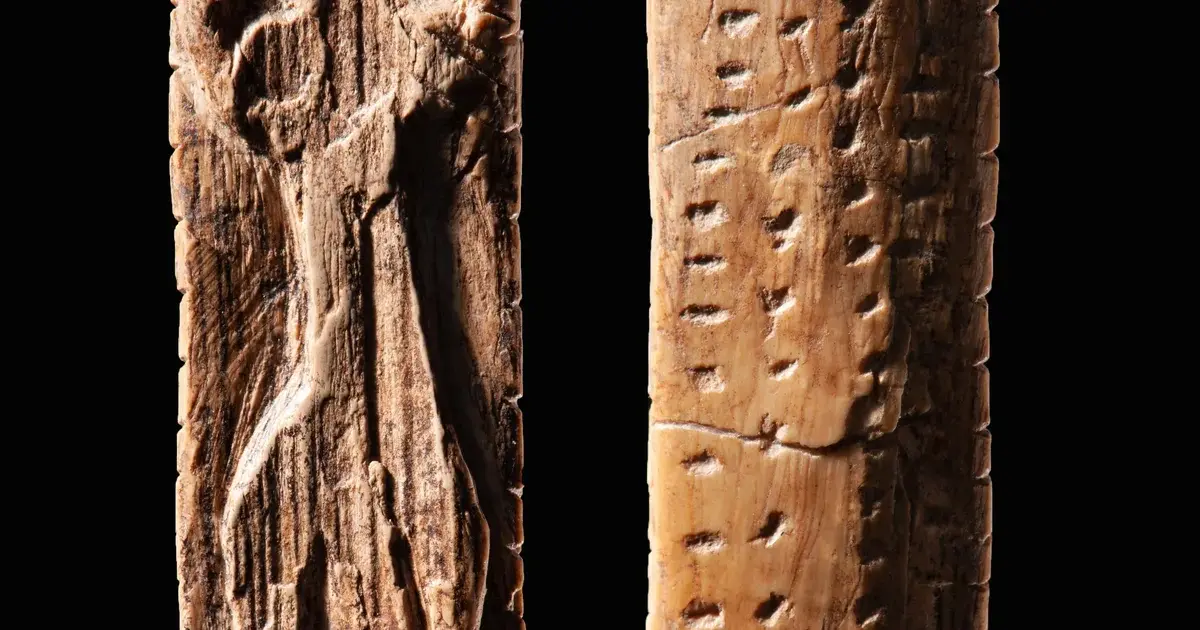
On most of the objects, researchers observed repeating patterns of crosses, lines, dots, and notches. While they have yet to decipher the exact meanings of these symbols, they noted certain patterns.
Co-author of the study, Christian Benz from Saarland University, told IFLScience that crosses appeared on images (figurines) of animals, particularly mammoths and horses, but were absent from images of humans. This suggests that crosses are “somehow associated with animals, not with people,” he said.
“On the other hand, we see that dots are associated with humans and lions, but not with other animals or tools,” Benz noted. This is clearly demonstrated by a statuette of a lion-human hybrid made from mammoth tusk, which is adorned with a series of dots.
This dotted decoration was linked to lions but could also pertain to humans, added co-author Eva Dutkevich from the Museum of Prehistory and Early History in Berlin.
By analyzing the frequency of repetitions and the predictability of the order of signs, the team determined the information density of the Aurignacian communication system. The researchers concluded that the arrangement of symbols in this system is incomparable to recognized forms of written language, except perhaps for the proto-cuneiform of the Sumerians.
“The information density in these signs almost perfectly matched that of early proto-cuneiform. At first, I thought it was a mistake because there are 40,000 years between these two systems,” Benz remarked. However, he noted that upon reviewing the data and studying the sequences and materials, it becomes clear that, given the structure, “essentially, they are the same.”
According to the scientists, the Aurignacian (quite traditional) system of signs may have been used for about 10,000 years before it disappeared. It was then re-developed by the Sumerians thousands of years later, ultimately evolving into a complex written language.
Benz stated that the inventors of this Paleolithic writing “demonstrated that they could have created a true writing system if their social context had required it.”
“But they did not develop writing, likely because, as hunter-gatherers, they did not need it,” he said.
The findings of the study were published in the journal Proceedings of the National Academy of Sciences.