
 A team of archaeologists from the University of Aberdeen, the Francis Crick Institute (UK), and Stockholm University (Sweden) has explored the Stora-Fervar cave on the Swedish island of Stora Karlsö in the Baltic Sea. During the Stone and Bronze Ages, this cave served as a refuge for fishermen and seal hunters.
A surprising discovery for the researchers was the finding of wolf remains, dated between 3000 and 5000 years ago, indicating that these predators coexisted with humans. Notably, the team found no evidence of other terrestrial mammals existing on Stora Karlsö, as reported by Independent.
This isolated island covers only 2.5 square kilometers. Researchers believe that wolves were brought here by humans, likely by sea.
Of course, humans had already long before this period, specifically between 40,000 and 15,000 years ago. It has long been known that domestic dogs descended from Stone Age wolves and were the first domesticated animals in the world. However, the exact locations and instances of domestication remain unclear. Moreover, scientists have yet to uncover the remains of the earliest domesticated dogs.
One leading theory suggests that wolves gradually adapted to living alongside humans, while another posits that people raised wolf pups from a young age.
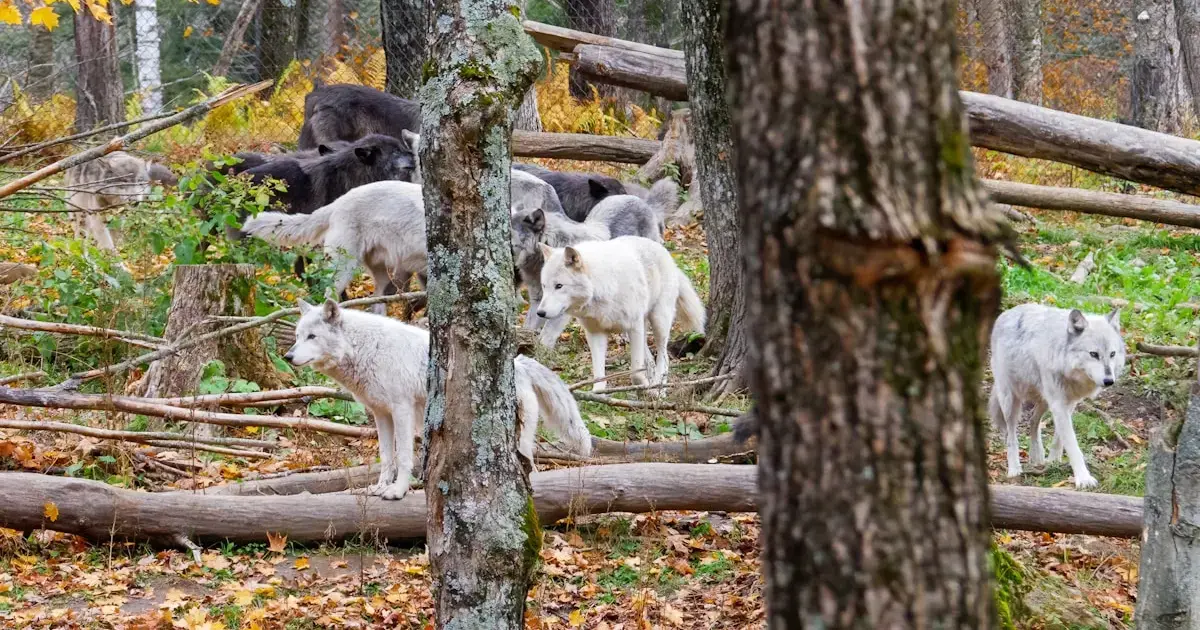
Why did archaeologists propose this theory?
On the Baltic island, researchers gathered evidence suggesting that wolves and humans lived together. This raises the possibility of early domestication of wolves in prehistoric times.
DNA analysis of the bones found in the cave confirmed that they were indeed wolves, not dogs. One of the wolves appeared to have survived after sustaining a limb injury, making hunting difficult. It is likely that humans cared for it.
“The discovery of these wolves on a remote island is completely unexpected. They were not only similar to other Eurasian wolves but likely lived alongside humans, fed on human food, and resided in a place that could only be reached by boat,” noted study co-author Linus Girdland-Flink.
While the fossilized bones did not clarify whether the wolves were domesticated or kept in captivity, the findings suggest that the relationship between humans and wolves was much more complex than previously thought.
According to the researchers, the interaction between humans and wolves in the cave likely involved close cooperation, indicating early experiments in the domestication of these predators.
“Although we cannot rule out that the low genetic variability of these wolves was due to natural causes, the data indicate that humans interacted with wolves and managed their population in ways we had not previously considered,” said study co-author Anders Bergström.
“This provocative case raises questions about whether humans could have kept wolves in their settlements under certain conditions and benefited from it,” added Pontus Skoglund, another author of the study.
The research findings were published in the journal PNAS.
Photo: Unsplash