
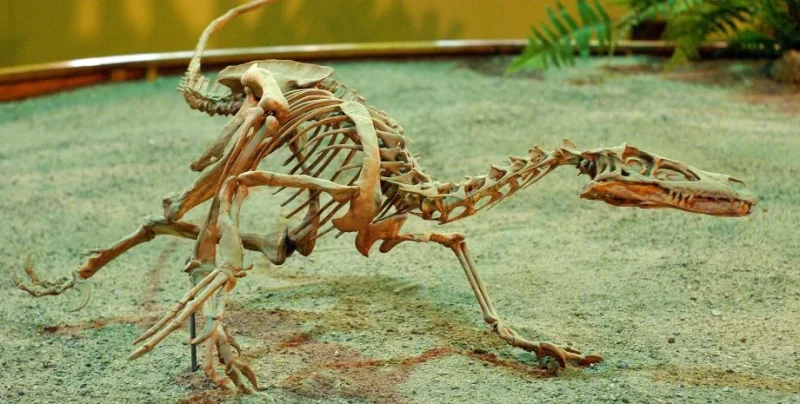
A Chinese-Australian team of paleontologists discovered 12 two-toed footprints in Fujian Province in southeastern China. The prints fell into two morphological groups based on size and shape. The smaller prints measured about 11 centimeters and were assigned to the previously known ichnogenus Velociraptorichnus. The larger prints, about 36 centimeters long, were attributed to a previously undescribed ichnospecies named Fujianipus yingliangi, and linked to troodontid dinosaurs (family Troodontidae). This family existed during the Jurassic and Cretaceous periods. The scientists were particularly surprised by the larger footprints. Until recently, researchers thought the biggest troodontids reached only about 2.5 meters in length. Some of the smallest paravians, such as anchiornithids, weighed just 100 grams. Based on the size of the new prints, troodontids could have reached lengths of up to 5 meters, with legs about 1.8 meters long.
“When people think of predatory dinosaurs, they likely picture the ones from the movie ‘Jurassic Park’ — muscular, aggressive, human-sized hunters,” said paleontologist Anthony Romilio of the University of Queensland. “But these footprints were left by a much more delicate and intelligent member of the troodontid family, which emerged in the Late Jurassic and persisted into the Cretaceous, roughly 95 million years ago,” he said. He added that this predator was much larger than the troodontids shown in Spielberg’s film. It’s frightening to imagine it charging at full speed.
The team compared the prints with those of other known two-toed dinosaurs from Asia, North America, South America, and Europe. Paleontologists found the shape and proportions of these prints were distinct from other known two-toed footprints, making them unique. “The concept of large troodontids has only recently emerged in the paleontological community,” Romilio said. “Bones found in Alaska suggest a trend toward gigantism near the ancient Arctic Circle, an area that may have had less species competition because of long winter darkness,” he added. However, the study’s findings indicate these giant predators migrated much further south and were more widely dispersed.
Romilio also noted some members of the team worked on what may be the smallest dinosaur footprints in the world, found in South Korea — just one centimeter long, according to Sci.News. “All of this demonstrates the incredible range of sizes among predatory dinosaurs, highlighting their adaptability and ecological diversity,” Romilio concluded. The findings were published in the journal iScience.