
In a small pond in Madison, Wisconsin, a pair of sandhill cranes (Antigone canadensis) is raising not only their own chick but also a gosling hatched from a Canada goose (Branta canadensis). It’s a charming sight: the crane couple strides purposefully through the marsh, followed by their russet offspring and a plump, yellow-feathered gosling. Ornithologists say this is only the third confirmed case of such interspecies adoption. In 2011, a Canada goose was observed living near a crane and behaving like one. In 2019, interspecies adoption was documented in Michigan, and just recently, in 2024, it happened in Madison.

These occurrences are not coincidental, according to Ann Lacy of the International Crane Foundation. Populations of sandhill cranes and Canada geese have rebounded in recent decades. Like foxes and coyotes, these birds are increasingly moving into urban and suburban landscapes. That shift has led to closer interactions between species, as noted by Smithsonian Magazine. How the gosling ended up in the crane family remains a topic of debate. Some experts and photographers believe a Canada goose may have laid an egg in the crane’s nest. Others suggest the cranes might have taken over a goose nest containing an egg after spring floods washed away their own nest. But one thing is clear: when the gosling hatched, it imprinted on the cranes and now walks alongside them as if they were its parents.
Local photographer Marjorie Ryan was among the first to spot this unusual family. What struck her most was the affectionate behavior of the crane father toward the adopted gosling: “He seemed very loving.” It was a touching scene: the crane with its long legs gently tended the fluffy yellow ball beside it.
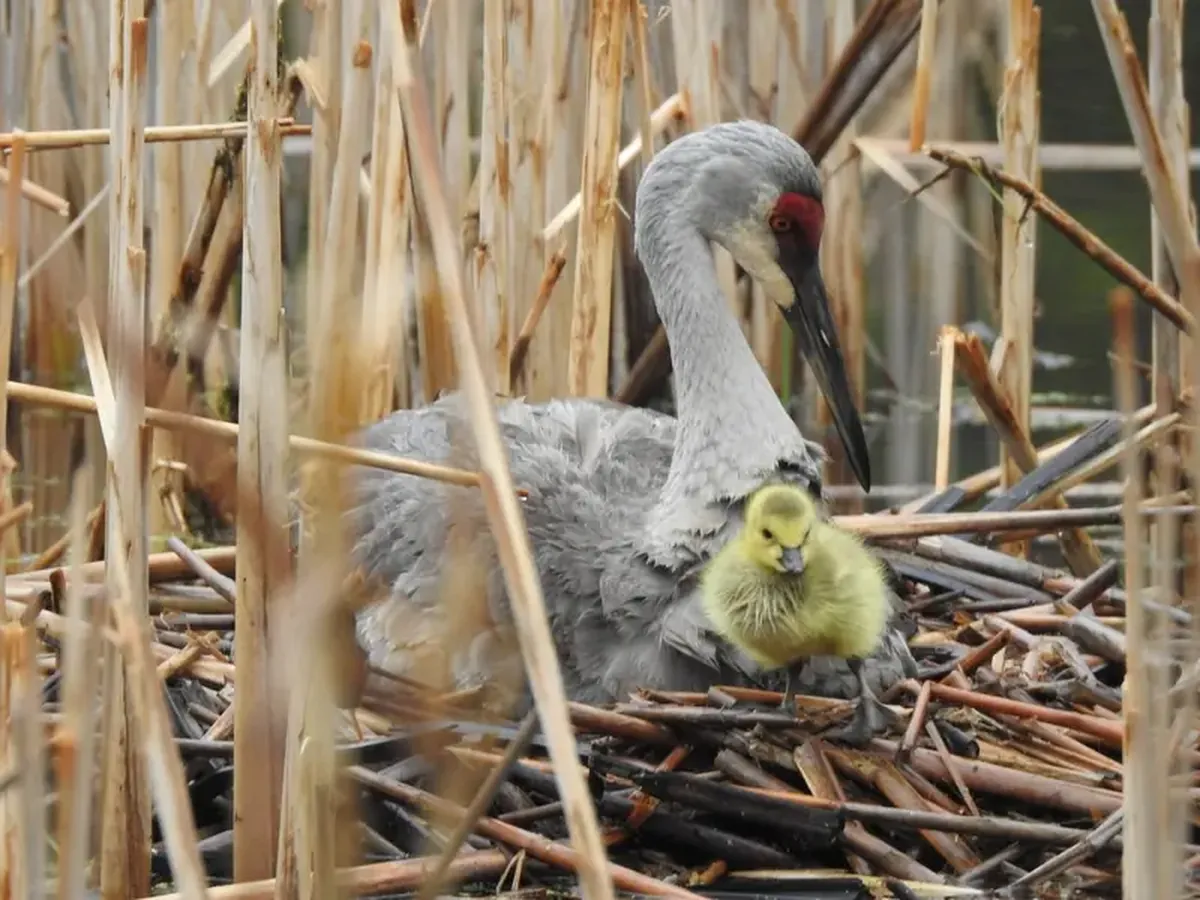
Numerous observers have seen other geese approaching the crane family repeatedly. The geese would circle above the nest, honking loudly and even swooping down at the pair. However, when other geese got too close, “Dad would chase them away with his powerful wings,” recounts photographer Alan Ginsberg, who witnessed several of these confrontations. Ornithologists worry that the gosling’s future could be complicated. Sandhill cranes and Canada geese differ significantly in diet, behavior, and migration strategies. Sandhill cranes are omnivorous, while Canada geese are primarily herbivores. “When I first heard about this last year, I had real concerns about the gosling. These birds have completely different diets,” says Lacy.
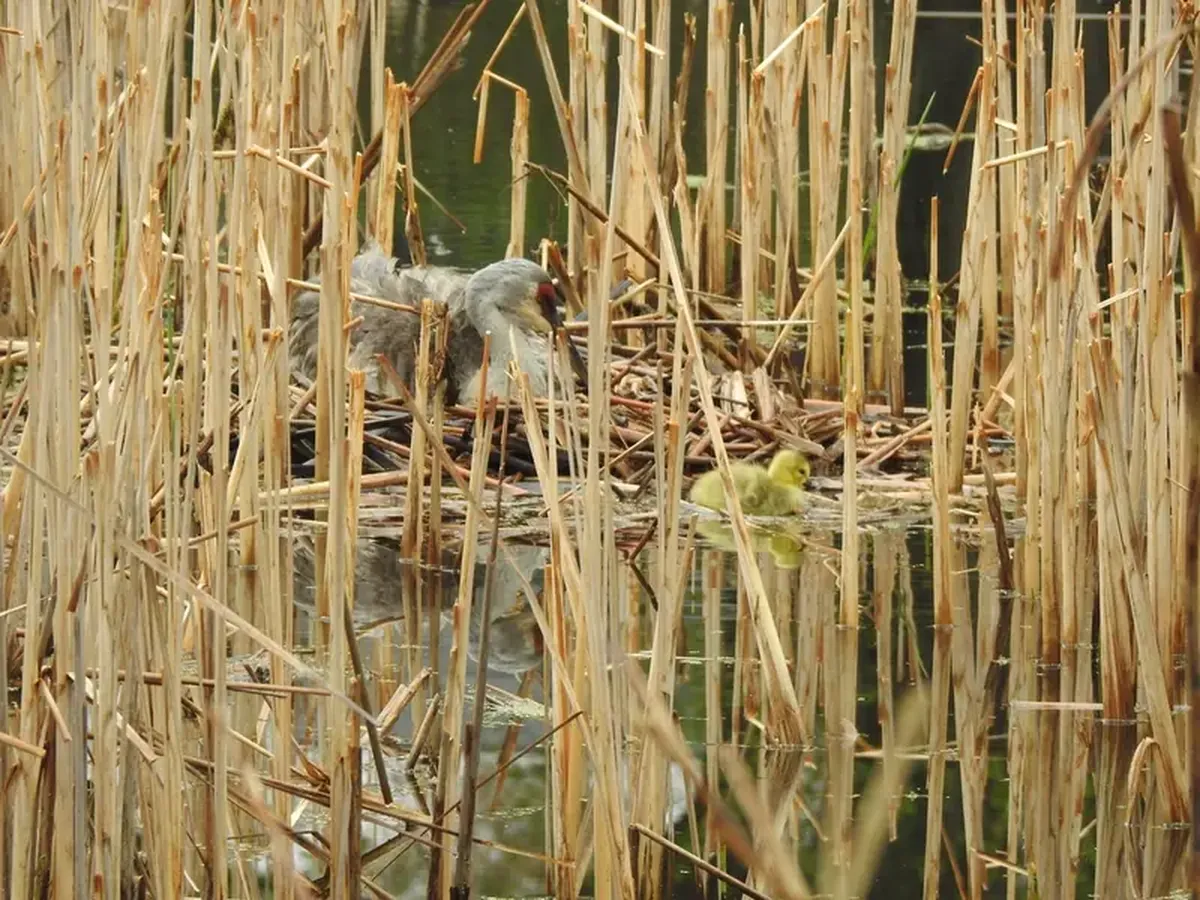
As the gosling grows, migration presents another challenge, says Michael Ward, an ornithologist at the University of Illinois Urbana-Champaign. Sandhill cranes often fly at altitudes around 1.5 kilometers — so high they are barely visible — while Canada geese typically migrate at altitudes between 300 and 900 meters or lower. Canada geese often leave Wisconsin in September, while sandhill cranes usually begin migrating in October or November, after the first cold snap. “It’s possible that the adopted gosling could migrate with the cranes. However, it’s likely to face physiological challenges,” Ward notes. Whether the gosling will survive to adulthood and attempt migration remains uncertain. Although the crane parents are vigilant over their young, the chicks face constant risks. The greatest threat comes from ground predators such as raccoons, foxes, and coyotes, especially early in the morning or in the evening when the parents go out foraging, Lacy explains. Still, while a gosling raised by cranes may have lower survival odds, there is reason for hope, Ward adds. He believes the chick is not necessarily doomed to an early death: it may eventually rejoin a flock of geese. Lacy shares that view: “The bird could join a flock of geese.”