
 In Hasankeyf, one of the most historically significant cities in Anatolia, have made a rare discovery. As part of the “Heritage for the Future” project, researchers uncovered a unique ivory ring that belonged to an archer from the Artuqid dynasty, dating back to the 12th–13th centuries.
Archers wore rings called “zihgir” on their thumbs to protect them from cuts caused by the taut bowstring.
What should you know about this discovery and its context?
Hasankeyf, located in southeastern Turkey at the crossroads of Mesopotamia, has been an important center of trade, culture, and defense for centuries. Surrounded by steep cliffs and a river valley, the city thrived for about 12,000 years under Roman, Byzantine, Artuqid, Ayyubid, and Ottoman civilizations. The stunning landscape of Hasankeyf, with its bridges, palaces, mosques, and rock-cut dwellings, reflects its long and complex history.
During the Artuqid dynasty, the city became a political and cultural capital. This recent discovery further confirms Hasankeyf’s role as a center of artistic creativity in the medieval Islamic world.
Archaeologists found the zihgir during excavations in the southeastern corner of the Great Palace, a building closely associated with the rulers of the Artuqid dynasty. The work was conducted by an interdisciplinary team of scholars led by Dr. Zekai Erdal from Mardin Artuklu University.
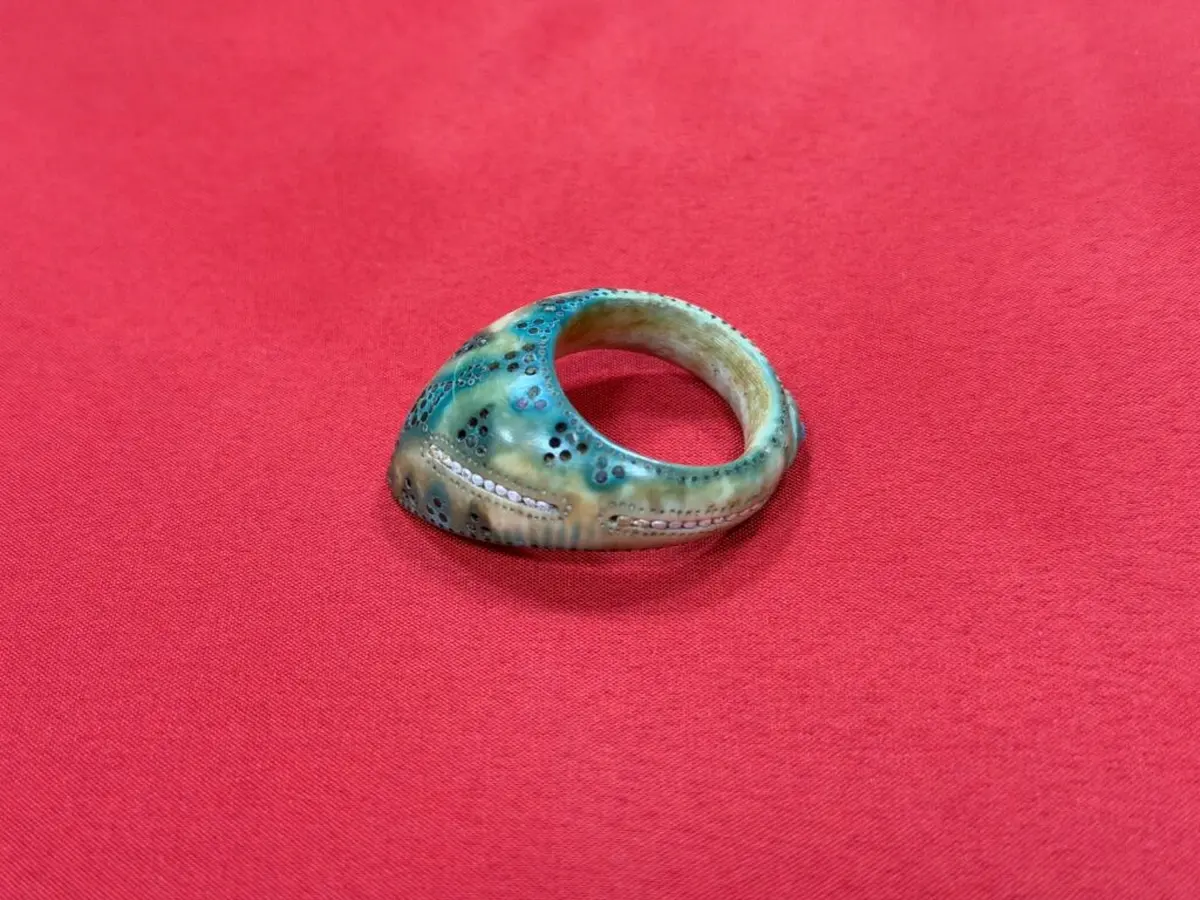
, found at the intersection of the palace walls, likely belonged to a high-ranking court official. At that time, ivory was a rare and expensive material, typically used to create luxury items that symbolized power and prestige, as reported by Arkeonews.
The discovered zihgir was inlaid with pearls and turquoise, adorned with silver elements. The artisan arranged small pearls in rows and set a turquoise stone in a diamond-shaped insert. At the center, an exquisite silver pattern crowned the composition.
In medieval Turkic and Islamic societies, archery was not only a military skill but also a mark of noble lineage. The ornate ring indicated the special status of the archer.
The intricate decoration of the zihgir from Hasankeyf compellingly suggests that it belonged to a member of the Artuqid dynasty or someone from the immediate circle of the rulers. Researchers believe that such an item was likely intended for ceremonial use rather than for the archers’ battles.
Comparative studies have shown that no other Islamic zihgirs inlaid with pearls have been discovered to date. Therefore, this archer’s ring is a unique artifact.