
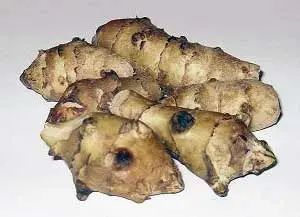
 Jerusalem Artichoke
The Jerusalem artichoke, also known as the sunchoke, originates in North America — which is where the “sunchoke” name comes from. In Ukraine, it has become popular as both a garden vegetable and an ornamental plant. Locally, it is referred to as “bulb,” “Valakhian turnip,” or simply “turnip.”
The Jerusalem artichoke is a perennial plant in the sunflower family. Its upright stem can reach heights of 6 to 10 feet (2 to 3 meters) and becomes semi-woody as it matures. The leaves have petioles, are pointed, and are densely hairy. Some years it produces light-yellow flowers in clusters. Its root system penetrates deeply into the soil and forms tubers that can be white, pink, or brown. These tubers may be round, pear-shaped, or elongated. The plant is cultivated primarily for its tubers, which have a nutritional profile similar to that of potatoes. Instead of starch, it stores inulin, a carbohydrate that can be a useful ingredient for people with diabetes.
Jerusalem artichokes are not picky about soil. They thrive in black soil, sod-podzolic soil, and sandy soils. They are cold-hardy, able to withstand frosts down to 23°F (-5°C) in spring and fall, and they overwinter well in the ground.
Plant in spring or fall in clusters spaced 60×60 cm in Polissya, 70×70 cm in the Forest-Steppe, and 80×80 cm in the Steppe, at a depth of 3–4 inches (7–8 cm), placing two tubers per cluster. After planting and once shoots appear, harrow the area and loosen the spaces between rows several times. Harvest tubers in the fall and store them in vegetable storage facilities or in heaps. For spring use, dig them up after the soil thaws. Tubers left in the ground over winter become tastier and sweeter by spring. They can reportedly grow in the same spot for up to a hundred years. Yields vary by region and growing conditions, ranging from 4,000 to 6,700 pounds (180–300 centners) per hectare.
The stems of the Jerusalem artichoke also provide nutritious feed for livestock.