
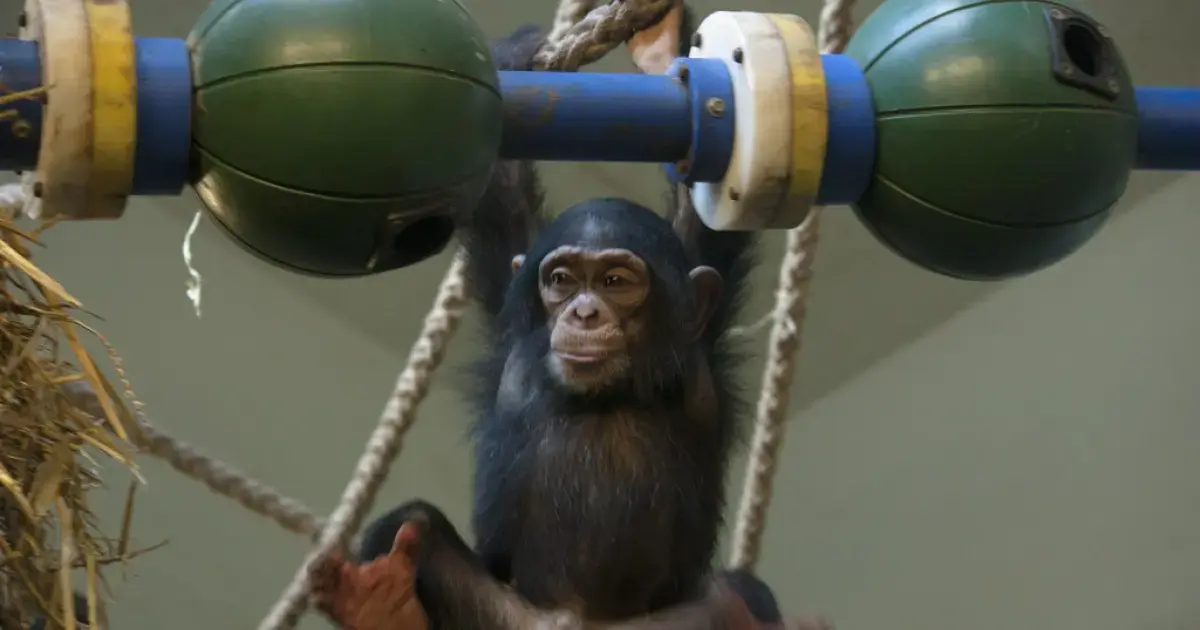
 For instance, baby enjoy free-falling from trees. Given the numerous similarities between humans and chimpanzees, it’s reasonable to assume that both species are equally prone to risky behavior within the same age range. However, while humans often indulge in risky antics during their teenage years, this tendency is characteristic of chimpanzee infants, specifically those aged from birth to five years, as explained by Popular Science.
After studying video footage of 119 wild chimpanzees, the research team observed that risky behavior peaks during childhood and then declines as the animals mature. The scientists documented that infants engage in risky actions three times more often, teenagers 2.5 times more often, and young adults 2.1 times more often than adults.
Thus, one of the main conclusions of the study is that baby chimpanzees are more inclined to embrace than teenagers and young adults. “This is not observed in humans,” noted Lauren Sarringhaus, the lead author of the study.
Her team also pointed out that the chimpanzees’ behavior was not influenced by gender or height in the trees. In other words, the likelihood of engaging in risky stunts was the same for both male and female infants at any height.
The researchers noted that one of the most popular forms of reckless behavior among young chimpanzees was free-falling, where they intentionally dropped from a branch or jumped from one branch to another without support. Naturally, the risk of free-falling comes with a high probability of injury.
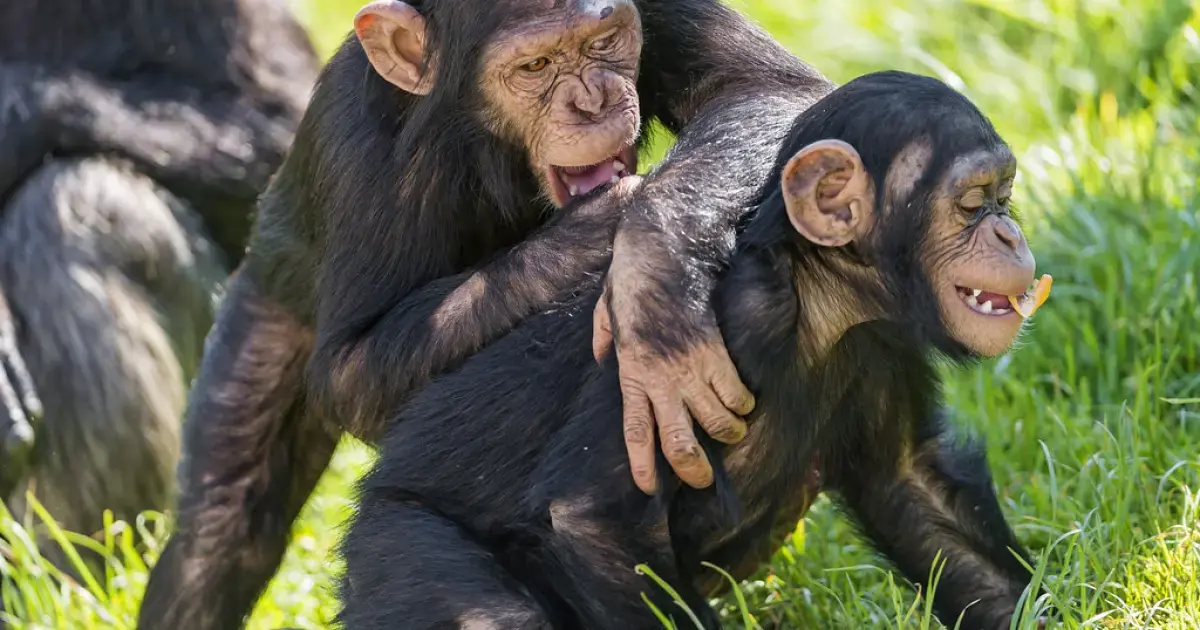
How Do the Risk-Taking Behaviors of Chimpanzee Kids Differ from Those of Humans?
Studying risky physical behavior in humans is more challenging than in chimpanzees. Nevertheless, previous research based on observations or survey data has shown that such daring actions are typically not repeated by human in adulthood.
The new study highlighted another difference in the approach to risk between humans and chimpanzees. While mother chimpanzees can curb this behavior in their offspring as long as they are physically present, human parents tend to monitor their children for a much longer time. However, scientists believe that if humans did not practice such prolonged supervision, their risky behavior would not be postponed until adolescence but would occur earlier.
According to previous research findings, play helps chimpanzees not only develop motor skills but also understand the consequences of risky behavior.
As biologists explained, baby chimpanzees often engage in risky actions during play to acquire the physical skills and confidence necessary for life in the trees. After all, an adult animal’s self-awareness largely depends on the experiences gained in early childhood.
The results of the study were published in the journal iScience.