
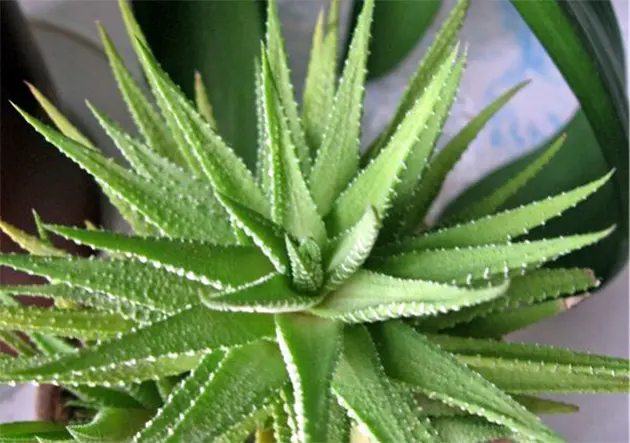
The healing properties of aloe (also called sabur) date back to the Egyptian pharaohs. People used its leaves on severe burns, stubborn ulcers, and wounds. Don’t forget the old remedy: if you get burned, mix aloe juice with an equal amount of honey and apply it to the burn as often as possible — it speeds healing. If you prick your finger and an abscess forms, try this: wash a leaf, cut it open, press it against the wound, cover with compress paper, and bandage. After a few hours the abscess may come to a head; keep the bandage on for about 12–14 hours to allow drainage and promote healing.
For poor digestion and to help regulate the menstrual cycle, take 8–10 drops of aloe juice twice a day.
Here’s a recipe used for chronic colitis and constipation: chop 150 grams of aloe leaves and pour 300 grams of hot (not boiling) honey over them. Let it steep for a day. Strain, warm the mixture, and take 5–10 grams an hour before breakfast. Remember: do not take aloe juice internally during pregnancy or if you have liver or gallbladder disease, hemorrhoids, cystitis, or uterine bleeding. The aloe emulsion sold in pharmacies is used to prevent and treat skin lesions caused by radiation sickness.
American agave looks similar to aloe, and some people believe they share healing properties. Still, be cautious about consuming agave: its chemical makeup isn’t fully understood. Agave juice can act faster and more powerfully than aloe but may cause mild inflammation in people with sensitive skin. Use leaves only from plants at least three years old. Between the two common types — dark green leaves and light green leaves with white edges — the light-green, white-edged variety is better for treatment. For sciatica, cut the leaves and apply them to the painful area for 2–3 hours before bedtime.
To remove warts, try euphorbia. Cut a stem and apply the sap to the wart, washing it off after 20–30 minutes. Repeat two to three times a day. Be careful: euphorbia sap is highly toxic, so wash your hands thoroughly after handling it.
Ivy is a common houseplant with several folk uses. Externally, its leaves have been applied to calluses, warts, infected wounds, and burns. Bulgarian researchers recommend a cold infusion of ivy leaves for gout and rheumatism: to make it, steep half a teaspoon of chopped leaves in a cup of cold water for eight hours, strain, and take a tablespoon four to five times a day for a week.
Tradescantia brightens a room with lush, drooping stems and pointed leaves. If it doesn’t get enough water, some stems will dry out — but don’t throw them away. Chop about 5 grams of stems, pour a cup of boiling water over them, steep for 30 minutes, and drink the infusion in three doses across the day. Swedish physicians have observed that the infusion contains many biostimulants and may support the liver, spleen, and bone marrow.
Crimson geraniums are classic windowsill plants; one variety is the blood-red geranium. Its rhizome has been used for bronchitis, pulmonary tuberculosis, diarrhea, and dysentery. To prepare an infusion, steep two teaspoons of chopped rhizome in two cups of cold water for eight hours, strain, and sip it throughout the day. For nosebleeds, use tampons soaked in this infusion. Apply compresses of the rhizome infusion to eczema, other skin conditions, burns, and inflamed joints. For the early stages of a runny nose, put 1–3 drops of geranium leaf juice into each nostril three to five times a day.
Physalis is a striking plant: its leafy stems bear orange papery lanterns that enclose bright red berries. The fruits have been used as a diuretic for kidney stones, bladder problems, urinary inflammation, dropsy, gout, and joint rheumatism. To make a decoction, boil 15–20 dried fruits in 0.5 liters of water for 5–7 minutes and sip the liquid in small sips over two days. Or eat 10–15 fresh berries. But beware: the lantern itself is toxic.
Our windowsill garden can be surprisingly useful. Use your window space wisely. When choosing plants, start with first-aid varieties — aloe, agave, cyclamen — before adding others.