
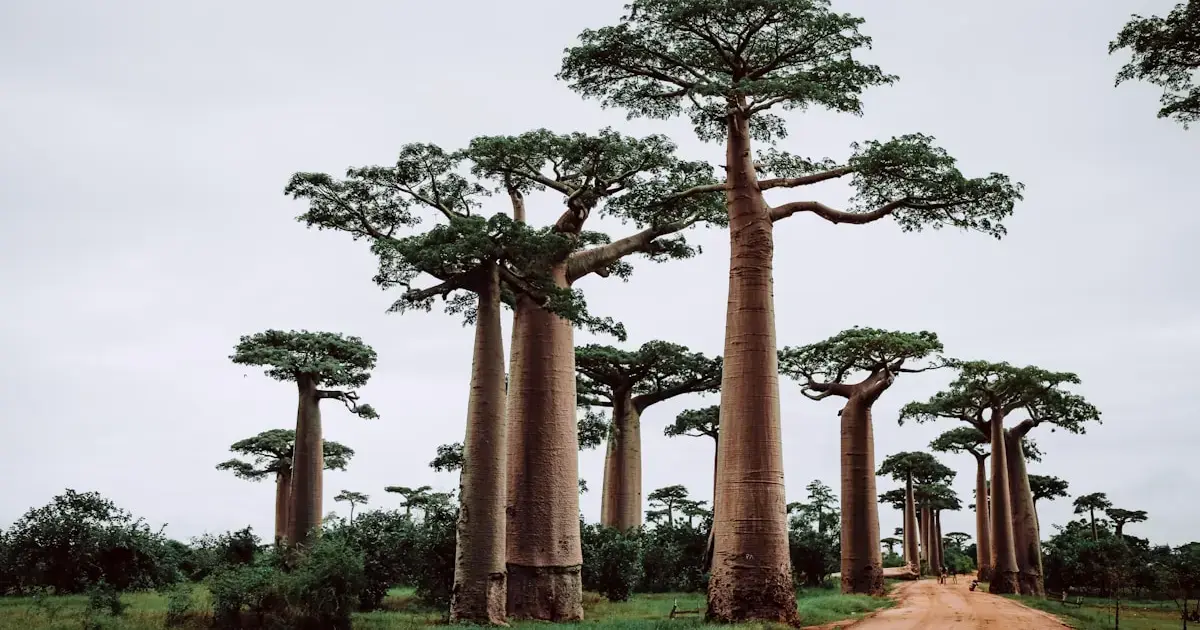
 The Avenue of the Baobabs is the first natural monument of , often referred to as the “Mother of the Forest.” These trees, which are around 800 years old, resemble titans holding up the sky. They are remnants of the dense tropical forest that once covered the entire island.
Giants Crying Out for Protection
The Avenue of the Baobabs is a 260-meter stretch of dirt road between Morondava and Belon’i Tsiribihina, two towns located in the Menabe region, near the island’s western coast. Along this stretch, more than twenty Grandidier’s baobabs (Adansonia grandidieri) grow—one of the six endemic species of baobabs found in Madagascar. An additional 25 trees of this species are scattered nearby, among rice fields and meadows, as reported by Live Science.
Facing the threat of extinction, Grandidier’s baobabs have been listed as natural monuments by the government of Madagascar. These trees typically reach a width of three meters and can grow up to 24 meters tall. The largest recorded specimen stood 30 meters high and measured 11 meters in diameter, according to the University of California, Davis’s Department of Plant Sciences.
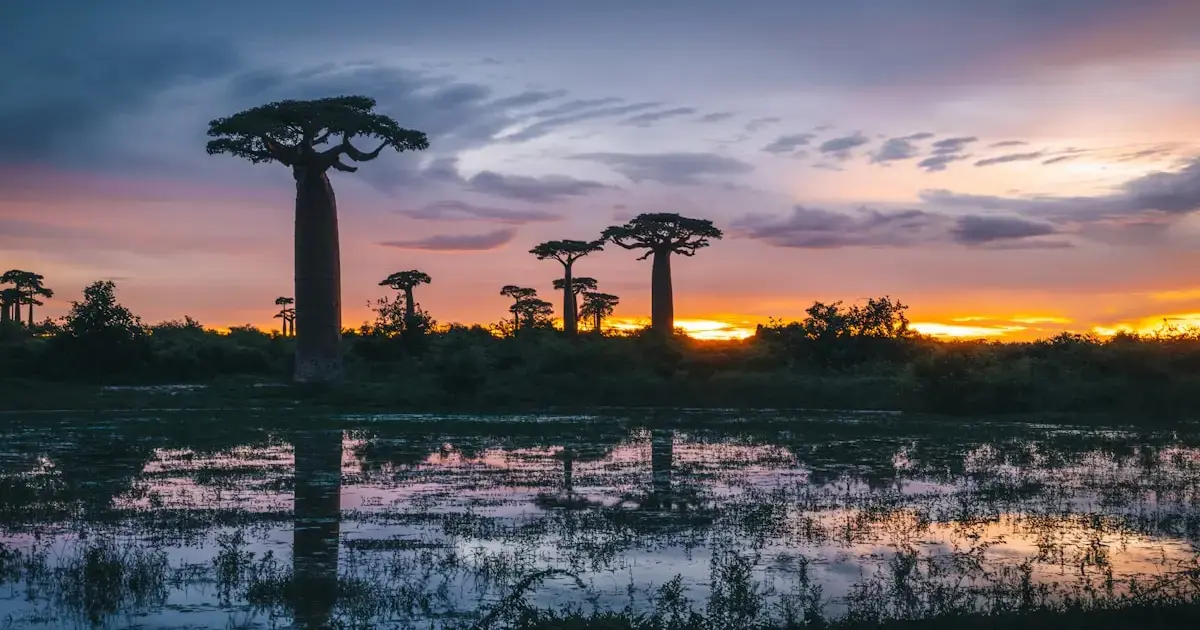
Scientists from the Baobab Foundation explained that the large trunks of Grandidier’s baobabs store water. However, if a hole is drilled into the tree, water does not gush out, as the baobab retains it within its cells to grow new leaves and maintain its structure.
A 2024 study revealed that baobabs appeared in Madagascar between 41 and 21 million years ago. Most species of baobabs still grow exclusively in Madagascar today. However, two species—A. digitata and A. Gregorii—are found in continental Africa and Australia, respectively. It remains unclear how baobabs reached these locations, but scientists speculate that the fruits may have been carried across oceans by currents or transported by humans.
The legendary trees of the Avenue of the Baobabs are called “renala” (or “reniala”), which means “mother of the forest.” Thousands of years ago, they thrived in a dense tropical forest, but they have become isolated only recently.
It’s no surprise that baobabs hold a revered place in Malagasy culture. These trees feature prominently in local legends, such as “The Lovers Baobabs,” which tells the story of two intertwined baobabs that grew together near the avenue, symbolizing eternal love.
Today, Madagascar’s baobabs are crying out for protection: due to illegal logging, wildfires, and the climate crisis, these majestic trees are becoming increasingly rare.