
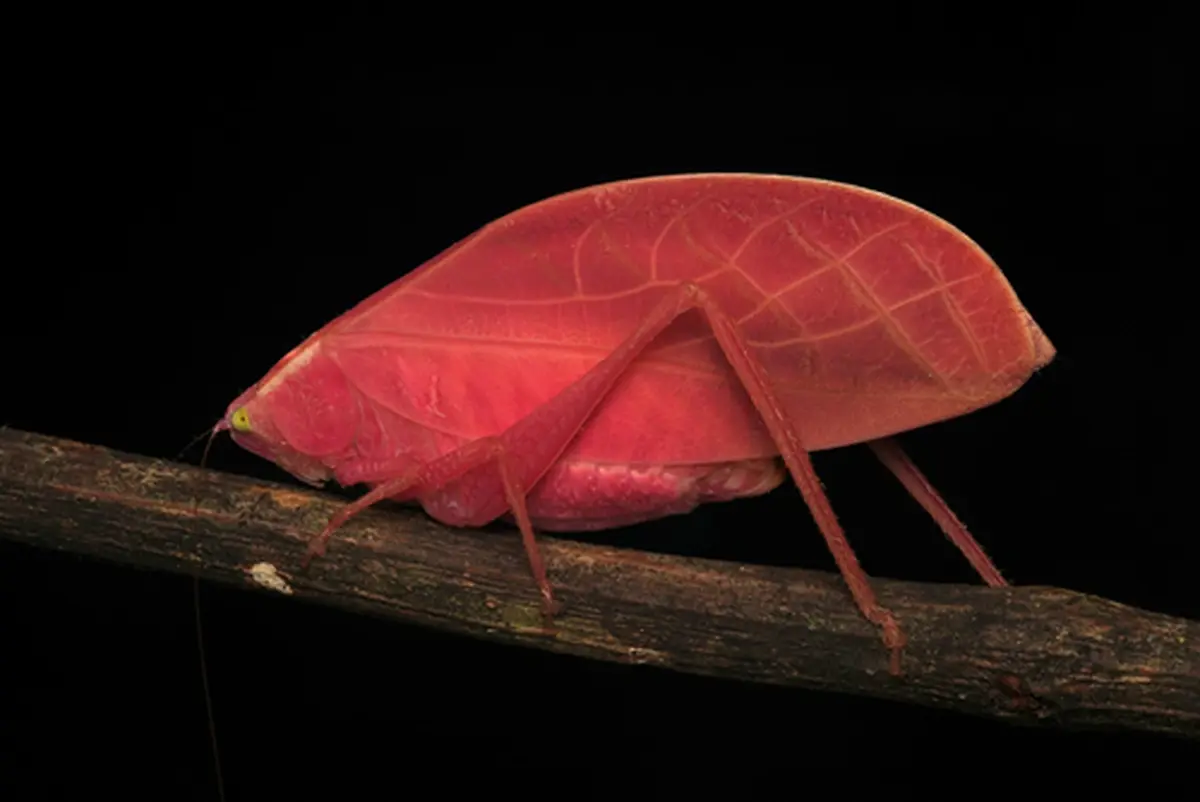
 Arota festae grasshoppers play by their own rules. Eleven days after hatching, these wild little insects start using a very unusual survival strategy.
When you hear the name ” that mimics a leaf,” or the nickname “bush cricket,” you probably picture something as green as fresh grass. And you’re almost always right. Though some Arota festae individuals will surprise you with a bright pink color.
Instead of writing that off as failed camouflage, Scottish researchers at the University of St Andrews who watched this insect decided it had evolved an original way to blend into its surroundings.
The scientists found the odd specimen at the field station of the Smithsonian Tropical Research Institute on Barro Colorado Island in Panama. “Because it was so rare, we kept it in natural conditions and found that it changes color from bright pink to green,” said Dr. Benito Wainwright, lead author of the study.
Eleven days after they found the hopper, its coloring matched the other members of its species.
Resemblance to an ordinary leaf is a common survival strategy. It appears across many branches of the insect family tree, including hundreds of grasshopper species that often look like tree leaves and are green or brown.
Still, naturalists have reported pink grasshoppers since at least 1878. Usually, that coloring was explained as a so-called “nonadaptive mutation,” similar to albinism in insects.
Wainwright and his colleagues questioned that idea. They caught and photographed the grasshopper throughout its transformation and watched it mate successfully after it took on the typical color for its species. In the end, the team concluded that earlier studies had been mistaken and published their arguments about this in the journal Ecology.
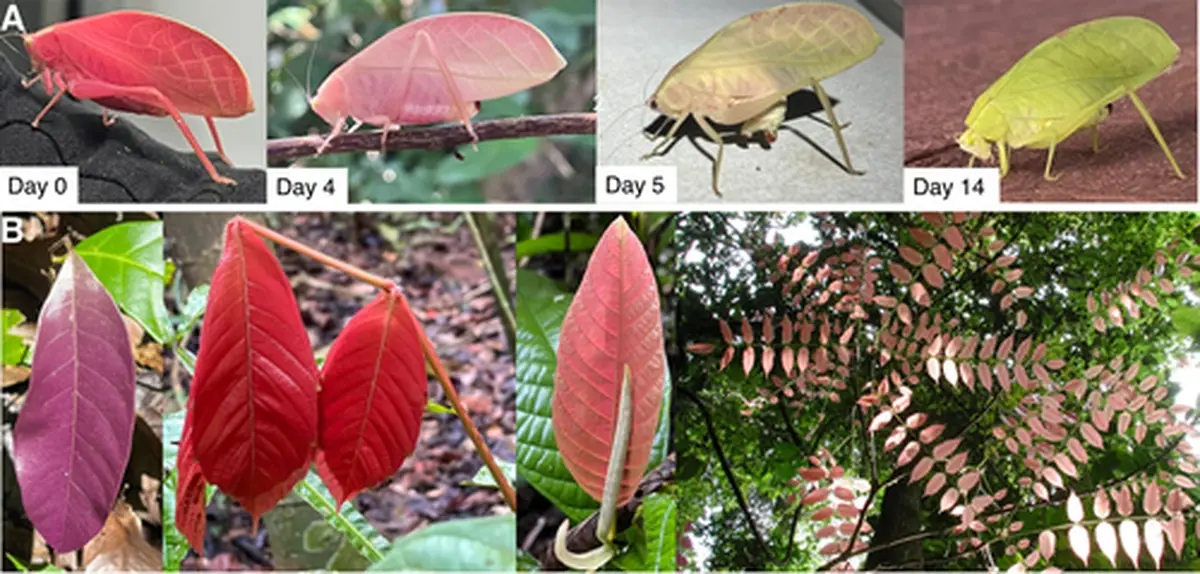
Why the pink grasshopper turned green
“This could be a finely tuned strategy tied to the life cycle of tropical forest leaves that the insect tries to resemble,” Wainwright said.
American poet Robert Frost wrote, “Nature’s first green is gold.” If he had lived in Panama, his line might read, “Nature’s first green would be pink,” because many tropical leaves start out pink or red and then gradually turn green as chlorophyll kicks in.
Wainwright and his colleagues observed that 36 percent of the plant species growing on Barro Colorado have leaves that begin red, white, or pink. Those colored leaves are thought to be less attractive to herbivores, so the coloring helps them survive to maturity.
For an insect 27 millimeters long and weighing less than a gram, survival depends on how skillfully it can fool a predator that wants to snack on it. And the pink helps, because predators usually don’t associate that color with grasshoppers.
“Tropical forests are extremely complex environments, and this discovery hints at how well some animals have evolved to exploit those environments,” said Dr. Matt Greenwell of the University of Reading (UK).
Despite the obvious advantages of being pink, the other 22 A. festae individuals the team found during the expedition were green. So pink individuals make up a cautious minority of the species.
