
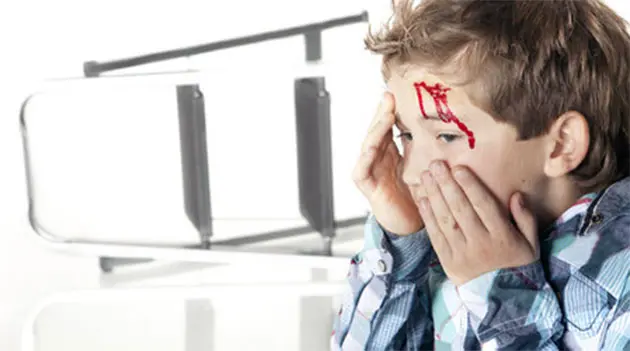
How often do we, as adults, end up responsible for a child’s accident? Often it’s a moment of inattention that puts them at risk. This is especially true when little ones start to roll over, sit up, and walk on their own. Here are some typical scenarios.
A mother is changing her baby on a changing table or couch. She steps away for just a moment, and the child falls to the floor.
You placed a kettle or pot of hot liquid on the table. A child playing nearby pulls the tablecloth or plastic cover towards them, tipping over the container and suffering burns.
Adults carelessly left medications within reach of the child, who mistook them for candy and swallowed them.
Small objects—buttons, coins, pins, beads—are scattered everywhere. A child, intrigued by a new item, will inevitably “test” it: putting it in their mouth, nose, or ear.
What to do if a child bumps their head. Lay the child down in bed. Apply a cold compress to the bruise and change the compress as soon as it warms up. If the child experiences nausea, vomiting, or dizziness, call a doctor immediately; they may have a concussion.
If they cut or scraped themselves. Clean the affected area with a cotton ball soaked in hydrogen peroxide. Apply iodine or antiseptic to the edges of the wound (only the edges!) and cover with a bandage. If the cut is deep and bleeding, seek medical attention.
If they scalded themselves with hot water. Rinse the affected area with cold water to reduce pain. Do not pop any blisters. If the burn is severe—about the size of the child’s palm or larger—get immediate medical help. Until help arrives, cover the area with sterile gauze. Do not apply any ointments or powders!
If they swallowed MEDICATION. Quickly induce vomiting by inserting a finger wrapped in a bandage into the child’s mouth and pressing on the back of their tongue. Immediately find out what medication was ingested and in what quantity. Sudden drowsiness, weakness, or, conversely, extreme agitation are signs of poisoning. Call for emergency help right away.
If they drank an ACID SOLUTION or VINEGAR. Before the ambulance arrives, start giving the child clean water or a mixture of water and egg whites.
If they swallowed a small OBJECT. If it’s a round, smooth object, don’t worry; it usually won’t harm the digestive tract and should pass within a day. A sharp object can injure the esophagus, stomach, or intestines. If the child complains of stomach pain, seek urgent medical assistance.
Do not give them laxatives. Give soft, bulky foods—stewed apples, mashed potatoes, or well-cooked, pureed porridge.
If they inhaled a small object. Encourage the child to cough. Do not stop a strong cough; instead, hold the child upside down over your knees (for a small child, you can lift them upside down by their legs) and gently pat their back. This position helps expel foreign objects from the airways. If it doesn’t work, seek medical help.
If they shoved beads or peas UP THEIR NOSE. Pinch the unaffected nostril with a tissue and have the child blow their nose hard. If the object is not too deep, this method may work. In other cases, seek medical attention immediately. Clumsy attempts to help can push the object deeper. Make sure the child breathes through their mouth; if they breathe through their nose, they may suck the object in further.
If they inserted a foreign object in their ear. Never attempt to remove it yourself—you risk damaging the eardrum. Take the child to a clinic immediately.
IN ALL CASES, TRY TO CALM THE CHILD.
Do not show your own anxiety.
ACT QUICKLY,
BUT WITHOUT PANIC.
