
 During a groundbreaking archaeometric study in the former city of Carthage Nova (now Cartagena), founded in 227 B.C., researchers uncovered a unique painting technique used by the . The scientists’ work shed light on how artisans of the past adorned elite homes with the most luxurious paints of antiquity.
The study revealed that the artists working in the House of Salvius developed a sophisticated method for applying cinnabar—the precious red gold of the Roman world.
The House of Salvius is one of the best-preserved Roman buildings in this city. This mansion, dating from the late 1st to early 2nd centuries, showcases the wealth and cultural sophistication of the local during the height of the Roman Empire.
Researchers focused on Room No. 3, which served as a formal dining room. The room’s significance lies in the fact that its wall paintings have remained in their original condition.
An interdisciplinary team of scientists aimed to uncover the technical recipes for creating the paintings, studying the materials and methods used to apply the pigments.
Microscopic analysis of thin slices, X-ray diffraction, and X-ray fluorescence revealed a complex four-layer plaster solution beneath the paintings.
Chemical analysis showed a high content of micritic lime, a more contaminated but very durable material, likely sourced from a nearby mountain range.
The plaster solution also included marble, quartzite, slate, and dolomite. The presence of marble fragments in the intermediate layers indicates a high quality of workmanship.
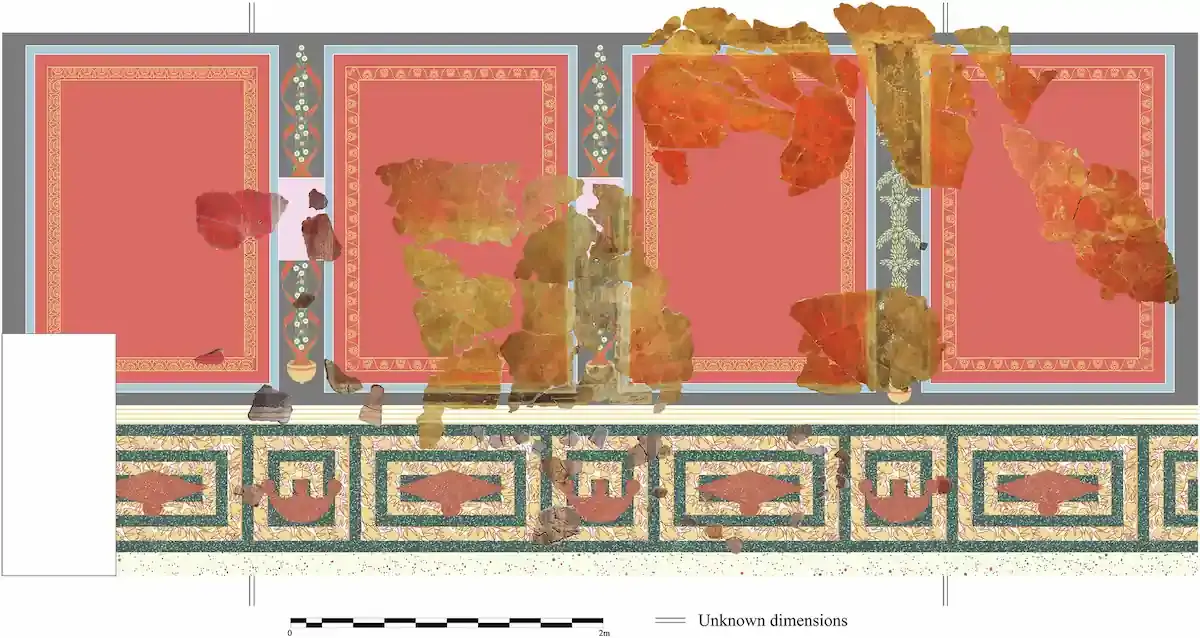
Palette: From Modest Ochre to Egyptian Blue
To identify the pigments, researchers turned to Raman spectroscopy. This method identifies specific chemical compounds through their interaction with light. Analysis of samples taken from the white, black, yellow, green, blue, and red areas of the paintings revealed a carefully curated and technically sophisticated palette.
The white tones were made from the same lime used in the plastering. In Roman fresco painting, lime was both a practical and effective material, as noted by the publication Arkeonews.
The black areas were created using plant charcoal. This pigment allowed for deep, durable tones, ideal for outlines and shading.
The yellow hues were derived from goethite, a natural iron oxyhydroxide commonly known as yellow ochre. This pigment produced warm, earthy tones and was well-suited for fresco techniques due to its stability.
The green color, along with muted olive and yellow-green shades used to depict plants and decorative details, was obtained from a variety of the mineral glauconite.
Notably, the blue pigment was confirmed through Raman analysis to be Egyptian blue, one of the earliest known synthetic pigments in history. This copper-calcium silicate material, created by heating a mixture of sand, lime, and copper compounds, yielded an intense, durable blue color.
However, the most astonishing discovery lay in the red pigment.
The Color of Luxury
The mineral cinnabar (mercury sulfide), known in antiquity as minium, was one of the most expensive pigments in the . It was mined in locations such as Sísapo (modern-day Almaden). Its production was hazardous and it came at a high cost. Pliny the Elder wrote about its steep price and frequent instances of counterfeiting.
The real breakthrough was not just identifying cinnabar but understanding how this paint was applied. The team learned this through electron microscopy with elemental mapping.
Instead of applying cinnabar directly onto the plaster, artists first covered it with a layer of yellow goethite. On top of this fresh layer, they applied cinnabar mixed with hematite (an iron oxide that gives the plaster an earthy red hue).
By mixing cinnabar with the cheaper hematite, artists extended the lifespan of the valuable pigment while maintaining the rich, prestigious red color favored by Roman nobility.
Essentially, ancient craftsmen were not just decorators but also material scientists. To ensure the paintings had brilliance and durability, they experimented with complex multilayered solutions.
The results of the study were published in the journal Scientific Reports.