
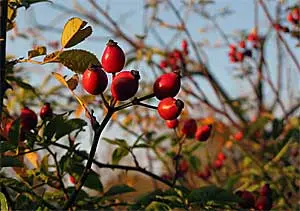
The wild ancestor of the cultivated rose grows across the country, from the European part to the Urals, Siberia, and the Far East. This thorny bush thrives in sunny spots such as steppes, forest edges, gardens, and parks.
The fruits of the rosehip are especially valued for their medicinal properties and are a true treasure trove of nutrients. They are rich in vitamins C, B, P, and K, provitamin A (carotene), sugars, organic acids (such as malic and citric), mineral salts, glycosides, pectins, and pigments. In terms of vitamin C, rosehip tops the list, outpacing blackcurrants, lemons, sea buckthorn, and sweet peppers. One hundred grams of fresh rosehips contain 470 milligrams of vitamin C, and 100 grams of dried rosehips contain about 1,200 milligrams. Rosehip—its fruits, leaves, and roots—is widely used in both folk medicine and conventional medicine to treat various ailments. Pharmaceutical products include a drug called “Holosas,” prescribed for cholecystitis and hepatitis as a choleretic, and an oil extract called “Karotolin,” used for certain skin conditions.
Rosehip is also popular in cosmetics. Creams often contain rosehip oil, and some include an infusion made from the fruits. These creams are formulated for normal, dry, and aging skin. For at-home masks and skin treatments, use a vitamin-rich infusion made from dried rosehips. Wash the fruits, blanch them in hot water for 6–10 minutes, grind them, and strain them through a sieve. Pour boiling water over the mixture and steep for 8–10 hours, then strain. Use the infusion within two to three days. Store it in the refrigerator.
Pour a tablespoon of crushed dried rosehips into a cup of boiling water, simmer in an enamel pot with a lid for 5 minutes, then let the mixture settle and strain. Wash your face with the cooled infusion.
For dry and aging skin, apply an infusion made from fresh rose petals. Finely chop the petals, pour two tablespoons of petals into a cup of boiling water, and steep for 20–30 minutes in an enamel or glass container. After cooling, strain the mixture.