
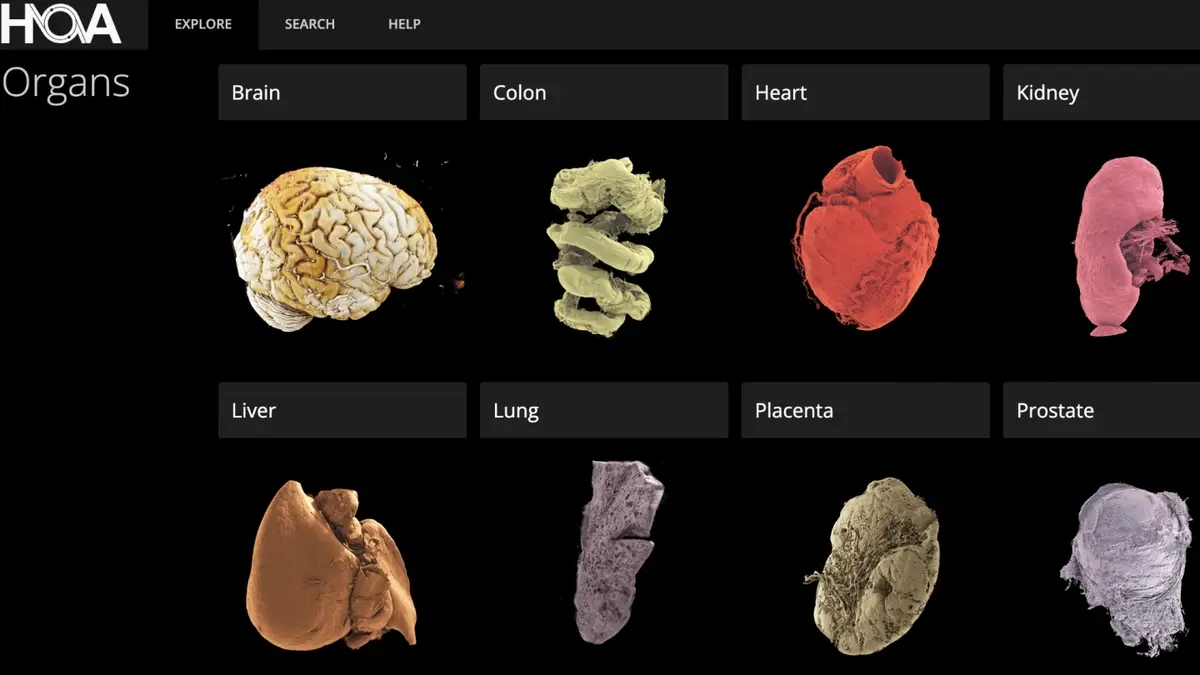
The 3D portal “Human Organ Atlas” (HOA), created by an international team of scientists, is now publicly available. It contains detailed information on 56 human organs.
The project brought together specialists from nine research institutions across Europe and the United States in a consortium called the Human Organ Atlas Hub.
Through the online atlas, users can examine the brain, heart, lungs, liver, and more. The developers say this resource will help anyone better understand anatomy and the diseases that affect people. Science Advances published a detailed description of the HOA.
The team built the new atlas on the original 2023 version. Now users can access the HOA directly in a standard web browser without specialized software. The portal runs on an advanced visualization method called hierarchical phase-contrast tomography (HiP-CT). This method uses the ultra-bright source at the European Synchrotron (ESRF), which is 100 billion times brighter than typical hospital CT scanners. That brightness allowed scientists to scan whole human organs without destroying them, Popular Science reported.

“From the start we wanted these data to be accessible to everyone and to create an open, shared scientific infrastructure on a global scale. This is a resource for researchers, clinicians, educators, and anyone curious about how the human body is built,” said Paul Tafforeau, a scientist at the European Synchrotron (ESRF).
The team also expects the HOA to become a resource for artificial intelligence. Its large, high-quality 3D datasets could help train advanced medical AI systems to detect disease and perform high-resolution analysis.
The Human Organ Atlas also opens new opportunities for medical education and public engagement with science.
“Students can study organs in 3D, scroll through anatomical slices, and zoom in on details of internal tissues,” added Oleksandr Belye, an associate professor of anatomy at Grenoble Alpes University Hospital in France. He said the online atlas is an exciting alternative to traditional anatomy references, offering a full spatial understanding of the body’s complex structures.
Over the next few years the team plans to expand the HOA database further by adding more organs.
