
 The results of this research could pave the way for a more environmentally friendly method of extracting mineral resources that humanity increasingly relies on.
What Makes This Discovery So Remarkable
Researchers from the Chinese Academy of Sciences uncovered a surprising ability in the fern Blechnum orientale: it grows rare earth element (REE) crystals inside its tissues.
There are 17 rare earth elements. These metals appear in many technologies — from wind turbines and computers to broadband cables and medical devices. They are not as rare as their name suggests, but extracting them from the Earth’s crust in usable form is complex and costly.
This is where phytomining comes in — using plants known as hyperaccumulators to extract metals from soil. These plants thrive in metal-rich soils and concentrate those elements, ScienceAlert reported.
“REE are critical metals for clean energy and high-tech applications, yet their supply faces environmental and geopolitical challenges,” the team led by geologist Lucina He wrote.
“Phytomining — a green strategy that utilizes hyperaccumulator plants to extract metals from the soil — opens up possibilities for sustainable supply of rare earth elements, but it remains underexplored,” the scientists explained.
The fern B. orientale was already known as a hyperaccumulator, but the researchers found something extraordinary: the plant actually grows REE crystals within its tissues.
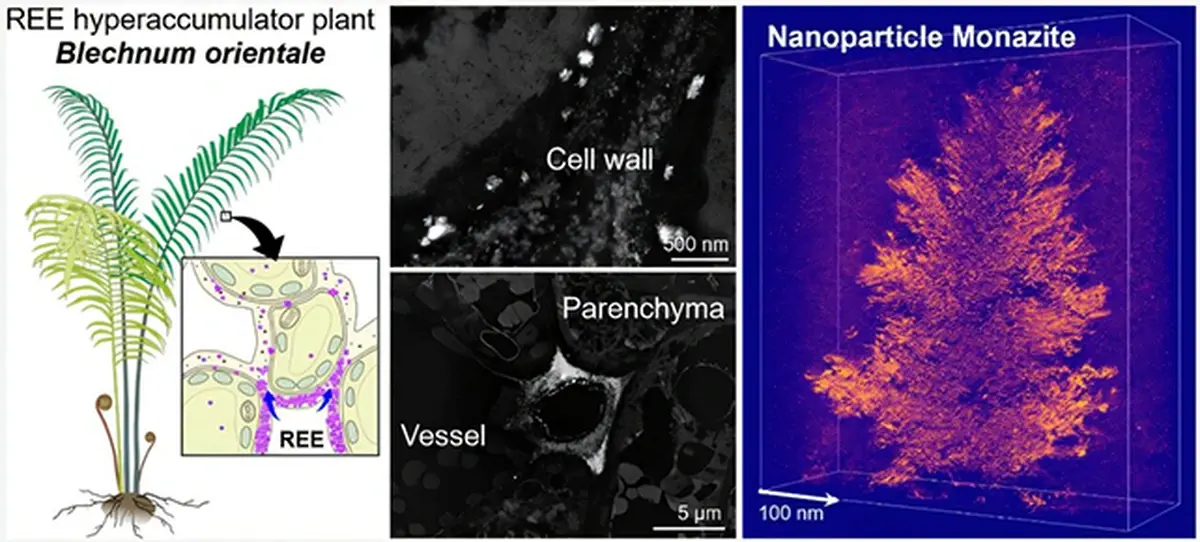
Researchers found that crystals of monazite form in the fern.
Using powerful microscopic imaging and chemical analysis, the team discovered that the rare-earth–rich mineral monazite accumulates in the plant’s tissues, creating a sort of “chemical garden” that self-organizes from elements like neodymium, lanthanum, and cerium.
This is the first time scientists have seen a plant form rare-earth metal minerals under normal conditions — without the high temperatures and pressures required for underground extraction.
The team is actively exploring phytomining’s potential and says it may be more promising than previously thought.
Further studies will determine whether this is a unique trait of B. orientale or if other plants can do the same. Some signs of similar behavior have been observed in another fern, Dicranopteris linearis, but there is no direct evidence yet that it forms the minerals.
Scientists hope to develop a method to extract monazite from the plants and break it down into its REE components with minimal resource loss.
“This discovery not only sheds light on the enrichment and sequestration of REE during chemical and biological weathering but also opens new opportunities for the direct extraction of functional REE materials,” the researchers wrote.
The findings were published in the journal Environmental Science & Technology.
Photo: Unsplash
