
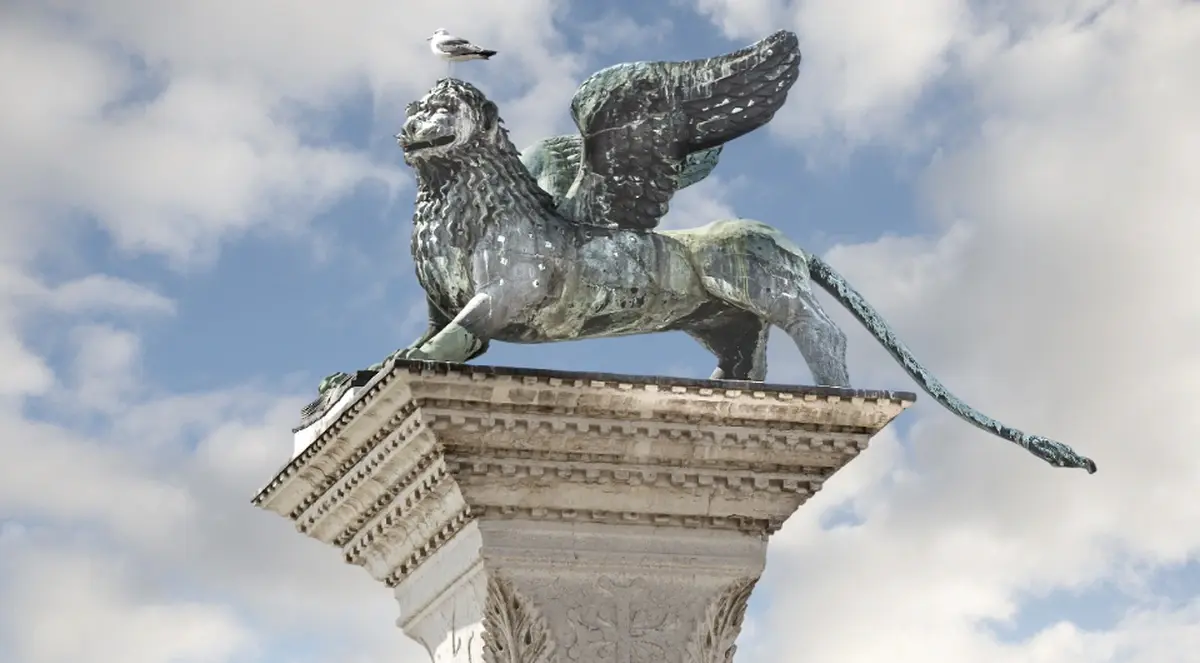
The winged lion that adorns one of the columns in St. Mark’s Square and serves as a symbol of Venice actually came from China in the 13th century. The statue was cast more than 1,000 years ago during the Tang Dynasty (618–907 AD). Researchers believe the artifact was transported along the Silk Road by Niccolò and Maffeo Polo, Marco Polo’s father and uncle.
How Did Researchers Discover This?
“Venice is a city full of mysteries, but we’ve unraveled one of them. The lion in St. Mark’s Square is Chinese, and it arrived via the Silk Road,” said Massimo Vidale, a professor of archaeology and the study’s lead author.
To prove the lion’s Chinese origin, the team analyzed the bronze, Live Science reported.
In total, the researchers examined nine metal samples from different parts of the statue. Using mass spectrometry, the team measured the lead isotope ratios in the bronze. By comparing the isotopic composition of the lead in the Venetian lion with reference databases, they narrowed the bronze’s origin to the lower Yangtze River region in eastern China. That area is rich in large metal deposits.
The team says this finding could explain certain stylistic features of the Venetian lion. Its appearance doesn’t match European medieval depictions of lions from the 11th to 14th centuries.

However, the winged symbol of Venice strongly resembles Tang-dynasty artworks. During the Tang Dynasty, Chinese artists often created hybrid creatures with lion-like faces and manes, pointed ears, horns, and raised wings. The Venetian lion shares several of these characteristics. It also has metallic “scars” where horns may once have been removed.
In the 13th century, Venetian merchants—brothers Niccolò and Maffeo Polo, Marco Polo’s father and uncle—traveled the Silk Road and set up trading posts. Eventually they reached the city now called Beijing and spent four years there. The brothers likely encountered a tomb guardian statue that matched their idea of what a lion should look like.
During the 13th century, when the Venetian Republic controlled eastern trade routes, its symbol was the winged lion. The image also appeared on the republic’s flag.
The team suggests the Polo brothers may have had “a somewhat audacious idea to rework the sculpture into a plausible (from a distance) winged lion.” The merchants likely shipped the statue to Venice in pieces and entrusted a local craftsman to restore it.
The team’s report in Antiquity says this is just one possible scenario based on historical and archaeometallurgical data—and now it’s up to historians.