
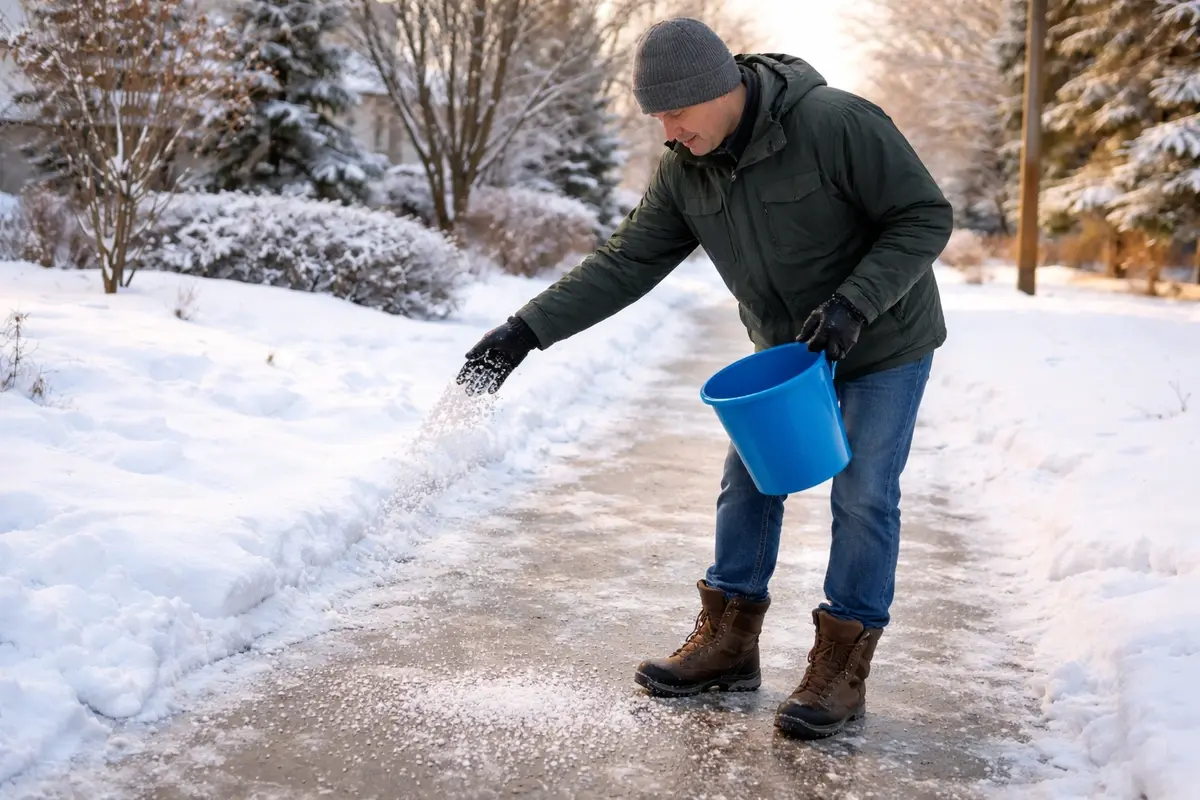
 When faced with a thick layer of icy snow in their yard, the first instinct for many is to rush to the nearest hardware store to grab a bag of rock salt.
However, American experts warn that before spreading salt on the ice, it’s important to consider the potential harm it can cause to animals and the environment.
Rock salt, also known as sodium chloride, is the cheapest and most commonly used product for removing snow and ice. But it’s not beneficial for the natural environment and isn’t the most effective option.
“We use a chart that indicates the effectiveness of chemical agents at certain temperatures. Honestly, when the temperature drops to -15 degrees Celsius or lower, you can keep adding more rock salt, and it won’t yield better results than what you already have,” says Martin Tirado, the executive director of the Snow and Ice Management Association (USA), a professional industry group.
Dangers to Plants and Animals
Pamela Bennett, a horticulture professor at Ohio State University, claims that rock salt is the worst thing that plants can encounter. It affects them through their roots and foliage.
Salt seeps into the soil. When plants absorb salty water in the spring, it leads to the drying out of roots first, and then the leaves. Brown tips on leaves can indicate that the soil is too salty, according to Independent.
Additionally, salt can land on the leaves of evergreen plants from mist and splashes. This issue is particularly prevalent on busy highways.
“When there’s a lot of salt on the highways, cars spray it around, and the wind carries it. On the leaves, this salt can cause something akin to burns,” explained Professor Bennett.
Meanwhile, Alison Manchester, an associate professor of clinical sciences at Cornell University, pointed out another danger of using salt to combat ice and snow. Many dog owners walking their pets in heavily salted areas have noticed their dogs suddenly stop and lift a paw as if in pain.
“Their paw pads can dry out or develop small cuts from the sharp salt crystals, and dogs start licking them because that’s the only way they know to relieve the pain,” the expert noted.

What About Sand, Calcium, and Magnesium Chlorides?
Abrasive materials like sand and gravel improve traction for pedestrians and vehicles on icy roads. However, the use of these materials also has environmental consequences.
According to Tirado, sand that enters freshwater bodies (lakes, streams, and rivers) can devastate vegetation. It accumulates in the soil, creating problems for plant growth. Experts say that when mixed with clay soils, sand can even form a type of concrete.
Calcium chloride and magnesium chloride—other proven agents against snow and ice—cost at least twice as much as rock salt. But these chlorides also have their downsides. They can contaminate freshwater, damage shrubs, trees, and grass, and deteriorate concrete sidewalks, porches, and driveways. Their long-term effects on human health are considered
So What Are the Alternatives?
Some of the safest de-icing agents are mixtures (usually liquid) based on calcium acetate and magnesium acetate. These were developed as a safer alternative to rock salt. Such products are more environmentally friendly, biodegradable, do not cause metal corrosion, and help preserve road surfaces and concrete structures from premature deterioration. Of course, these products are significantly more expensive than regular salt.
But perhaps not as pricey as the de-icing agent produced by the South Korean company Star’s Tech. It’s made from a material derived from invasive sea stars. This agent releases chlorides more slowly, thereby preventing corrosion and the environmental issues associated with salt.
Expert Tips
Experts believe that to ease the battle against ice and snow, it’s essential to . Start by monitoring weather forecasts to know how much snow is expected.
“Typically, people wait until the storm is over to start clearing snow. That’s fine if only 2.5 to 5 cm of snow has fallen. But if it’s 7, 10 cm or more, you can’t wait too long—you need to go outside with a shovel several times,” said Tirado.
Proper application of de-icing agents on sidewalks or driveways is also crucial. “The key is not to use too much and not to spray too heavily,” emphasized David Orr, director of the local roads program at Cornell University.
By the way, while some are trying to clear snow as quickly as possible, .
Photo: Unsplash