
More than 2,000 years ago, Hippocrates taught that humans are generally born healthy and that many diseases enter the body through the mouth — via food. He believed a person could live 120, 130, or even 150 years if they ate properly.
As centuries passed, millions of people lacked access to scientific knowledge or a secure life. Natural disasters, political upheaval, and constant wars kept most people from thinking about the simple mechanics of digestion. Still, some of the best minds focused on healthy eating. In the 10th century, Abu ibn Sina (known in Europe as Avicenna) wrote the “Treatise on Hygiene,” arguing for the need to separate different foods in time. By the 19th century, physicians were exploring the idea of separate nutrition, most notably American physician Shelton in his book “The Fundamentals of Rational Nutrition.”
An interesting perspective on separate nutrition comes from academician Mikulin. As a leading aircraft-engine designer, Mikulin treated the human body like a complex machine, though he did not study the biological processes that drive life. While experimenting with different food combinations, he noticed that separating foods could boost productivity, vitality, and overall energy. But he did not foresee the need to cleanse the body of waste products from digestion, and for that reason he hesitated to recommend the regimen in his book “Active Longevity.”
Countless chemical and energy transformations happen inside us all the time, and those processes can’t be reduced to purely mechanical terms. Molecular reactions in the human body occur at about 36.4 degrees Celsius (97.5 degrees Fahrenheit). That’s why keeping the digestive “reactor” — the stomach and intestines — clean and free of harmful residues matters.
The gastrointestinal tract converts food into building blocks for the body and into the energy that fuels muscles and the brain. Whether those building blocks and that energy are sufficient and high quality depends on what we eat, how we eat it, the sequence and combinations of foods, and how the digestive tract processes those foods given our eating habits.
The Theory of Compatibility.
Scientists classify foods into three groups based on the enzymes that digest them in the gastrointestinal tract.
Protein Group. Proteins are broken down by stomach acid and by proteolytic enzymes produced in the stomach and pancreas.
Carbohydrate Group. Carbohydrate digestion begins with salivary amylase in the mouth and continues with pancreatic amylase in the small intestine.
Group of “Living” Foods. Raw foods often contain active enzymes and intact nutrients, which can reduce the amount of digestive work the body has to do — the idea behind raw-food diets.
Fats, because they combine easily with both carbohydrates and proteins, are often treated as neutral and grouped with the “living” foods. Melons get special attention here: traditional sources treat them as cleansing fruits that can clear blockages in the intestines and sometimes trigger diarrhea or vomiting. People also claim melons reduce intestinal mucus and influence the acid–alkaline balance and electrical properties of digestive and circulatory tissues. Folk medicine uses melon seeds and rind in recipes aimed at flushing kidney stones and clearing bile ducts. The only practical rule for melons is to eat them alone: two hours before or two hours after a meal.
Only after a two-hour break can you safely eat foods from groups considered incompatible. For example, if you had a sausage with stewed cabbage and now want potatoes, wait two hours before eating the potatoes. If you bought a sausage sandwich, eat the sausage first and wait two hours before eating the bread. Dairy products should be combined only with other dairy: sour cream with cottage cheese, milk with cheese — not mixed with unrelated foods. While following this scheme, remember proponents also recommend a weekly cleansing enema, which is discussed later.
A two-hour break, when you follow these combining rules, gives your digestive system time to finish one set of reactions and prepare for the next. It’s the minimum interval needed for acid-driven digestion to wind down before alkaline-driven digestion begins. If incompatible food groups are eaten together, acids and alkalis can neutralize each other — and then how can the body absorb nutrients?
The diagnosis “indigestion” is used less often today, but the term still captures many dysfunctions of the digestive system. The food-group classification is a compromise: meat contains some carbohydrates, and bread contains some protein. Those natural combinations are generally manageable for the body, but they’re nothing like the complex mixes that many chefs create. As the English proverb goes, “God gave people food, but the devil sent the cook to mix it all up.”
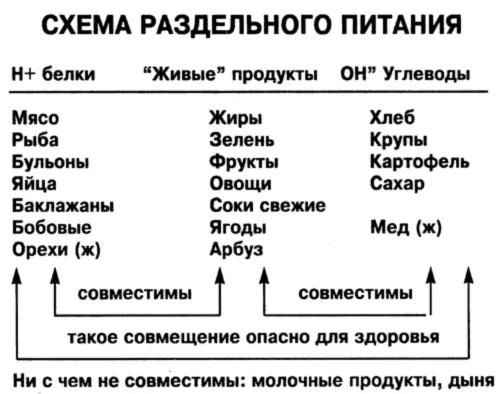
In the diagram, the protein group is marked with the acidic hydrogen ion H+, while the carbohydrate group is marked with the hydroxyl ion OH-. The protein group also includes items marked with “l,” indicating living proteins. Nuts, depending on the variety, can contain up to 40 percent of this so-called living protein, which means they require less digestive work in the stomach. Meat, by comparison, contains about 20 percent protein and produces more waste products that the body must eliminate.
What We Know About Honey and Potatoes
In the carbohydrate group, the “l” symbol indicates material that is hard or slow to digest. The sugar in honey functions as a particularly efficient carrier of calcium into the bloodstream, and calcium is essential for healthy bones and nerve tissue. According to Dr. Jarvis, about 20 minutes after taking a tablespoon of honey, blood calcium ion levels (Ca2+) rise above typical levels and can stay elevated for a day.
Refined sugar is not the same as honey. To act like honey at the biochemical level, refined sugar must undergo several transformations in the body that produce waste, and not every digestive system has the energetic reserve for that work. Over time, that can contribute to calcium shortages in the blood and to bones becoming more brittle. Surgeons can mend fractures, but the underlying nutritional issue can remain.
Potatoes are another curious carbohydrate. If you boil or bake potatoes in their skins, you’ll find a shiny, smooth layer just under the skin that contains enzymes that help break down potato starch. Peel raw potatoes and you discard that valuable layer. Without those enzymes, potato starch must be broken down by your own digestive enzymes, which increases the digestive load. Constantly eating mashed potatoes, fried potatoes, or pre-peeled boiled potatoes may place extra strain on digestion. Some proponents warn that the body can struggle to digest potato starch and suggest this may contribute to circulatory problems such as varicose veins.