
 Auguste Rodin’s “The Thinker” is perhaps the most recognizable sculpture in the world. A man frozen in thought, resting his chin on his hand, has become a symbol of deep contemplation and intellect. Humanity has come to see this pose as a triumph of reason, even though the artist originally sculpted Dante above the gates of hell. You can read more about the history of this masterpiece and its creator in the article . However, scientists assert that are the only primates on the planet with a distinct chin.
Unique Among Primates
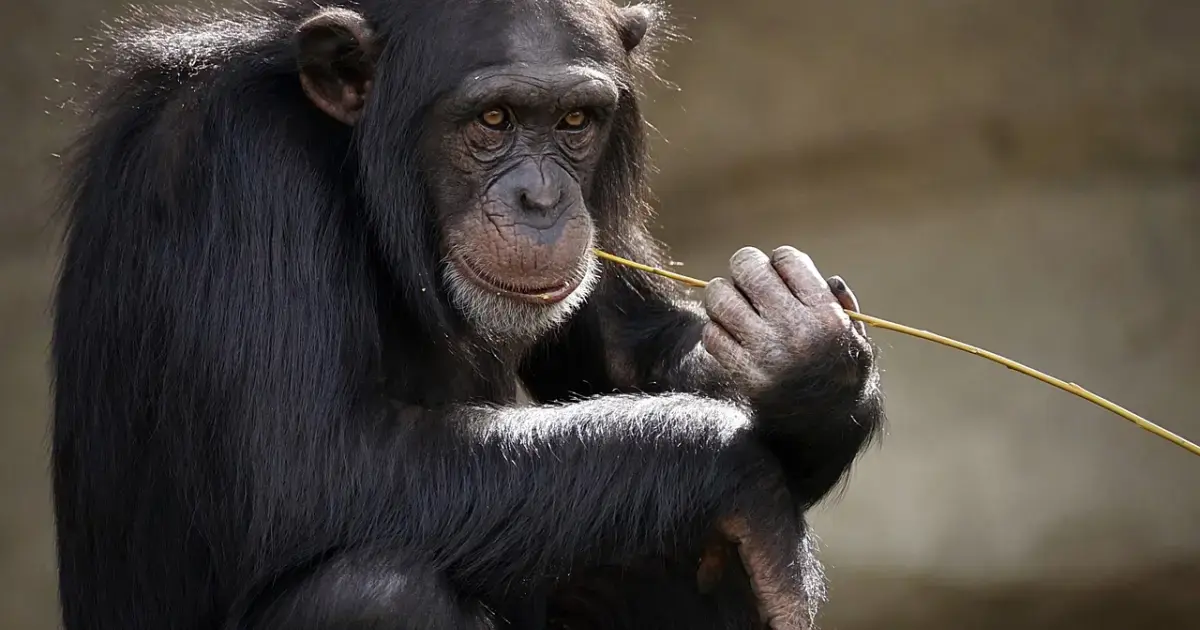
The evolutionary tree of humanity presents a rather clear picture. Our closest relatives, chimpanzees, do not have a protruding lower jaw. This feature was also absent in other great apes. Moreover, even our extinct relatives, the and Denisovans, did not exhibit this anatomical trait. It turns out that the chin is a relatively new characteristic of our species.
Is the Chin a Result of Natural Selection?
It seems logical to assume that this part of the lower jaw developed for facial protection or to enhance contour. However, this theory relies on a common oversimplification that all traits of an organism must be the result of direct natural selection. Professor Norin von Cramon-Taubadel, an anthropologist at the University of Buffalo (USA), explains that the chin likely was not a target of direct evolutionary selection; it formed primarily as a byproduct of changes in other parts of the skull. Along with her colleagues, she published a study in the journal PLOS One, where the lower part of the face is examined as an example of an evolutionary “spandrel.”
What is an Evolutionary Spandrel?
The term “spandrel” is borrowed from architecture. It refers to the triangular space between an arch and its framing—a zone that inevitably arises from the structure rather than being a separately designed element, as reported by Popular Science.
In 1979, paleontologists Stephen Jay Gould and Richard Lewontin transferred this concept to evolutionary biology. They proposed the idea that some anatomical features:
- arise as a byproduct of changes in other structures;
- are not direct adaptations;
- may later acquire functions, but were not initially “planned” by natural selection.
According to this logic, the chin is precisely such a structure.
Null Hypothesis Instead of an “Adaptive Tale”
Most previous theories attempted to explain this trait as an adaptation for speech, chewing, or protection. However, von Cramon-Taubadel’s team approached the question differently—through what is known as the null hypothesis.
The researchers compared the anatomy of human and ape skulls to determine whether the chin’s prominence is indeed the result of separate selection. The conclusion was unexpected: the traits in this area are better explained as a consequence of changes in the overall shape of the face and jaws, rather than as an independent adaptation.
Is the Chin Even Necessary?
The fact that the chin developed in conjunction with the entire skull does not mean it is entirely useless. This anatomical feature may:
- partially strengthen the lower jaw;
- help distribute stress during chewing;
- play a role in shaping facial contours and hint at how scientists believe may change under the influence of modern lifestyles.
However, it is clear that the development of Homo sapiens did not “move forward” because of the chin. We simply acquired it as a side effect of deeper structural changes in the skull.
And this is an important lesson in evolution: not every unique trait is the result of a struggle for survival. Sometimes nature does not construct—it remodels. And the chin turns out to be not the hero of the story, but rather an accidental witness.
Photo: pixabay.com