
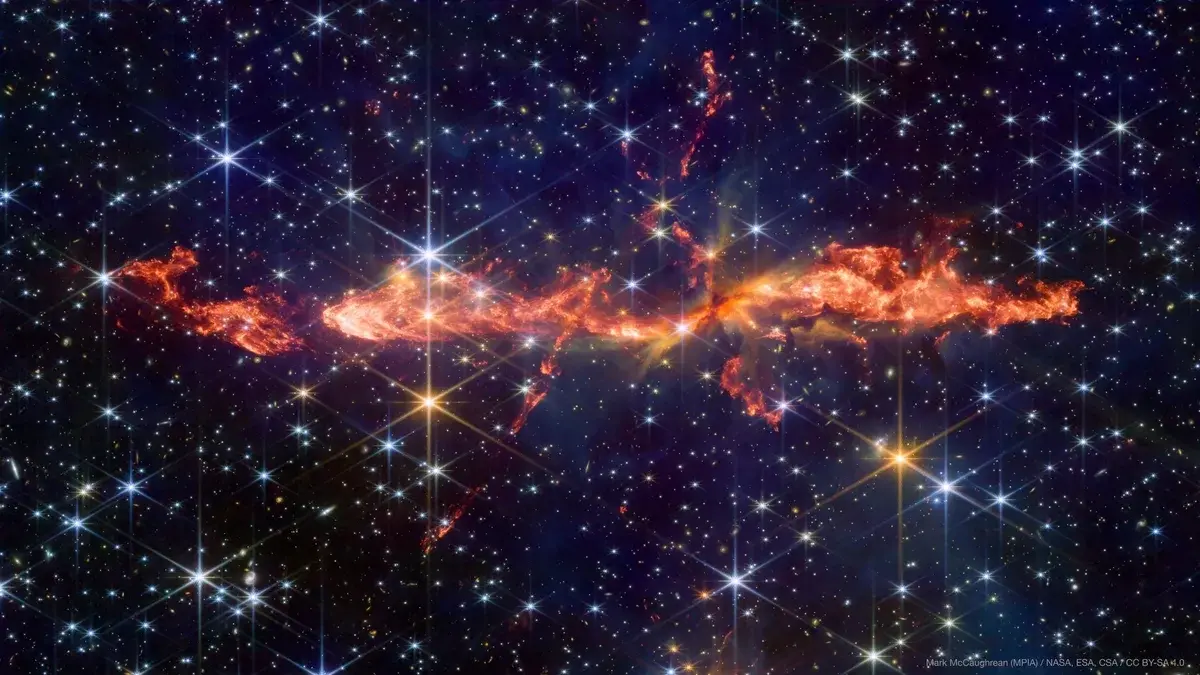
A team of astronomers spotted this in a stunning image from the James Webb Space Telescope (JWST) while exploring a star-forming region in the constellation Cassiopeia.
The background of the image is densely filled with stars. At the center, a large, almost straight jet resembling flames can be seen.
The photo showcases the striking complex of protostellar outflows known as HH288, which scientists also call the “Dragon Jet.” It was discovered by researchers in the 1990s. The structures, reminiscent of a giant dragon, are jets of material ejected by protostars. (A protostar is a star in the earliest stage of its formation.)
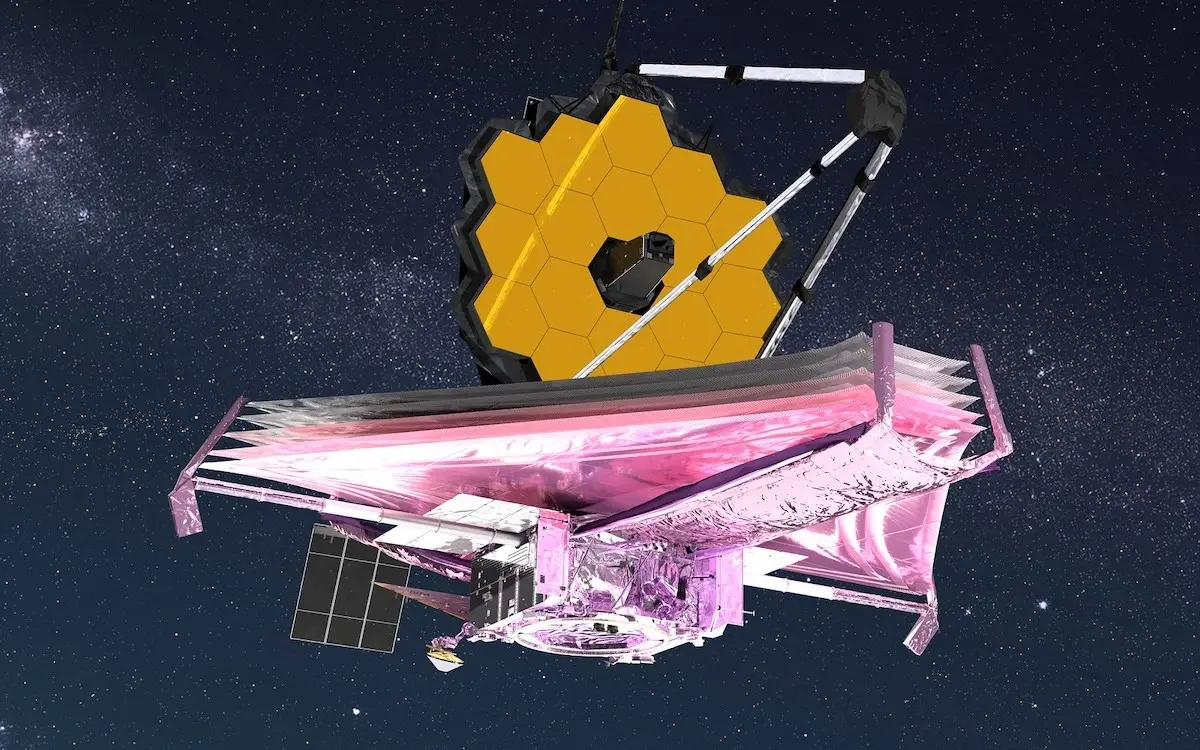
The James Webb Space Telescope
“In the process of star formation, they are like babies. They are fed so they can grow, but then part of that food comes back out. And, just like with babies, it all comes out from both ends,” joked Dr. Mark McCaughrean, a senior scientist at the Max Planck Institute for Astronomy in Heidelberg, Germany, and the study’s lead.
A star does not form fully grown. In its protostar stage, it pulls in a lot of material from the gas and dust cloud from which it was born. Some of this material flattens out, forming a disk from which planets can eventually form.
The ejections of material are a crucial component of star formation. They are also quite spectacular. In the case of the “Dragon Jet,” the material is expelled from the protostars at speeds of about 100–200 kilometers per second.
During previous observations, scientists had seen two nearly perpendicular flows. However, the new image captured by the JWST in the near-infrared spectrum revealed that, in addition to these two flows, there are five or more others. This indicates a dense cluster of intermediate-mass protostars.
“In this cluster, there is quite a chaotic motion happening. We believe that at least five different protostars are flaring up simultaneously. There is a large flow—the main body of the imagined Dragon with a tail, head, and flames. And if you look closely, you can see bright red lines extending in various directions,” noted McCaughrean.
The mass of each of these protostars falls within the intermediate-mass range, meaning they are several times more massive than the Sun.
McCaughrean said, “The story of how intermediate-mass protostars influence their surroundings and disperse all this material is probably the most fascinating part.”
The team plans further observations at millimeter and radio wavelengths to obtain even more detailed characteristics of this system.
Webb Captures a Fiery ‘Dragon Jet’ of Protostars in Cassiopeia
23
