
 Joan of Arc is a quintessential example of a national heroine, embodying the fervor of a patriot determined to triumph over her enemies. She combined virtue, charisma, and an unwavering belief in her divine calling with military effectiveness at a critical juncture in her nation’s history. The fiery fate of this illiterate young peasant girl, who altered the course of the Hundred Years’ War in just two years of her brief life, was unprecedented not only in the grim Middle Ages. At the age of 17, dressed in men’s clothing, she led an army to liberate her country from English rule, and by 19, she was executed on trumped-up charges of heresy, later to be rehabilitated and canonized by the Church. The tragic sentence handed down to this innocent victim of political intrigue and religious fanaticism, who was burned alive in 1431, has made her a fascinating historical and cultural figure at the intersection of spirituality and mysticism.
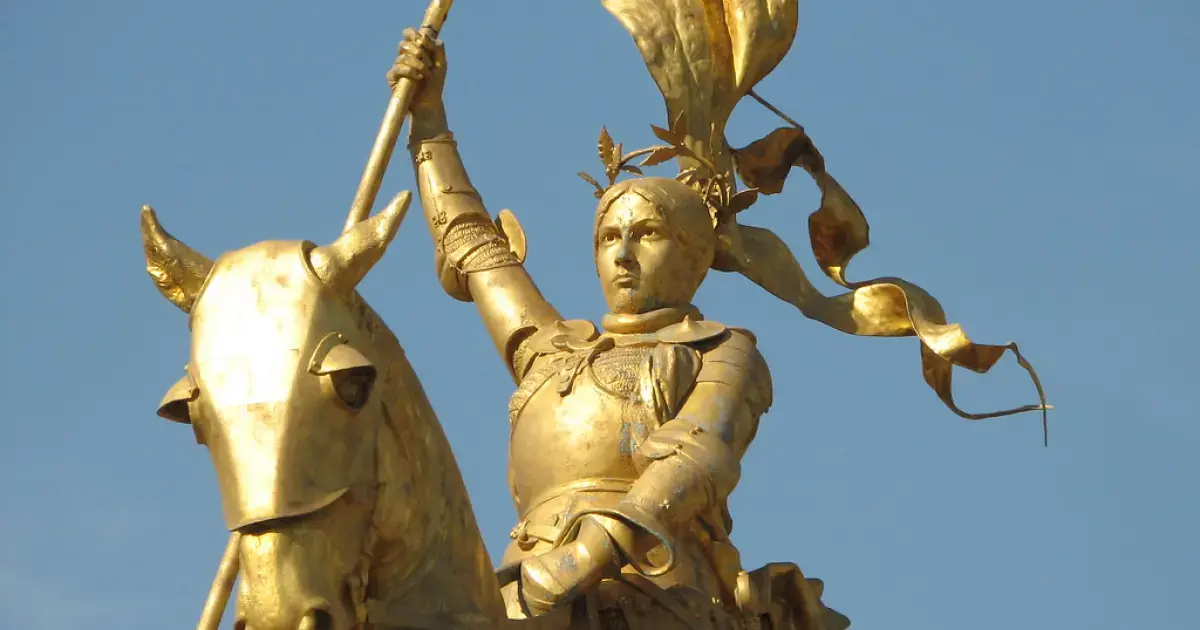
Symbol of France
First and foremost, Joan of Arc is a successful and enduring brand, shaped by popular reverence, religious mysticism, and political promotion. For centuries, her phenomenon has been supported by a carefully constructed biography: Joan of Arc, as a real person and a popular artistic figure, became a powerful propaganda tool for uniting France during the challenging historical context of the Hundred Years’ War. Her emergence in 1429 came against a backdrop of widespread despair and division.
At that time, a third of French territory was under English control. In a ravaged and divided country, the Duke of Burgundy sided with the enemy. The French army was losing its last strength. The heir to the throne had been stripped of his right to the crown by treaty and was hiding in the town of Chinon in southern France. The English monarch Henry VI was set to become king, which would mean the end of an independent France. To fully subjugate the foreign lands, the English needed to capture Orléans.
The city that immortalized Joan of Arc was barely holding on when the maiden appeared on the political scene, promising victory for France and quickly becoming the most famous French military leader. She did not devise intricate military operations but was the driving force that propelled the army forward. Ultimately, both the English enemies and the traitorous compatriots recognized the threat she posed: the demise of the beloved heroine was facilitated by the inaction of French King Charles VII, who did nothing to save her.
The moral symbol and example to follow became the sacrifice and heroic resistance of the steadfast Frenchwoman against the enemy. The title “Maid of Orléans” was associated with the city she saved and with biblical purity. Key elements in creating the mystical image of a person who became a symbol of faith and struggle were the “voices”: Joan of Arc claimed to receive guidance from Archangel Michael and Saints Catherine and Margaret, which provided divine justification for her actions.

The nature of those “voices” remains a topic of debate (whether they were psychological phenomena, mystical visions, or political maneuvers), as does the biography of Joan of Arc. Questions begin with her origins. Historical “PR strategists” portrayed her as either a beggar or an illegitimate princess, but neither was true. The emergence of such a figure served the coronation of Dauphin Charles and aligned with France’s interests as a political tool for national consolidation.
With Joan of Arc’s help, Charles VII and his supporters were able to boost the morale of the French and legitimize his power. The transformation of the popular heroine into a martyr and innocent victim of France’s enemies, following her public burning, strengthened the national idea. After Joan of Arc was proclaimed the patron saint of France, this historical figure became an embodiment of national unity and patriotism. Joan of Arc is a national symbol, mythologized according to the characteristics of her era.
The martyr’s tragic, early death, the rehabilitation process in 1456, and her canonization by the Catholic Church in 1920 solidified her status as a saint with a mysterious aura that attracts and inspires. Her popularity in literature, music, film, and pop culture is sustained by the archetype of the “strong woman” who defies societal norms, mobilizes, and instills faith in miracles. People perceive the story of Joan of Arc as an example of a legendary life worthy of artistic interpretation.
A Foretold Mission
Joan of Arc was born in the village of Domrémy on January 6, 1412. She came from a relatively well-off peasant family, the daughter of Jacques d’Arc and Isabelle Romée: her parents owned 50 acres of land, about 20 hectares, and the head of the family not only managed their farm but also served as the head of the village watch and collected taxes. Living in an area loyal to the French crown, the family was surrounded by Burgundian lands and periodically faced attacks. In her childhood, Joan witnessed the burning of her village.
Perhaps the childhood trauma triggered her first vision at the age of 12: in 1424, she saw figures of Archangel Michael and Saints Catherine and Margaret in a field, who commanded her to drive the English from French soil and lead Dauphin Charles to the throne in Reims. Joan recalled crying when the heavenly figures disappeared; they left a profound impression on her. Four years later, the 16-year-old asked a relative to take her to a nearby castle, where she made an unusual request to the commander of the garrison.
Joan approached Count Robert de Baudricourt to request permission to visit the royal court. After receiving a sarcastic refusal, the determined girl did not back down. When she appeared before Baudricourt again at the beginning of 1429, accompanied by a “support group,” she predicted a change in the situation around Orléans. Her words were taken seriously when her warnings were confirmed by frontline news that no one could have known in advance. She was granted an escort to the residence of Dauphin Charles VII.
To cross enemy Burgundian territory, Joan decided to wear men’s clothing provided by her uncle. A private audience with the future king was preceded by two weeks of verifying the girl’s identity. This began with the acknowledgment of two midwives that she was indeed a virgin. Making a strong impression on the royal court, Joan of Arc asked for permission from Charles’s mother-in-law, Yolande of Aragon, who was then financing support for Orléans, to go to war as part of a reinforcement unit.
The resolute girl was given a horse, a sword, and allowed to wear knightly armor. Joan moved ahead of the army with a banner in hand. Although no contemporary images of the unusual warrior have survived, historical documents provide accounts of what Joan of Arc actually looked like. Referring to court witnesses, Philip of Burgundy claimed she was dark-haired, with a bob haircut and a large birthmark behind her right ear. Her squire, Jean d’Olon, noted Joan’s robust health.
Despite her short stature (5’2″ to 5’3″), slender waist, and soft voice, the self-assured dark-eyed combatant was not weak. The delicate young rider in knightly gear endured the hardships of military life alongside men, earning their respect and sympathy due to her modesty and morality. According to her comrade Gilles de Rais, no one ever saw Joan kill an enemy with a sword. Before battles, she would take communion, and after fights, she prayed for the fallen, encouraging other soldiers to do the same.
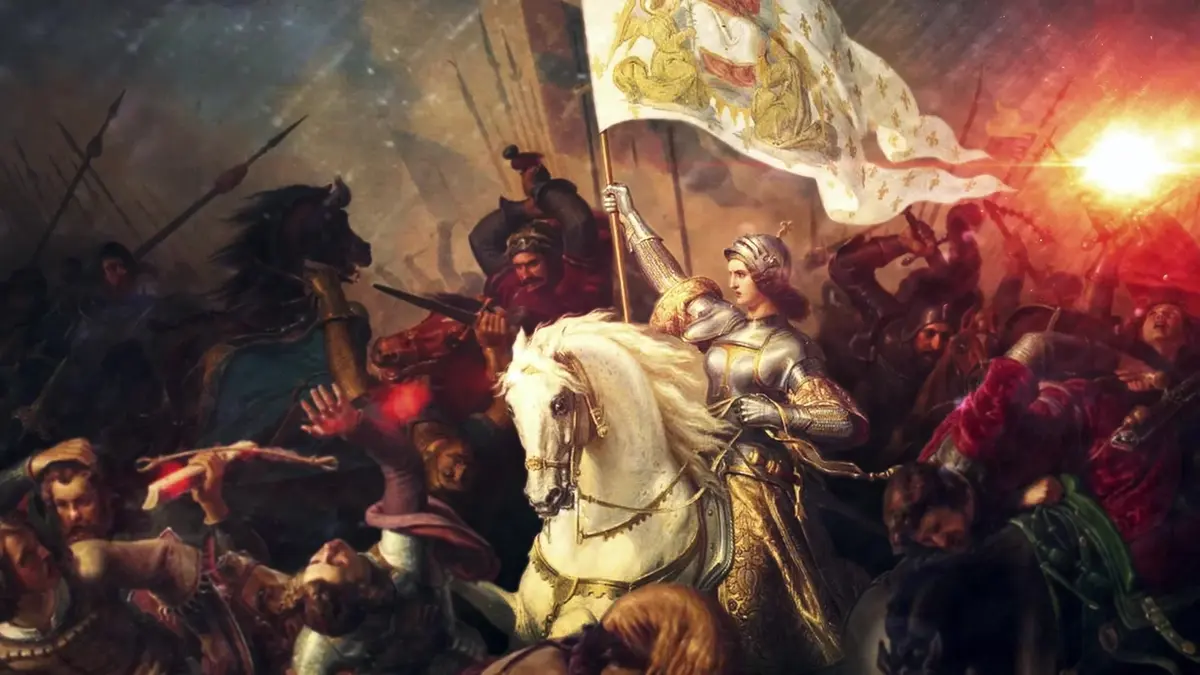
Priest Jean Pasquerel confirmed that Joan of Arc fasted weekly: on Fridays, she mostly did not eat or drink. There was no swearing or fighting around her. People who believed in the ancient prophecy expected that the maiden would save France, which would be lost by a woman. The savior Joan was contrasted with the “mad queen” Isabella of Bavaria—the wife and regent of the mad King Charles VI, who signed the disgraceful treaty in Troyes in 1420, which made the English king the ruler of France.
“Ladies” and “Gentlemen”
Thus, for those who believed in Joan of Arc’s special role, the victory at Orléans was to be a test of the truth of her claims. However, it is known that upon her arrival in Orléans on April 29, 1429, the 17-year-old girl faced resistance from the royal court. The leader of the Orléans dukes, Jean de Dunois, did not allow her to attend military meetings and did not inform her of plans to attack the enemy, while Joan participated in skirmishes despite the prohibition, leaving the extent of her military command a subject of historical debate.
Later, during the trial, the warrior claimed that she “preferred the banner to the sword,” and this admission has led some researchers to consider her merely a standard-bearer meant to boost the army’s morale. Yet, under her unqualified leadership (Joan, who could not read, had not even learned the basics of military strategy), the French achieved a series of victories that changed the course of the war. When the enemy abandoned positions without a fight, historians ironically noted that “English gentlemen do not fight with ladies.”
At Orléans, Joan of Arc dared to launch a swift attack, discarding the cautious strategy typical of previous campaigns. Under the command of the Maid of Orléans, the city was liberated from a prolonged siege within a week. To rally the exhausted soldiers for an assault on the English stronghold, Joan set a ladder against the fortifications and shouted, “Who loves me—follow me!” She did not leave the battle even when an enemy arrow struck her collarbone. The fortress of Le Turel was captured by the French in a day.
The next battle did not occur—Joan of Arc tried not to fight on Sundays, and the English retreated of their own accord. After the siege was lifted, Joan of Arc was expected to attempt to reclaim Paris or advance into Normandy. Important cities along the army’s path also switched to the French side without resistance. Thanks to the victorious tactics of the warrior, the coronation of the French king took place in the summer of 1429. The assault on Paris was postponed due to peace negotiations between the royal court and the Burgundians.
Political mistakes after the coronation prevented the defense of the capital. The delay in the advance allowed the enemy to strengthen their positions. After being wounded in the leg by a crossbow bolt on September 8, Joan of Arc continued to command the troops fighting for Paris until the end of the day, but by morning, a royal order for retreat arrived. Despite this setback, in less than a year of participating in the military campaign, Joan of Arc transformed from a peasant girl into a noblewoman after another victory in October 1429.
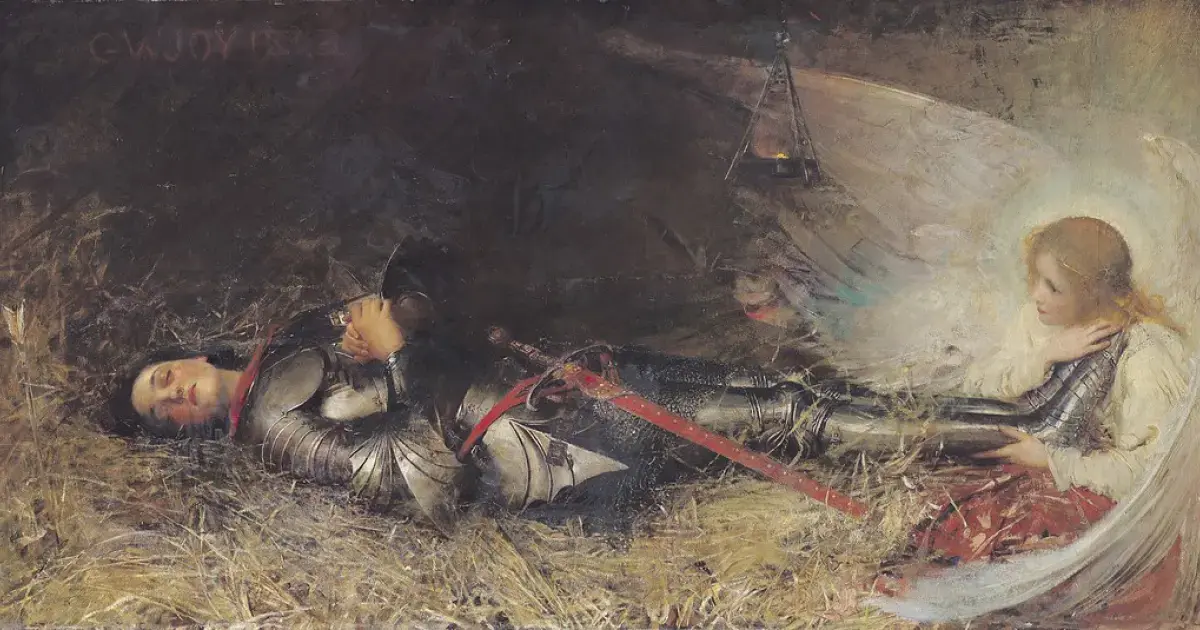
However, the girl did not have time to enjoy her well-deserved noble status. During an attack on the enemy camp on May 23, 1430, Joan was struck from her horse by an arrow and captured by the Burgundians, who sold her to the English for 10,000 crowns. Crowned thanks to Joan of Arc’s victories, Charles VII did not wish to ransom his captive. Joan made several unsuccessful escape attempts on her own, even jumping from a 21-meter tower. Subsequently, the English authorities dealt with their enemy through the Church.
The pro-English Bishop Pierre Cauchon was appointed to oversee the inquisitorial process in Rouen, where Joan was accused of heresy and witchcraft, despite lacking jurisdiction according to church laws. The process was marked by numerous procedural violations. The defendant miraculously managed to navigate the scholastic traps, but the records of the court sessions were altered to her detriment. The aim of accusing Joan of Arc of heresy was to undermine the legitimacy of the French king.
The Death of Joan of Arc
The political trial that ended with her execution by burning at the stake in 1431 was based on unsubstantiated confessions of the defendant as a witch (the court prejudicially regarded the “voices” that guided Joan as a phenomenon of a diabolical nature). To extract the desired confessions, the judge resorted to intimidation and deceit: showing the defendant a prepared pyre for her burning, Joan was offered to sign a document of submission to the Church and renunciation of heresy. However, the agreed text was replaced with another.
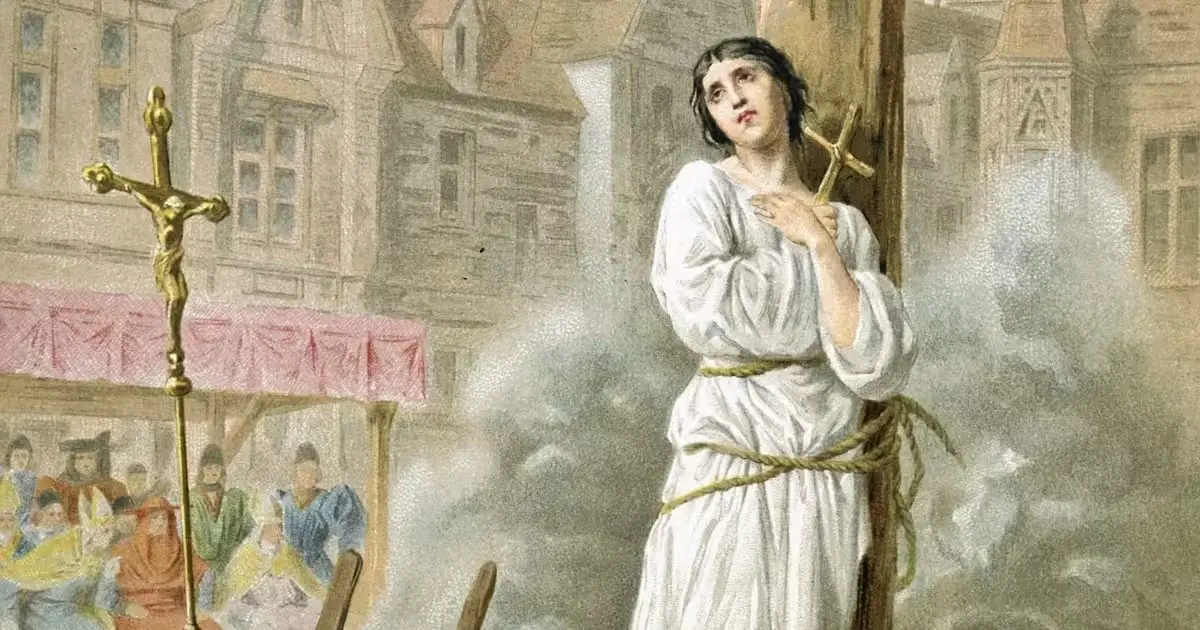
Under the renunciation of all “false judgments” (twelve counts of accusation), Joan signed with a cross, although in letters prepared by the scribe for the truce, she had signed her name as Johanne. Committed to wearing women’s clothing, a few days later, Joan donned men’s clothing again, which was punishable by execution as a repeat heresy. The “apostate” explained this as protection against rape—she did not feel safe in prison or at war.
Historians have not determined from the court materials what exactly led to the fatal decision: perhaps Joan’s dress was stolen or taken away to leave her with no choice. There is also a version that some unwelcome guest—a significant English lord—had made advances toward Joan while she was imprisoned (allegedly, she complained about this during the trial). Yet, her virtue and faith in God remained with Joan until the end, which came on May 30, 1431. When the flames of the pyre in the Old Market Square in Rouen engulfed her body, she cried out, “Jesus!”
Burned alive as a “heretic, apostate, idolater” (such was the inscription on the paper mitre that 19-year-old Joan wore to the pyre), she asked for a cross at the end. Joan of Arc’s death did not help the English recover from the blow she dealt them. Four years later, France and Burgundy reconciled, signing a treaty against England. As it should be, all wars end in peace—even the Hundred Years’ War. The eternal confrontation between the French and the English halted the liberation of Paris, Normandy, and Bordeaux.
After the war, at the request of King Charles VII, a legal rehabilitation process for Joan of Arc was initiated. Her verdict was declared invalid, the accusations were dismissed, and the victim of political retribution was declared a martyr. After Joan of Arc was canonized as a saint, statues of the Maid of Orléans now stand in nearly every Catholic church in France. The official image of the national heroine is that of the appearance for which she was executed: in men’s clothing and with a sword in hand.
Joan of Arc: Interesting Facts
- The name “Joan of Arc” is a later conventional designation, as she did not have this form of name during her lifetime and might not have understood the address. The apostrophe and “d’Arc” appeared much later due to confusion over her father’s origins and the lack of a stable spelling in the 15th century.
- Modern neurologists suggest that Joan of Arc’s “voices” could have been manifestations of idiopathic partial epilepsy with auditory hallucinations, often exacerbated by loud sounds, including bells. Other historians do not rule out the possibility of schizophrenia.
- Contemporaries described Joan as fiery and demanding: she scolded knights for swearing, gambling, and missing mass. She also punished soldiers for looting and sternly reproached commanders for indecisiveness in battles.
- At the beginning of the investigation, the list of charges against Joan consisted of 70 points, including accusations of witchcraft. Over time, most of these were deemed unfounded, and only twelve counts remained in the final version.
- After her execution, several women claimed to be Joan, and even her brothers supported one impostor for profit.
- One of Joan of Arc’s companions was Marshal Gilles de Montmorency-Laval, Baron de Rais—her protector and military commander, an educated aristocrat, alchemist, and owner of a vast library. According to legends, in his castle, he sacrificed between 150 and 800 children to Satan and killed several of his wives who interfered in his affairs. Eventually, the baron was captured, accused of witchcraft, murders, and heresy, and burned at the stake, with his gruesome story inspiring Charles Perrault’s fairy tale “Bluebeard.”