
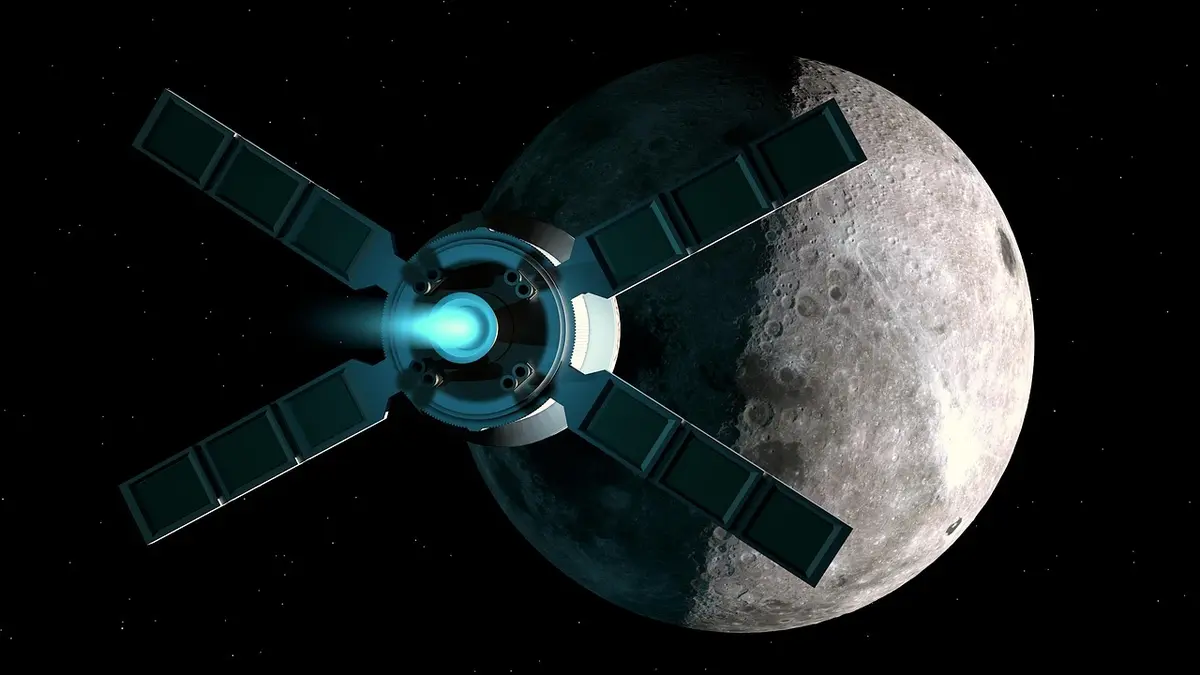
 According to scientists, certain areas of the Moon are destined to become graveyards for spacecraft. These defunct structures are expected to crash far from sites of scientific or historical significance.
In the next two decades, the number of satellites orbiting the Moon is projected to surge. Space agencies and private companies are building lunar bases, attempting to extract valuable minerals, and creating scientific instruments in this barren landscape.
However, when these satellites run out of fuel, operators will have no choice but to drop them onto the Moon’s surface. “These satellites will have to be discarded on the Moon, so it could potentially turn into a junkyard,” says Fiona Thompson, a senior research fellow at Durham University in the UK.
At the same time, researchers are concerned that if numerous defunct satellites crash onto the Moon, it could damage structures, scientific instruments, historical sites (such as the first footprints of astronauts), and pristine areas that are of scientific interest.
Due to the high speed of impacts, collisions with the surface will cause strong vibrations that could disrupt the operation of sensitive instruments that scientists plan to install on the Moon. The scars created by these impacts are expected to stretch for tens of meters and generate huge clouds of abrasive dust that will hinder telescope observations.
“The more lunar satellites there are, the higher the likelihood that some of them may crash into objects of significant scientific or cultural importance. We really need a plan for the future,” noted Professor Ian Crawford from Birkbeck, University of London.
Scientists regularly utilize Earth’s atmosphere to dispose of defunct satellites. Each year, thousands of such satellites burn up upon re-entering the atmosphere. But since the Moon lacks an atmosphere, lunar satellite operators need alternative solutions.
What options are lunar satellite operators considering?
Over the next two decades, more than 400 lunar missions are planned. Lunar satellite operators have three main options. If equipped with a propulsion system and sufficient fuel, a satellite can launch and enter orbit around the Sun. However, this is expensive.
It can also transition to a more distant lunar orbit, but the uneven gravitational field of Earth’s natural satellite complicates this maneuver. Ultimately, a satellite can be crashed into the lunar surface, but this requires very careful planning.
Sarah Boyall, a research fellow at the UK Space Agency, stated that the UN’s Advisory Group on Lunar Activities (ATLAC) and the Inter-Agency Space Debris Coordination Committee (IADC) are currently working on developing advanced methods for disposing of lunar satellites.
Spacecraft graveyards are one of the prioritized disposal options, as reported by The Guardian. “Creating burial zones for spacecraft on the Moon is the most practical solution,” asserts Ben Hooper, senior project manager for Lunar Pathfinder at the satellite manufacturing company SSTL. According to him, these specific areas will be separated from regions designated for future mission participants and scientific research.
The Earth’s natural satellite still holds many mysteries, some of which scientists are beginning to unravel: for instance, we discussed as well as unexpected discoveries by researchers .
Photo: Pixabay.com