
A team of scientists from the University of Science and Technology of Macau (China) says that leakage of oxygen from Earth is likely responsible for transforming iron into hematite (oxidized iron, Fe2O3) at the Moon’s poles. Laboratory modeling showed this is the only explanation for both the large amount of hematite and its uneven distribution on Earth’s natural satellite.
The study also sheds new light on the complex chemical exchange between Earth and the Moon. “We conducted a series of experiments involving oxygen and hydrogen irradiation to simulate processes on the lunar surface. Our experiments demonstrated for the first time both the formation and reduction of hematite minerals,” wrote the team led by planetary scientist Xiandi Zhen.
The Recipe for Hematite Formation
Hematite forms as a result of iron oxidation, a process commonly known as rusting. This mineral is abundant on Earth. Meanwhile, the Moon lacks an atmosphere, possessing only a thin exosphere that does not contain oxygen. Additionally, our planet’s natural satellite is constantly bombarded by a stream of hydrogen from the solar wind. Hydrogen acts as a reducer, donating its electrons to the materials it interacts with. Oxidation happens through the loss of electrons. So even if all the elements needed for oxidation were present on the Moon, the solar wind would undo that oxidation.
One possible explanation for the presence of hematite is linked to Earth. The solar wind influences Earth’s magnetosphere and causes it to stretch away from the Sun. This magnetospheric tail also contains particles that leak from Earth’s atmosphere.
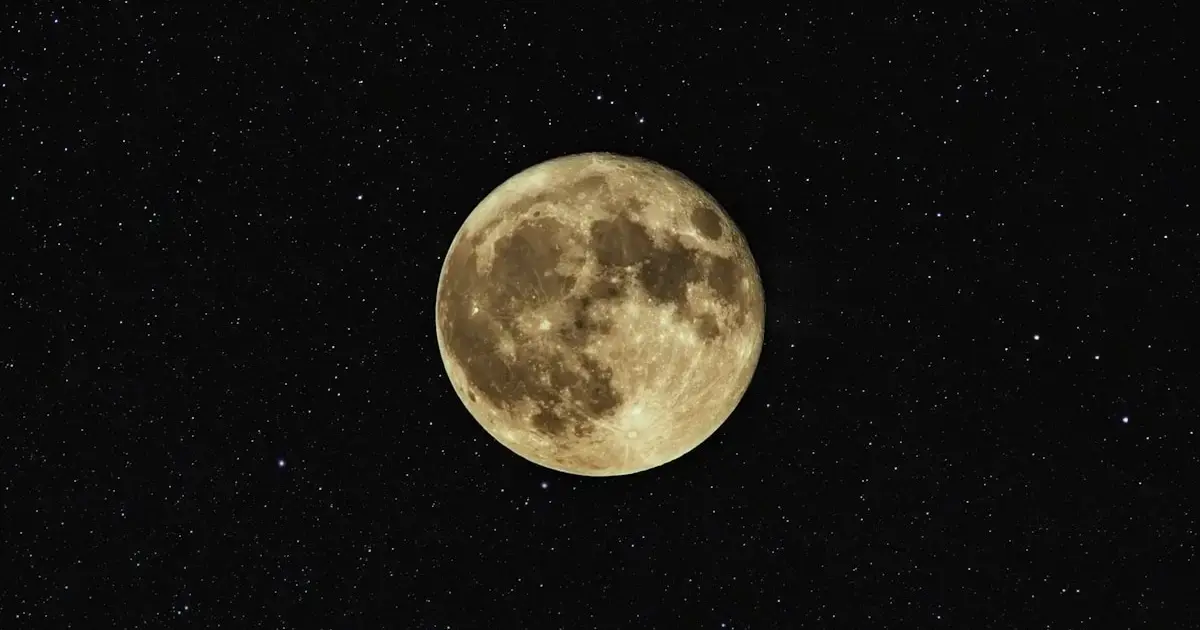
During a full moon, ions of terrestrial oxygen reach the Moon as it passes through the tail of Earth’s magnetosphere. Being in Earth’s shadow means that 99 percent of the solar wind cannot reach the Moon.
This means that the Moon is bombarded by oxygen for about five days each month, while experiencing reduced bombardment by hydrogen. That creates a potential recipe for hematite formation.

Diagram illustrating the configuration of Earth, the Moon, and the Sun that can create hematite.
What Did the Experiment Show?
During the laboratory experiment, researchers directed oxygen ions at iron-rich minerals to simulate the effect of Earth’s wind in the magnetospheric tail. For lunar iron-mineral analogs, the scientists used pyroxene, olivine, ilmenite, troilite, and an iron meteorite. They also ran experiments with magnetite (Fe3O4), confirming that this mineral is an intermediate stage between metallic iron and hematite.
The results showed that oxygen ions can oxidize metallic iron, ilmenite, and troilite. However, the effect was much stronger for metallic iron. At the same time, iron-bearing silicates like pyroxene and olivine did not form hematite at all, showing the selectivity of the process.
“Our experimental results demonstrate that hematite can form on the Moon’s surface under the influence of oxygen ions. Earth’s wind—the primary source of energetic oxygen ions on the Moon—acts as an oxidizer, causing the oxidation of various minerals, such as metallic iron and iron-bearing oxides and sulfides, prevalent in the lunar regolith,” the researchers wrote in their report.
They say that while these iron-bearing minerals occur as microparticles or small crystals in the lunar regolith, they can undergo direct oxidation under the influence of Earth’s wind.
The solar wind cannot reverse the rusting of lunar iron caused by the periodic influx of terrestrial oxygen. That also helps explain why hematite is concentrated near the lunar poles: Earth’s magnetospheric tail directs oxygen ions toward high latitudes while deflecting many hydrogen ions.
The study was published in the journal Geophysical Research Letters.
Photo: Unsplash