
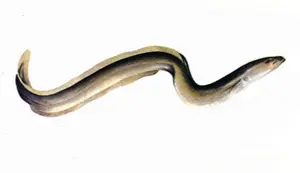
Few fish are as fascinating as the eel. It spends about twenty years in rivers that flow into the Baltic Sea and in lakes connected to those rivers. It lives there but does not reproduce. Then, at a certain point, an invisible force—some call it a calling—beckons the eel to embark on a long journey. It travels through the Kattegat and Skagerrak straits, across the North Sea and out into the distant Atlantic, to a sea without shores known as the Sargasso Sea. Here the eel spawns and then meets its end.
The hatchlings that emerge from the eggs will spend three years making their way back to the Baltic, to the very rivers and lakes where their parents once lived. And after two decades, the cycle will begin anew…
How do eel larvae find their way back? People say they follow instinct. But that doesn’t explain much. Otters also eat berries instinctively to compensate for a lack of hydrochloric acid. But they eat berries, not bits of lime like chickens do, because chickens need lime for their eggshells.
So what drives the eel? Scientists believe that at different stages of their lives, eels exhibit either an excess or a deficiency of salts in their blood. This prompts them to move, seeking the environments that their bodies require at various points in their development.
