
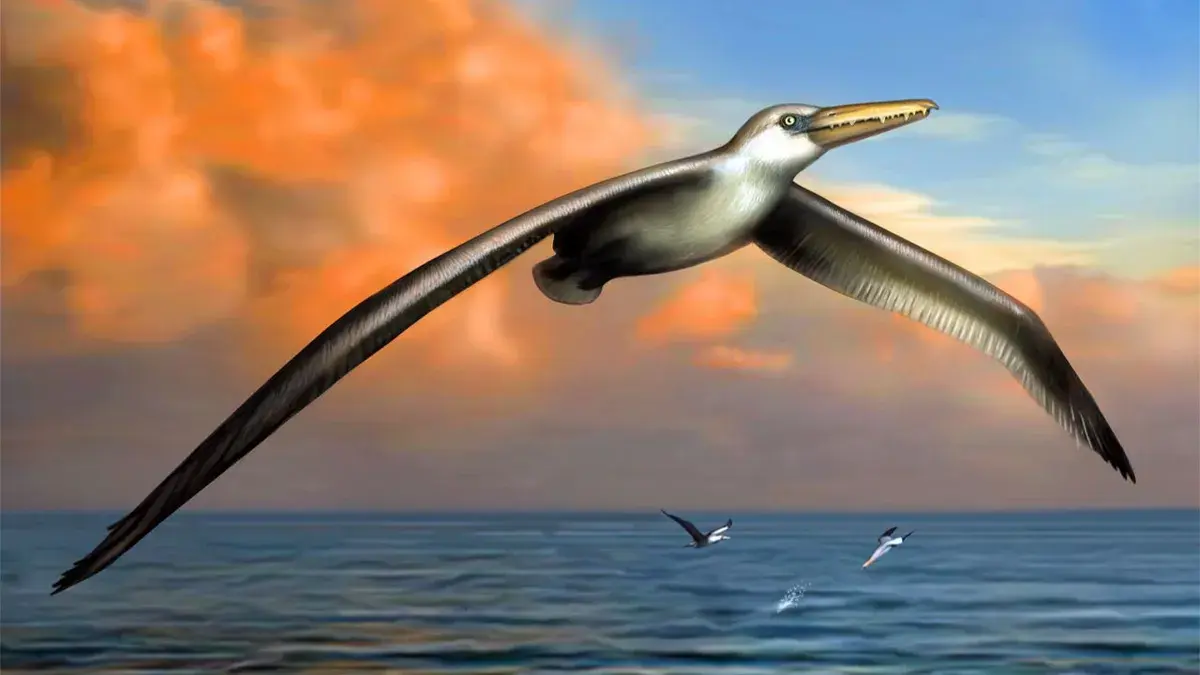
 The bird species Pelagornis sandersi is one of the largest known flying birds in history. It also boasts the largest wingspan ever recorded, measuring between 21 and 24 feet. This magnificent creature roamed our planet between 33.9 and 23 million years ago.
The fossil of this giant bird, which first introduced the world to Pelagornis sandersi, was discovered in the early 1980s beneath the international airport in Charleston, South Carolina.
Pelagornis sandersi was so massive that researchers initially debated whether it could even fly at all. Ultimately, they concluded that it likely glided low over the water’s surface, utilizing a phenomenon known as the “wing-in-ground effect” to gain additional lift.
An Unsolved Mystery
However, researchers have been unable to definitively answer how this creature fed itself. Some previously speculated that during hunting, the toothy giant would dip its beak to the ocean floor, similar to the modern skimmer bird (Rynchops). This bird flies low over the water, occasionally submerging 19 percent of its beak to catch unsuspecting marine life.
The bizarre pseudoteeth of Pelagornis—spike-like projections on the upper and lower parts of its beak—seemed to support this theory. Researchers suggested that these features helped the bird catch prey as it glided over the water’s surface. The arrangement of bones in its jaw and the anatomy of its vertebrae also pointed to this possibility. However, new research has significantly challenged this idea.
What Did Scientists Discover?
A team of researchers from PSL University in Paris (France), Lincoln University, and the University of Reading (UK) believes that Pelagornis sandersi would have struggled with the energy costs associated with gliding close to the water’s surface.
The scientists posited that Pelagornis would experience tremendous hydrodynamic drag if it attempted to dip its beak into the water like skimmers do. They calculated that in such a scenario, air resistance would increase ninefold, making the maneuver too energy-intensive for the bird to sustain.
This was confirmed by modeling the immersion of even small portions of Pelagornis sandersi’s beak, such as five percent of it.
“Our research shows that despite Pelagornis being one of the largest flying birds in history, it could not have covered the enormous energy costs required for catching prey by gliding over the water’s surface,” said co-authors Olivia Hellier-Price, Chris Venditti, and Stuart Humphries in an interview with IFLScience.
However, they did not completely rule out any form of behavior involving dipping its beak into the water, as birds can generate more than their maximum metabolism for short periods during various maneuvers. Based solely on fossil data, it is challenging for scientists to determine whether this was feasible for Pelagornis.
So how did this prehistoric bird catch its prey? It’s possible that it stole food from other birds (a phenomenon known as kleptoparasitism) or raided their nests. Alternatively, Pelagornis may have acted as a fierce predator, snatching small birds in mid-air and devouring them. As of now, there is no definitive answer.
The findings of this research were published in the journal Royal Society Open Science.
