
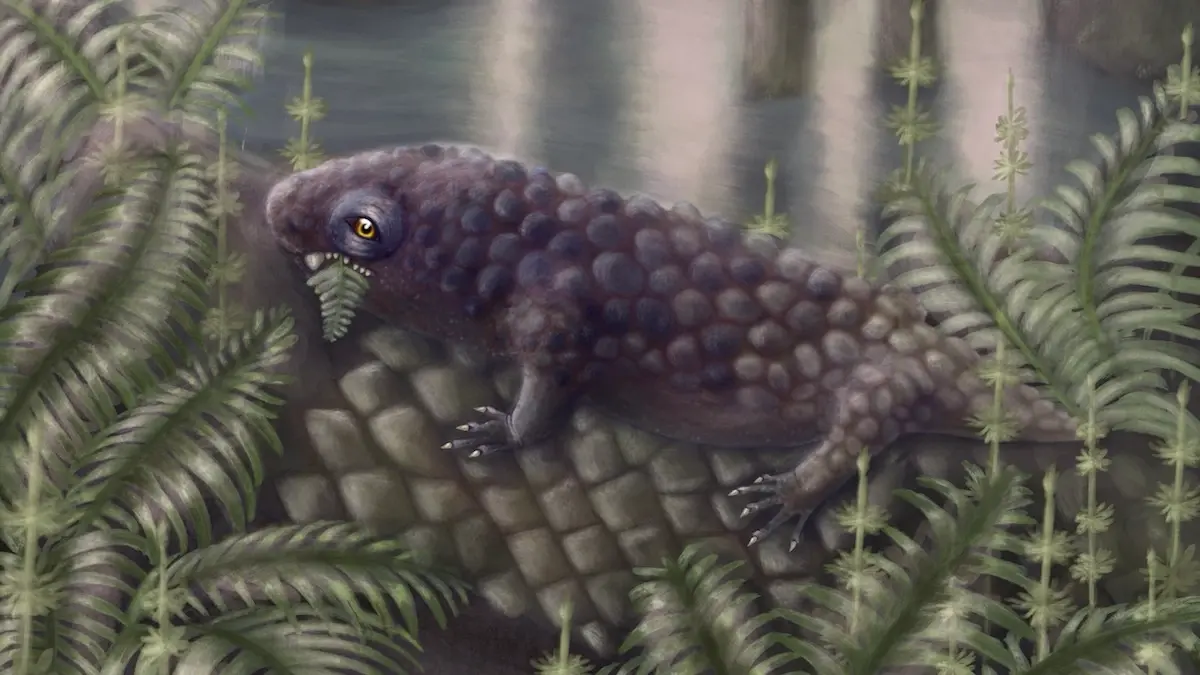
 A recent archaeological discovery shows that experiments with plant-based diets began long before the first humans appeared. Scientists have identified one of the earliest land creatures that shifted from meat to ferns.
When the first vertebrates began to emerge from the water onto land about 370 million years ago, they primarily fed on each other for millions of years. Meanwhile, plants thrived without many natural predators. But evolution quickly found a way to tap into that energy source.
According to a study reported by ScienceAlert, scientists have discovered a new species – Tyrannoroter heberti. This creature, which lived 307 million years ago, was one of the first animals to incorporate plants into its daily diet. Over different eras, nature produced remarkable adaptations and defenses, from tiny herbivores to giants we’ve covered previously.
Ancient Dentistry
Despite its fearsome name, Tyrannoroter was quite small – about 25 centimeters long. The real sensation was hidden inside its skull, which was found in a fossilized tree stump in Nova Scotia, Canada.
Using high-resolution micro-CT scanning, paleontologists discovered a unique feature: in addition to the regular teeth along its jaws, the animal had specialized “dental batteries” on its palate.
These bony plates functioned like millstones, grinding tough leaves and stems of ancient plants.
“This is one of the oldest known four-legged animals that began eating its ‘vegetables,'” says Aryan Mann, an evolutionary biologist at the Field Museum in Chicago. Such discoveries help scientists reconstruct past ecosystems, like recently found remains in Peru, shedding light on life in ancient oceans.
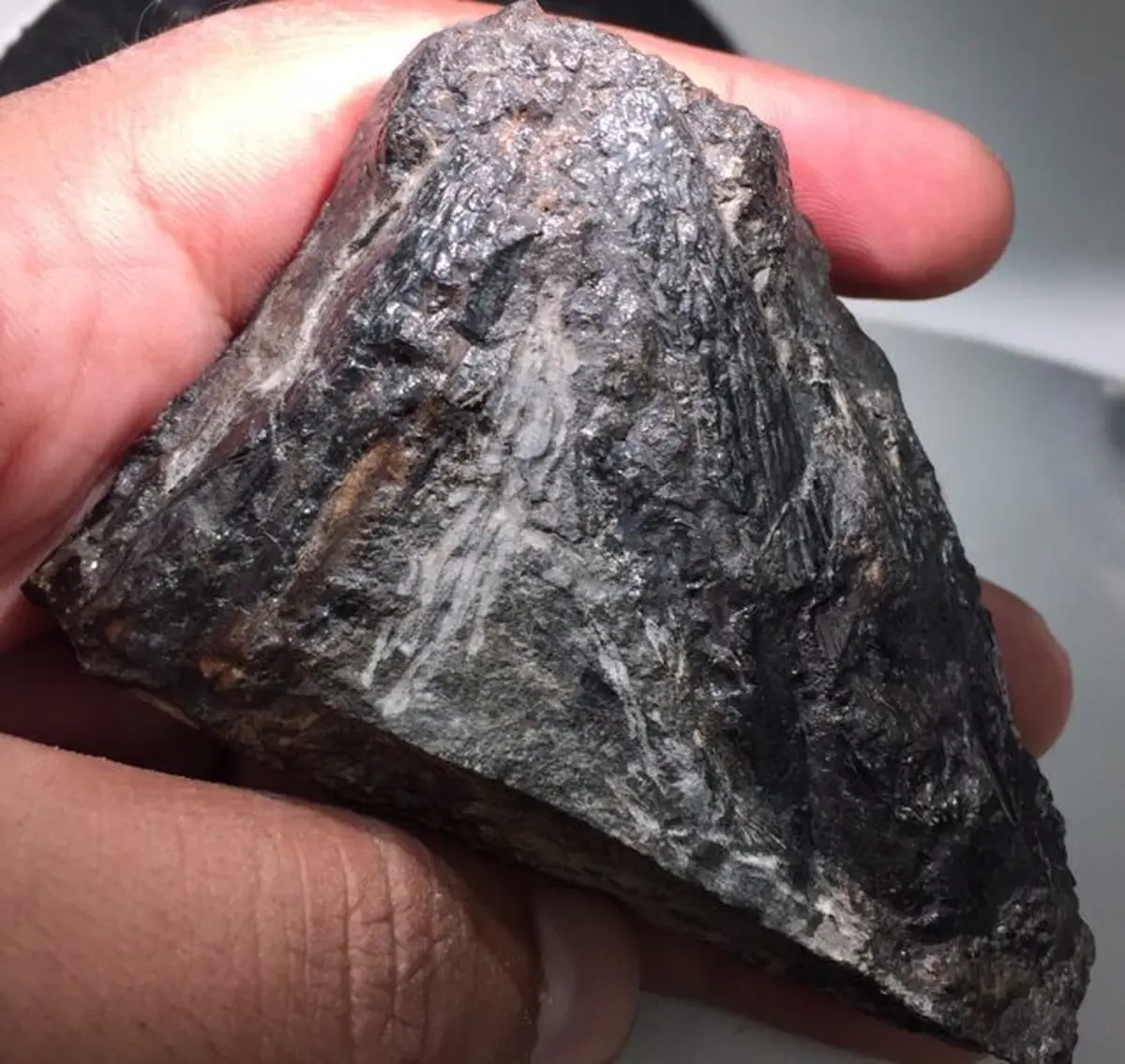
Fossilized skull of Tyrannoroter
From Insects to Greens: The Evolution of Diet
Scientists suggest that the shift to vegetarianism was gradual. Initially, the ancestors of Tyrannoroter used their strong teeth to crush the hard shells of insects. Over time, they “realized” that the same mechanism was perfect for shredding ferns. This discovery shows that our taste for plant-based food has roots stretching back 300 million years – from the first herbivores to modern plant-based dishes.
Why Does This Matter to Us?
This discovery rewrites the timeline of herbivory. It shows that as soon as animals established themselves on land, they quickly began to use plant resources. That shift laid the foundation for the later evolution of terrestrial ecosystems, including the one we live in.